This is the sixth part in a series of blog posts I’ve been doing about prophecies in the Bible (part 1 is here). The one I’d like to talk about today was one of the first ones that really hit me like a hammer when I first started examining the Bible’s claims critically. In my opinion, it’s extremely strong evidence that the Bible was not really inspired by God.
Ezekiel’s prophecy of Tyre is very interesting to look at. In fact, it’s one that is often used as evidence by both sides of the inerrancy debate. Ezekiel 26-28 details a prophecy against the island city of Tyre. It was a great trade center and features fairly prominently throughout the Bible.
Once Judah was led into captivity by Nebuchadnezzar of Babylon, Ezekiel prophesied destruction for Tyre, since they were glad at the destruction that had been wrought on Jerusalem. And the benefit of this prophecy is that it is very specific. Chapter 26 says that many nations would come against Tyre, and in verse 4, Ezekiel says that their walls and towers would be torn down, and it would be made a bare rock.
Then, in verses 7-14, Ezekiel is even more specific by saying that Nebuchadnezzar would come against the city. He will kill Tyre’s “daughters on the mainland” (vs 8 ) and direct a siege wall against them to destroy their walls. He would enter the city with his army and kill, plunder, and cast the debris into the sea. They would be a bare rock and never be rebuilt.
In fact, Nebuchadnezzar did bring his army against Tyre. And he did destroy the mainland suburbs of Tyre, just as was predicted in verse 8. He also besieged the city, as was predicted. But the similarities end there. He besieged Tyre for 13 years without success. Tyre finally signed a treaty with Nebuchadnezzar, but their city remained unharmed. Ezekiel even admits as much in 29:17-18 when he says that Nebuchadnezzar got nothing in his efforts against Tyre.
About 250 years later, Tyre did finally fall to Alexander the Great. And many Christians view this as the fulfillment of Ezekiel’s prophecy. But then why didn’t Ezekiel prophesy that Alexander would do it? God could have easily revealed that to him. Also, verses 7-14 show no apparent break in speaking about Nebuchadnezzar’s attack. Where is the indication that the actual destruction wouldn’t come for another 250 years?
And furthermore, Tyre was rebuilt shortly after Alexander defeated it. It was still a prominent trade center during the times of Jesus and Paul. In fact, Tyre is the 4th largest city in Lebanon today. That is a problem since Ezekiel says it would be utterly destroyed (26:14) to the point that no one would be able to find it again (26:21), and it would be “no more forever” (27:36).
Prophesying that Tyre would be gone forever is an immensely bold claim, and it’s also extremely important. It is one of the few biblical prophecies that we would actually be able to verify today, if it were true. So how do people answer it?
Taking the prophecy at face value isn’t going to work. That’s a shame, because if Tyre was still a “bare rock” as Ezekiel says, then it would be great proof of prophecy fulfillment. So instead, we have to think of other ways to explain it. One is to say that Ezekiel was only talking about the mainland portion of Tyre. This one is used quite often – some apologists even claim that Tyre was only on the mainland at this time and moved out to the island once Nebuchadnezzar besieged them. But this seems unlikely because Ezekiel often refers to Tyre as being “in the midst of the sea,” or “on the sea,” or “borders are in the heart of the seas,” etc (26:5, 17, 18; 27:4, 25, 26, 32; 28:2, 8). In fact, chapter 27 compares Tyre to a ship that will sink because of the destruction that God is bringing upon it. So trying to say this is the mainland is somewhat ridiculous. It also goes against the historical and archaeological evidence [src].
Sometimes, people try to explain the prophecy by noting that the city that exists today in that spot is actually called Sur. Therefore, it’s not the same city, and Ezekiel was right. However, “Sur” is the way Tyre is spelled in Arabic, and in Hebrew it’s “Tzur.” In fact, the Old Testament essentially spells it as “Tzur” – just check an interlinear Bible for the Hebrew translation of this passage. So the city still has the same name that it had back then.
Another explanation is that this is a prophecy against the people of the city, so when it says Tyre would never be rebuilt it’s just saying that it will never be those same people. But when you really start to think about it, this is also silly. Ezekiel himself says that Nebuchadnezzar was unable to take the city (Ezek 29:18-20), so God would give him Egypt instead (this is also something that doesn’t appear to have happened, by the way). But anyway, Nebuchadnezzar was unable to take Tyre. So those inhabitants were not defeated, and we have to wait for Alexander the Great to take the city. But this happened two or three hundred years later. So how could Ezekiel have been talking about the people of the city in his prophecy? All those people were dead and gone by the time the city fell to Alexander. Besides that, why bother even making the prophecy that the city would never be rebuilt if you’re only talking about the inhabitants? Who would possibly think those people would re-inhabit a city once they were dead?
Instead, about the only possibility we’re left with is that Ezekiel was merely being figurative. He didn’t really mean that the city would never be rebuilt. He simply meant that they would be punished in some way (this is where Alexander the Great fits in) and never come back to their former glory. I guess we can see why Ezekiel didn’t phrase it this way because it does seem to lose some of its grandeur. Of course, even then it’s hard to put your finger on exactly when this was fulfilled, because Tyre still enjoyed some prominence for a long time after Alexander took it.
But the benefit of saying that the prophecy is just figurative is that you can’t disprove it. Ezekiel could have said almost anything and it wouldn’t matter – whatever reality actually occurred would be the prophecy fulfillment. Everything is vague and non-specific so that we have no problem reading the fulfillment into whatever happens. It’s much like the fortune from a fortune cookie. They give a vague pronouncement that’s supposed to happen over an unspecified time so that if you really try, you can find the fulfillment to your fortune. The problem with this view is that there was no point in Ezekiel’s prophecy at all. The specific things he mentioned don’t really happen in the way he described. And even though he seems emphatic in at least 3 different places that Tyre would never be rebuilt, people just say that he didn’t mean that. What else could he have said if his true intention was that the city would never be rebuilt in any fashion at all? People who use this excuse in order to maintain the inerrancy of the Bible aren’t viewing this prophecy as any kind of proof (which is at least part of the reason it would have been given). Instead, they’ve made up their mind that it must be true, regardless of the facts. So there was really no point in even recording it.
This is one of the most blatant and obvious examples of a failed prophecy in the Bible. It is clear and specific, yet it did not come to pass. The conclusion is obvious: at the very least, Ezekiel was not a true prophet. At most, the entire Bible is uninspired. If you’re a firm Bible-believer (as I was), are you honest and brave enough to accept it for what it is? I hope you’ll think about it.
We’ll continue our study of Bible prophecies in the next post.

 Finding Truth
A real prophecy would be unambiguous— i.e, provide precise dates, times, places and events that could not be influenced by man.
Examples:
A magnitude 9.0 (Mw) undersea earthquake off the coast of Japan will occur at 14:46 JST (05:46 UTC) on Friday 11 March 2011, with the epicentre approximately 70 kilometres (43 mi) east of the Oshika Peninsula of Tōhoku and the hypocenter at an underwater depth of approximately 30 km (19 mi).
An asteroid will enter Earth’s atmosphere over Russia on 15 February 2013 at about 09:20 YEKT (03:20 UTC), with a speed of 19.16 +/- 0.15 km/s (60,000 – 69,000 km/h or 40,000 – 42,900 mph) and explod in an air burst over Chelyabinsk Oblast, at a height of around 29.7 km (18.4 miles, 97,400 feet). The explosion will generate a bright flash, producing a hot cloud of dust and gas that penetrates to 26.2 km, and many surviving small fragmentary meteorites, as well as a powerful shock wave equivalent to approximately 500 kilotons of TNT (about 1.8 PJ)
The biblical prophecies are so vague and open to interpretation they’re useless.
LikeLike
Well, it doesn’t appear that the Bible ever refers to Ushu at all, and I don’t see why it would need to. It wasn’t nearly as significant as the island city of Tyre.
So do you think destroying the suburbs of a kingdom is fitting as a fulfillment of the following prophecy from Ezekiel 28?
Mike said:
Did the mainland suburbs not share the wealth with their seat of government? I’d be shocked if that were the case. Tyre was centered on the island. That’s where its government was headquartered — any wealth that came through trade, whether land or sea, found its way to the heart of the city. Every city operates that way.
I have a feeling that if the island of Tyre had been obliterated by either Nebuchadnezzar or Alexander, and it was still a bare rock (or even just ruins) today, you would find no reason in the text to make you insist that the mainland was the real focus of the prophecy.
LikeLike
Thanks for the kind reply, Kathy.
I understand why you see it this way. You have many reasons for believing in the Christian God — this is actually how I used to view the different gospel accounts of the resurrection. In fact, I was teaching a high-school-age class on the subject once, and I told them that I didn’t know exactly how or in what order all the events of the resurrection worked out, but they obviously did somehow, since the Bible is inspired. That made sense to me. So I think I understand why you feel the way you do about this. We’re just coming from two completely different directions, because I no longer believe in a god. So yes, when I see some of the issues in these prophecies, I don’t view it as God working mysteriously, but as evidence that the writers weren’t really inspired.
But I don’t want to get too far off subject — just wanted to say that I see where you’re coming from.
If you’d like to read more about Alexander’s siege, there’s a good article here:
http://www.ancient.eu.com/article/107/
He did eventually bring in a fleet, and that was one of the main things (his causeway being the other) that finally spelled defeat for Tyre. Prior to his fleet, which the Tyrians didn’t know he had, they were holding their own pretty well. And this strategy had always worked for them in the past. Their defenses were rather good on the island. They had high walls that went right to the sea, which is what made them so difficult to attack. That’s why Nebuchadnezzar (it was his attack that lasted 13 years, btw) was not successful. He finally signed a treaty with Tyre — they paid homage to him, but he never was able to take the island.
Again, I’m not trying to suggest that this prolonged siege was just a walk in the park for Tyre, but their trade with other ports allowed them to stave him off rather comfortably for the duration.
Personally, I don’t read Ezekiel’s prophecy as just promising punishment for Tyre — it’s promising destruction. Destruction to a point that the city would never be rebuilt. That’s why this one seems so significant to me, because that simply didn’t happen.
Think of it like this for a moment. In the Old Testament, when God promised to do something, he usually went all out. Take Sodom and Gomorrah, for instance. In Genesis 18, God talks to Abraham about his decision to destroy Sodom and Gomorrah. Abraham pleads with him several times to not destroy the entire city if some righteous can be found within. God finally settles on sparing the cities in their entirety if there are only 10 righteous people found within them. Of course, he can’t find 10. When he destroys the cities, it’s with fire from heaven:
When he destroyed those cities, he destroyed them, down to plants that grew there. They were gone. The end.
The OT is filled with examples like that: the 10 plagues, the walls of Jericho, Elijah and the 450 prophets of Baal, etc. That’s why it’s so hard for me to see the current reality of Tyre as a fulfillment of Ezekiel’s prophecy.
This is an epic prophecy. It’s specific, and it’s terrifying. The surrounding nations will tremble and wail about the destruction wrought upon Tyre. It would be laid waste, uninhabited, never found again… Just as God destroyed even the plants that grew in Sodom and Gomorrah, Tyre would be completely bare — just a rock.
From the way God is presented in the OT, it’s easy to imagine what one would have expected to happen to Tyre had they lived in Ezekiel’s time. Images of Sodom and Gomorrah would have readily come to mind.
But it’s nothing like what really happened.
That’s how I see it. Even if you disagree, do you see why I might expect that kind of fulfillment, considering the god we’re talking about? Considering his past accomplishments?
[Sorry for the long reply…]
LikeLike
My dear, you really need to study the history of your religion a lot more before you make such absurd pronouncements.
It is such levels of ignorance that have ensured generations of children have spent their entire childhood living in fear of utter disgusting dogmas such as Hell.
God belief and specifically belief in the Abrahamic god, Yahweh has seen the development of three specific religions with three unique doctrines, each one despising the other to the point they have gone to war against each other and even fought internecine wars over utterly ridiculous points of doctrine.
Within your own religion, Christianity, you have such idiotic extremes of belief that claim the world is no more than 10,000 years old, that the bible must be considered literal, that dinosaurs existed with humankind.
Islam teaches its own set of preposterous lies and is prepared to annihilate children in the cause of Islam.
It is a fact that the majority of those who consider themselves religious are largely ignorant of what it is they claim they believe.
Sadly, your comment reflects this ignorance and sadder still you likely pass on this ignorance to children in one form or another.
Go and read your bible with an open honest and above all critical mind.
It may be the most important decision you ever make.
LikeLike
Tyre today, just for comparison (from Google Maps):
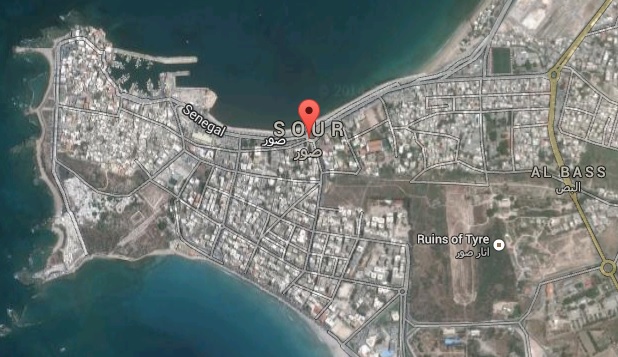
When Alexander attacked, there were 40,000 people in Tyre, because most of the women and children had fled to Carthage. So before their flight, that would have given the city about 120,000 – 150,000, maybe? I don’t know if that number only comes from the island itself, or also includes the suburbs. Today’s population numbers are hard to come by, but according to Wikipedia, they seem to range between 60,000 (if you’re only counting the city) to about 175,000 if you include the metro area.
While ruins are certainly visible in this picture (which doesn’t cover everything), it’s also clear that there are people living and working on the area that used to be the island, on the mainland, and on the isthmus that’s built up around Alexander’s causeway. This is why a number of people view this as a failed prophecy.
LikeLike
“Well, it doesn’t appear that the Bible ever refers to Ushu at all”
Oh it appears from all the verses I gave to you it refers to Tyre on the mainland but you do a mean impression of an ostrich when I show them to you. Last one that shows that people came to tyre on the mainland as they travelled down the coast your impression of an ostric was to say something to the effect “well they could see if half mile off the coast is what it meant.”
Like I say you can fudge with the best of those you claim fudge (of course actually better)
“So do you think destroying the suburbs of a kingdom is fitting as a fulfillment of the following prophecy from Ezekiel 28?”
I didn’t make a point about a suburb being destroyed – don’t try and fudge that too. I made a point about where the king living making no material difference to him being addressed as the ruler of a mainland tyre regardless of where he lived suburbs, island or Kansas city. He could live anywhere if his rule was over mainland tyre he would be addressed – the end
“Did the mainland suburbs not share the wealth with their seat of government? I’d be shocked if that were the case.”
I’d be shocked if you finally admitted the obvious that traders on the mainland would benefit the most from mainland trade and so they would be the ones most likely rejoicig that LAND trade would be turned their way. After all theres nothing in the text that says he rejoiced over taxes collected from trade but the trade itself so thats just another fudge
“I have a feeling that if the island of Tyre had been obliterated by either Nebuchadnezzar or Alexander, and it was still a bare rock (or even just ruins) today, you would find no reason in the text to make you insist that the mainland was the real focus of the prophecy.’
Your “Feelings” makes no point. I have a feeling that if the Bible said Tyre bordered Sidon you would try to claim the island at sea shared a border with the city on land that was not even across from it or if people traveling down the coast in the Bible said they actually came to the city as they travelled down the the coast you’d claim it meant “we saw it out at sea”.
But then thats not a feeling is it?
At this point I suspect even you realize how much you are fudging those texts to get your failed failed prophecy to stick
It just aint working is all
LikeLike
I don’t agree with your view of those verses, just as you don’t agree with my points about all the verses that show the prophecy’s focus on the island. Other readers of this thread can simply make up their own minds.
LikeLike
Oh, and about the king of Tyre: he wasn’t killed. We know that from history. He lived on the island, which Nebuchadnezzar never touched. That’s why I view the prophecy against him as another strong indication that the focus of Ezekiel’s prophecy was the island.
LikeLike
@Ron.. that’s A way to give a prophecy.. it’s not the only way. It’s about the odds.. however the prophecy is styled. The odds of Tyre being scraped clean with it’s contents thrown into the sea.. is an improbable prediction.. no times or dates were necessary.. the odds were STILL improbable. There is no “codebook” for prophecy writing.
LikeLike
@Arkenaten I’ve read the Bible and I know what Christianity is about. And just by reading your short comment I already know you have no idea what the Bible is about. You’ve covered a good portion of the false beliefs non believers have about Christians. The biggest one being that the actions of Christians somehow defines Christianity.. they doesn’t. The Bible does. Christians fighting over disagreements in doctrine is precisely what Jesus warned us NOT to do. And not all Christians take Genesis literally or believe that dinosaurs and humans lived at the same time.
And I have no idea why you are telling me about Islam.. that’s a false religion.. it has nothing to do with Christianity. Yes, I know they claim to worship the same god but in reality they don’t.
You’ve proven me right by your comment which contains many of the common lies that atheists spread.. thanks 🙂
LikeLike
Nate.. I just read your latest response but wanted to finish responding to the other one first..
I said:
“Well, the mainland is apparently rock also.”
You: “Could you provide your evidence for this, please? Even if the name of the town could refer to either source, this does not by default mean that Ezekiel was talking about the mainland.”
I don’t have a source yet other than the Tyre link which states: “The name means ‘rock’ and the city consisted of two parts, the main trade centre on an island, and ‘old Tyre’, about a half mile opposite on the mainland. The old city, known as Ushu, was founded c. 2750 BCE and the trade centre grew up shortly after. In time, the island complex became more prosperous and populated than Ushu and was heavily fortified.”
http://www.ancient.eu.com/Tyre/
This states that “Old Tyre” came about first.. so, since it was named “Tyre”.. it’s reasonable to believe that it was rock also. Why would they name a city “rock” after a neighboring island of rock?
You: “And why would their trade have dropped to almost nothing? Their harbors were on the island — Nebuchadnezzar couldn’t block them. ”
Why wouldn’t Neb send ships to surround the island? I agree that they were able to survive fairly well.. but I still don’t see anything that indicates that it was easy.. that they didn’t suffer. Again, they couldn’t rely on the mainland anymore, surely they did to some extent??
You: ” This leads me to your point about the walls and towers. I don’t know if the mainland portion was fortified or not — either way, it certainly wasn’t as fortified as the island portion. So no, I don’t believe that Nebuchadnezzar destroyed the walls and pulled down its towers. I believe that part of the prophecy was definitely pointing to the island.
I do believe that when Neb took the mainland, walls and towers did come down just as the prophecy says “he” takes them down.
Reading the prophecy again.. I found something interesting.. in vs 7-11 it is all “he will”..
read each of these and see if any of it COULDN’T have happened on the mainland.. do we have any historical records that indicate that the mainland didn’t have these features? I dont’ know of anything.. there’s no reason to believe the mainland wasn’t a large built up city with walls and pillars etc.
7 “For thus says the Lord God: Behold, I will bring against Tyre from the north Nebuchadnezzar[a] king of Babylon, king of kings, with horses and chariots, and with horsemen and a host of many soldiers. 8 He will kill with the sword your daughters on the mainland. He will set up a siege wall against you and throw up a mound against you, and raise a roof of shields against you. 9 He will direct the shock of his battering rams against your walls, and with his axes he will break down your towers. 10 His horses will be so many that their dust will cover you. Your walls will shake at the noise of the horsemen and wagons and chariots, when he enters your gates as men enter a city that has been breached. 11 With the hoofs of his horses he will trample all your streets. He will kill your people with the sword, and your mighty pillars will fall to the ground.
Now notice vs 12..
“12 They will plunder your riches and loot your merchandise. They will break down your walls and destroy your pleasant houses. Your stones and timber and soil they will cast into the midst of the waters.
It switches to “they” when it talks about plundering riches and merchandise.. which, would be on the island.. along with the pleasant houses I would imagine. And it says “Your stones and timber and soil “THEY” will cast into the … waters.”
Again, which we know Alexander did this.. along with looting the “merchandise” of the Island.. that we know from Ez 29 that Neb didn’t get any rewards for his siege.. yes, he took the mainland but they spent the next 13 years using up the rewards of that.. ultimately ending up with nothing but “bare heads and raw shoulders”. And this doesn’t conflict with the prophecy btw.
phew.. ok, I’ll respond to the other points tomorrow.. 🙂
LikeLike
No dear, I haven't. But you have aptly demonstrated what indoctrination does to people by your comment.
Especially that you didn't read it correctly and then said that Islam is a 'false religion'. This is laughable.
Your knowledge and understanding of your religion has likely been gleaned via the pulpit, parental indoctrination and selective readings/interpretation.
If you cared enough to study the history of the Old Testament as it relates to the New, you would soon discover that every prophecy is nothing but a fallacy.
That the Pentateuch; its leading characters and the events it describes is fiction.
You ire is no different than anyone inculcated with religious nonsense. For heaven’s sake, you are commenting on a blog post where the majority of visitors are deconvertees, who have been exactly where you are now, who have read and studied the bible inside out and backwards, were taught apologetics and how to deal with skeptics yet you carry on as if you are addressing a bunch of Sunday School kids!
Furthermore, you have yet to list a single ‘lie’ that non believers spread.
I will offer you a challenge.
List ten of theses ‘lies’ you claim atheists spread and I guarantee that each and every one will be positively refuted by someone on this forum.
LikeLike
“Why wouldn’t Neb send ships to surround the island? I agree that they were able to survive fairly well.. but I still don’t see anything that indicates that it was easy.. that they didn’t suffer. Again, they couldn’t rely on the mainland anymore, surely they did to some extent??” – Kathy
that’s a good question, but he didnt is all i know to say. maybe since Neb was coming from the middle east he didnt have the ability to send ships to the Mediterranean. maybe he just didnt have the resources, the skill or the imagination to build a navy. maybe he couldnt buod ships because Tyre’s navy was so strong, that they were able to prevent any ship from being launched. i just dont know. Neb laid siege to tyre for many years, and couldnt take it, although he had the mainland.
This is important, because it demonstrates that tyre still existed, and still remained unconquered even when the mainland had been taken. it shows that the everyone understood that the island stronghold was the key to tyre.
I”t switches to “they” when it talks about plundering riches and merchandise.. which, would be on the island.. along with the pleasant houses I would imagine. And it says “Your stones and timber and soil “THEY” will cast into the … waters.” – Kathy
it does switch to “they.” It could be in reference to Neb’s men who are supposed to storm the place, or it could reference other nations. Ezekiel doesnt make this perfectly clear.
If we’re starting from the premise that the bible is perfect and is god’s, then we’d take the end result and see if it could fit, in any way, to what was said. We’d see that Neb didnt sack tyre, but Alexander did hundreds of years later, we’d certainly say that this was the fulfillment.
Except that nothing was perfectly fulfilled. Predicting that the babylonians would attack a place and destroy it and loot it, during the time when they were conquering many places, seems like a safe prediction to make.
So ezekiel predicted that a warring, growing and empirical nation was going to attack and loot a place that was renown for trade and influence? This prediction being made and fulfilled isnt impressive, it’s what military analysts do on the national news all the time.
Granted, even though ezekiel doesnt specifically state that it was only the mainland that would be scraped bare, it is either a coincidence or miraculous that alexander took the building materials of the mainland to construct his causeway. But i dont think anything indicates the mainland was scraped down to bare rock. They had planted fields and mike says that the mainland is where they got all of their trees – was all of the topsoil scraped away too? I havent found any indication that the mainland was ever down to bare rock or ever the place where fishermen spread their nets – the net spreading was on parts of the island, from what i understand.
But let’s say that the “bare rock” was just figurative language being used and that alexander fulfilled this part of the prophecy.
1) is it really your position that the Ezekiel wasnt talking about a complete and a permanent destruction?
2) Do you really think that when ezekiel was saying so much about punishing their king, that he really didnt mean that he’d punish the king beyond taking the suburbs of the mainland?
Remember, this king was ling dead before alexander took the island,and even then, alexander didnt execute everyone from tyre.
When i was a christian, I thought if god said something, that he meant it. So with all that god supposedly directed ezekiel to say in regard to tyre, i certainly would have expected much more than what happened.
It would be like having the story of jericho, but fining out that only a portion of the north wall fell down – after it was breached with battering rams. And it that story, it said whoever would rebuild jericho, would (I’m paraphrasing) would do so at the expense of their children – something like the foundation would be laid on their firstborn and something else on another (too lazy to look it up, but will if you dont remember this story). Then lo and behold, that happened exactly. Exact prophecies, being fulfilled exactly
– we just dont have that with Tyre.
and please dont say that I’m just a biased atheist. I’m not exactly an atheist, but i used to be a fervent believer. I know that journey I went through – where I cam from and where I ended up – you do not. Also, christians have biases too. I suspect that you have always been a christian – and that doenst mean you’re wrong, but i have changed from strong position to another – and Didnt do so lightly.
If I really didnt believe what i do now, i wouldnt be wasting my time with this blog or with response to others. so please, no motives or insults. the facts are what they are. ezekiel said what he said. the pic that nate posted speaks volumes.
either ezekiel didnt really mean everything he said, or he was wrong.
LikeLike
This is a good point. I think it would depend on why “old Tyre” was ever called that. It’s also called “Ushu” in ancient sources, so it makes me wonder if it’s called “old Tyre” because of its relationship to actual Tyre and not because it was ever really called “Tyre” itself.
Consider this as an illustration: New York used to be called New Amsterdam. When people talk about the history of New York today, they don’t usually begin referring to it as New Amsterdam, even though that’s how it was known back then. The newer name remains. So was Ushu sometimes called “old Tyre” to highlight its relationship with Tyre, even though it was never actually known as “Tyre” itself? I tend to think this is the most logical explanation of the fact that the mainland was known as Ushu as well as old Tyre.
Another thing to consider is that if the mainland was first called Tyre, why did it ever change? When New York was established (as New Amsterdam), it added “new” to its name, rather than original Amsterdam taking on “old.” I think that’s another indication that “old Tyre” may have referred more to Ushu’s relationship with Tyre than with ever actually having that name. After all, the Assyrian texts refer to the mainland as Ushu, while it’s the much later Greek texts that use “Paleotyre.”
I think this is a minor point either way — it’s just something I’ve been thinking about.
Actually, there’s lots of good reasons to think that the mainland was not a large built-up city. Every historical source I’ve ever seen indicates that the mainland just consisted of suburbs. There was not a city center on the mainland — it / they were truly just the suburbs of Tyre.
http://en.wikipedia.org/wiki/Tyre,_Lebanon
http://www.ancient.eu.com/Tyre/
http://www.livius.org/tt-tz/tyre/tyre_history.html
Ezekiel prophesied against Tyre — so when he said that Tyre’s walls and towers would be torn down, there’s simply no reason to think he was talking about anything other than the actual wall and towers of Tyre, which were on the island. To note the pronoun change in the prophecy and then say that Ezekiel must have meant the mainland portion because that’s all that Nebuchadnezzar took is looking at it backward. It’s one of the clear indications that Ezekiel’s prophecy didn’t come true. Looking at it the way you’re suggesting would require us to already have our minds made up that Ezekiel was right before we ever really investigate it. That’s not how we would treat any other issue. Should we assume Muhammad actually rode a winged horse to Jerusalem, or is it appropriate to have initial skepticism about that?
One point about Nebuchadnezzar’s siege — he doesn’t appear to have had much a navy. I’ve spent some time trying to research this, but can’t find much. If he’d had a massive navy, similar to the one Alexander was able to amass, then Tyre couldn’t have lasted 13 years.
LikeLike
@Kathy
I fail to see great odds in Ezekiel’s prophecies. The probability of Nebuchadnezzar engaging in military campaigns is one. The probability of other nations eventually going up against Tyre is one. And without specific dates, the probability of Tyre eventually being overtaken by a stronger nation is also one. So one times one times one equals one. Moreover, the fact remains that Tyre’s very existence negates the one specific prophecy that it would become desolate and never be found again. Arguing that the prophecy was fulfilled because the present day city no longer occupies the exact same footprint as the old or still contains sections with ruins betrays the apologist’s desperation in coming to grips with the facts of reality.
And while there’s no “codebook” for prophecy writing, one would nonetheless expect prophecies emanating from an omni-max deity to include far greater precision than those coming from an earthly source.
LikeLike
Look at the picture. Is there a city there?
By reading Ezekiel, did it appear that he thought there would be?
LikeLike
@Ark.. “Especially that you didn’t read it correctly and then said that Islam is a ‘false religion’. This is laughable.”
What didn’t I read correctly, and how is Islam not a false religion? You accuse me of being a “typical indoctrinated” Christian WHILE proving to me that you couldn’t get more typical as an atheist/ liberal. Your “argument” against my points is a TYPICAL diatribe of my “faults” according to you.. while you give ZERO proof to back it up. Again, couldn’t be more liberal and typical. It’s about the actual points.. just as a prophecy is about the actual numbers. NOT your biased ignorant arrogant judging of those who don’t share your destructive liberal views.
And your challenge is ridiculous… a site full of “deconvertees”?.. so fair and objective.. I gave you one example already that you.. ooops conveniently ignored.. you/ liberals/ atheists believe that the actions of Christians in history somehow defines Christianity.. that’s what your comments implied even though, since I know how so many liberals are, you will deny that you made that implication now.. guaranteed.
And sorry but every prophecy has been fulfilled. I challenge you to give specifics to your claims.. and address my actual points.
LikeLike
@Ark.. and also, being a former Christian and now a non believer means absolutely nothing. I will easily prove your bias and lack of objectivity.
LikeLike
Let’s hit reset, if we can. Ark, we were having a fairly productive conversation, but I feel like it’s going off the rails now. Kathy, would you be inclined to get back to some of the points you were discussing with William, Ron, and me?
Thanks
LikeLike
“@Ark.. and also, being a former Christian and now a non believer means absolutely nothing. I will easily prove your bias and lack of objectivity.”
kathy, i dont know if you meant to be answering me on this or if ark said something similar, but let’s avoid all this.
You can claim bias, i can can claim bias – it just get’s in the way. We’re interested in facts and in the text, right?
LikeLike
@Ron.. “And while there’s no “codebook” for prophecy writing, one would nonetheless expect prophecies emanating from an omni-max deity to include far greater precision than those coming from an earthly source.”
So, it’s not possible that you “expect” incorrectly? These are the kinds of assumptions that show a lack of objectivity. Again, God has a sovereign right to issue His prophecies however He chooses. People who don’t want to believe, will give the kinds of “arguments” you give.. “one would expect”.. completely subjective. Objectivity would be to look at the ACTUAL prophecy.. and go by the ACTUAL words.. not dismiss it based on what YOU have decided it “should” be.
This is a great example of why detractors dismiss prophetic legitimacy.. you inject your OWN subjective aka biased beliefs into the actual prophecy.
As for the odds.. I agree that a successful city is naturally a target.. but, regardless of that, the prophecy STILL holds specific details that defy the odds. And surprise.. you conveniently discount them. The scraping of the city, it ending up under water.. there were plenty of successful cities.. did they end up scraped and under water? Neb’s attack happened months after Ezekiel’s prophecy. If this attack was imminent, wouldn’t the ppl have been more prepared? Would the “daughters” have stayed on the mainland and not move to the island?
“Moreover, the fact remains that Tyre’s very existence negates the one specific prophecy that it would become desolate and never be found again. ”
No, no it doesn’t. “Old Tyre” fulfills to a T the prophecy. It’s under water.. never to be rebuilt.
There is no specific prophecy that ALL of Tyre would be under water.
It is you all who ignore the reality that AMAZINGLY the prophecy was fulfilled. The odds of predicting that an entire city would be scraped into the sea are insurmountable.. how many times had this happened before? or since?? Sorry but you all don’t get to ignore this.. doing so is dishonest.. because it’s against incredible odds. And because of that.. it SHOULD help in determining that ALL of Tyre wasn’t meant.
LikeLike
“No, no it doesn’t. “Old Tyre” fulfills to a T the prophecy. It’s under water.. never to be rebuilt.
There is no specific prophecy that ALL of Tyre would be under water.”
Kathy, I’m not sure what you point to in saying this. Are you’re saying that the “Old Tyre” fulfills to a T the prophecy. It’s under water.. never to be rebuilt” is true because all ezekeil was talkjng about was the original building materials from tyre’s mainland portion?
because no actuall land of the old mainland is underwater… some of the old island is, while much of it is still above water and being lived on. So it seems like youre saying the prophecy was directed at the building materials of the mainland?
not that it really matters, but are there any sources saying that all the foundations were thrown into the sea – or even all of the superstructures? I cant find any.
Because, looking at the photo of tyre, the old mainland has settlements on it today, as well as the island and the causeway. Tyre, the city, all of it, has been rebuilt and was not completely scraped bare. the king wasnt captured or looted – the looting didnt take place until hundreds of years later with alexander, but even so, there tyre is today – a city.
Are you saying that ezekiel was only referring to the actual building materials that exsisted at that time?
also, you keep saying that if it happened to mainland tyre, then it happended to tyre. I can see where you’re coming in this, but with destruction and desolation, how does that happen in parts? It’s saying youre gonna kill someone, but then only cutting off there arm and declaring you didnt short step your promise, because their arm is now dead… it just doesnt fit. do see where i’m coming from here?
what i’d like to know is:
1) is it really your position that the Ezekiel wasnt talking about a complete and a permanent destruction?
2) Do you really think that when ezekiel was saying so much about punishing their king, that he really didnt mean that he’d punish the king beyond taking the suburbs of the mainland?
3) is it your understanding that ezekiel was speaking only about the building materials of mainland tyre?
LikeLike
@William.. “that’s a good question, but he didnt is all i know to say. maybe since Neb was coming from the middle east he didnt have the ability to send ships to the Mediterranean. ”
That is a valid point.. I don’t know.. it’s a question I would like to find the answer to.. knowing more details would help in deciding the accuracy of the prophecy.. for nay sayers that is.. I see no valid argument that the prophecy wasn’t fulfilled.. it all hinges on if the portion of “never to be rebuilt” is in regards to ALL of Tyre or just the mainland. And since Ezekiel’s style is interchanging, I believe it argues that all or part of Tyre could apply anywhere in the prophecy.
“it does switch to “they.” It could be in reference to Neb’s men who are supposed to storm the place, or it could reference other nations. Ezekiel doesnt make this perfectly clear.
If we’re starting from the premise that the bible is perfect and is god’s, then we’d take the end result and see if it could fit, in any way, to what was said.”
Don’t start from ANY premise.. that’s the problem. I’m learning this as I go along.. it seems that with prophecy it’s different than interpreting scripture. We have to apply context to scripture.. but with prophecy maybe NO.. maybe we have to hold it to it’s exact words. If not, then wouldn’t ANY prophecy be arguably fulfilled or not fulfilled?
Don’t apply a premise that God wrote the prophecy.. just look at the actual words of the prophecy. The words MATCH what actually happened.. “he” took the mainland.. “they” took the island.. AND scraped the mainland into the sea. We KNOW this happened. And the prophecy fits this when you apply “he” and “they”.. it matches PERFECTLY.
LikeLike
“Don’t apply a premise that God wrote the prophecy.. just look at the actual words of the prophecy. The words MATCH what actually happened.. “he” took the mainland.. “they” took the island.. AND scraped the mainland into the sea. We KNOW this happened. And the prophecy fits this when you apply “he” and “they”.. it matches PERFECTLY.”
not perfectly. The text doesnt specify that it’s the mainland that would only be scraped. and besides, there was more to the prophecy.
answering the below would really help me understand how youre viewing this.
1) is it really your position that the Ezekiel wasnt talking about a complete and a permanent destruction?
2) Do you really think that when ezekiel was saying so much about punishing their king, that he really didnt mean that he’d punish the king beyond taking the suburbs of the mainland?
3) is it your understanding that ezekiel was speaking only about the building materials of mainland tyre?
LikeLike
God has a sovereign right to issue His prophecies however He chooses. — Kathy
This seems to be the crux of the discussion. Those who believe God exists will attest to this statement and for them, it is the final word. No matter what discrepancies or confusion exist within the prophecy, the debate ends here.
For me, personally, I take Ezekiel at his word … in its simplest form: I will bring you to a dreadful end, and you shall be no more; though sought for, you will never be found again.
LikeLike