Recently, the ten most memorable moments of British TV were voted on, and Colin Firth coming out of the lake in Pride and Prejudice won most memorable. To commemorate, a huge statue of Colin Firth has been sculpted and has apparently been making the rounds to various lakes in Britain.
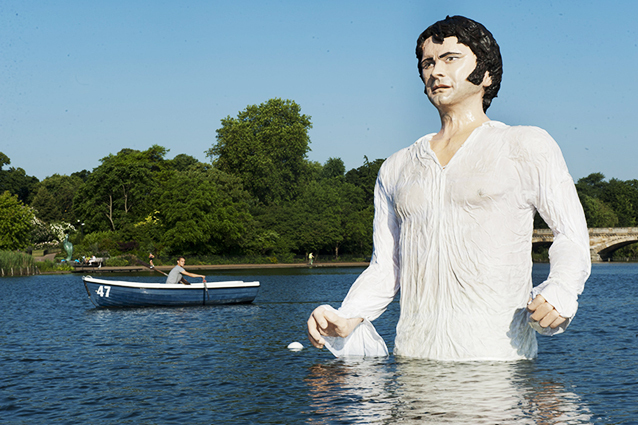
But what’s really interesting about the scene this statue depicts is that it never actually happened. Check out the following clip to see Firth talking about it:
http://www.nbc.com/the-tonight-show/video/colin-firth-never-came-out-of-the-water/2771254
And here’s a clip from the film to prove it:
This mini-series ran in 1995, and now 20 years later, people have mis-remembered a scene from it to such a degree that they’ve voted it the most memorable scene in British television history. Aside from it being an interesting anecdote, why do I bother to bring it up here? Because apologists often tell us that the period of time between Jesus’ death and the first Christian writings (at least 20 years) is not long enough for legends to develop; therefore, Paul’s epistles and the gospels must be recording actual events. Yet in this day of photographic evidence, we have an example of how easily the actual facts can be embellished.
This scene was created simply through the evolution of human memory. No one stood to gain anything by making this up. By the same token, apologists are wrong when they claim that if the gospel accounts aren’t accurate, then they must have been developed by a conspiracy. There’s no reason to believe that at all. Stories change as they pass from one person to another, and 20+ years is an awful lot of time for the telephone game to take its toll.

 Finding Truth
I don’t know why I didn’t get a notification of your comment, Josh, but for whatever reason, I didn’t, so I’ll have to piggy-back off of Nate’s – we were talking about Brandon, or “naive thinker,” sorry for the misunderstanding.’
LikeLike
Besides, you big lug, you should know by now I’d never say anything bad about you, you’re one of the good ones, you never proselytize.
LikeLike
Thanks, Arch! And, apologies for the misunderstanding. I don’t know if I’d say I “never proselytize”, but maybe that’s just my manipulative proselytization at work 🙂
LikeLike
Arch — Hate to use Nate’s blog, but I’ve sent two emails to you and no response. I’d hate to think you’re ignoring me and would rather think you haven’t ever received them …
LikeLike
SUDDENLY, at 3:55 (my time), your comment, Josh, just popped into my email – again, sorry for the misunderstanding, but I have NEVER said anything negative to, or about, you, and can’t imagine I would ever have occasion to do so.
LikeLike
Well, if you can pull it off so subtly that even I can’t detect it, I’d say you’re home free.
LikeLike
No, I’m ignoring you, because I can’t seem to find the review I wrote, and I’m ashamed to admit it. But I’m still looking, if that makes you feel any better.
LikeLike
@Howie,
“I’d like you to reply to my comment with what you think about what I’ve said here. You seem to like ignoring direct questions or inquiries for clarification sometimes. Please don’t get me wrong I’m totally cool with that – maybe you are busy or maybe you don’t think we are sincere, or maybe you don’t want to engage in useless talk, or maybe whatever – it’s cool. But I would like to gently suggest that if you do that you may be part of the cause for why you get so frustrated with being misunderstood.”
Oh, I wish it were only that I “like ignoring direct questions”. I’m so dense I honestly don’t understand what you’re talking about. It’s not that I’ve decided to ignore your question(s) I honestly don’t realize there’s a question hanging in the air.
I think, a long time ago, you asked me if I based my belief on any author’s writing. I couldn’t think of any. Most of the time, when I read literature aimed at exploring Christian “controversies”, I get more and more uncomfortable with every page I read. The things some people write! Just plain stupid.
I prefer orthodox, devotional stuff actually.
Spoon feed me. Ask me one question. Ask slowly and speak distinctly. Imagine that you’re speaking to a cognitively impaired person. (That’s how my wife handled me and it worked out best that way.)
🙂
P
LikeLike
But if it makes you feel any better, your two emails are sitting at the top of my, “To Be Answered” list —
LikeLike
Oh no worries Paul. I was curious in this post if Nate and I understood your main point this time. From our responses last night what did you think? Are we still missing your point?
LikeLike
I may be way off base here, but what I get from Paul’s (CC) many comments is that he feels he has a relationship with God. Period. He’s not concerned about all the trappings that go with that relationship (e.g., the hereafter, judgment, resurrection, etc.). He just focuses on what God means to him and how he can live a better (and more benevolent) life in the here and now with his God’s help.
How close am I, Paul?
LikeLike
@Howie,
I am both impressed and delighted with the attentiveness and open-mindedness both you and Nan have demonstrated in your conversations with me.
It’s not just a question of your “understanding” me; it’s also a question of me figuring out what really, really matters to me and what it is that I’m interested in discussing with all of you.
I am by no means promising that this will be my “final word” on the subject since these conversations are, for me, as much a matter of exploration as they are of exposition; but lately I’ve become very interested in figuring out which points of philosophy and/or theology are really important to get to the truth about and which points are less important. In other words, I think there are some issues where — even if your belief is false — your false belief is basically benign; whereas there are other issues where — if you get it “wrong” — your false belief is malignant.
For example, let’s consider the issue of the afterlife. Two people might disagree about whether our souls continue to have some sort of life experience even after our bodily death. We could reasonably assume that one of these people is “right” and the other is “wrong”. I personally have never collected sufficient evidence in favor of the existence of an afterlife to become convinced that we actually continue after death. On the other hand, I haven’t collect sufficient evidence disputing the reality of afterlife to convince me that there is no afterlife.
The big obstacle — for me — preventing a firm conclusion is that no one has ever “come back” and given us a report. I’m perfectly willing to accept an answer to this question on the basis of ‘scientific evidence’; but there are actually no experiments on the subject for us to consider. You can’t say that a belief in the afterlife is ‘unscientific’; but neither can you say that a rejection of belief in the afterlife is ‘unscientific’. No one can apply the scientific method to matters that have no experimental results.
So, if half the people in a particular group believe in an afterlife and the other half believe there is no afterlife we know that half are right and half are wrong. We just don’t don’t which half is ‘right’ and which is ‘wrong’. It’s an interesting question to many of us, but since one must die in order to know, very few of us are sufficiently interested to become impatient to find out.
You might be right in your belief about the existence of the hereafter, you also might be wrong. It is my opinion, however, that if your belief is wrong your false belief is benign.
On the other hand, if you are wrong in your belief about whether your mistakes or wrongs or sins (or whatever you want to call them) make you deserving of punishment, your false belief is malignant. I think it’s very, very important to get that one right. Getting the “right” answer to the question of whether God exists or not is actually far less important, at least in my assessment of the matter, than getting the right answer to the question of whether your wrongdoing causes you to deserve punishment. If you get that one wrong, you’ll not only make yourself miserable, you’ll make other people miserable as well.
I’m not going to make a big deal of a disagreement between myself and somebody else on the question of God’s existence, or on the question of the afterlife, or on the question of whether the ‘miracles of Christ’ actually happened or not. I think it won’t cost you any points if you get those questions wrong, so I’m not going to put a lot of effort into promoting my opinion on those matters. Actually, I don’t think it’s worthwhile to put ANY effort into such arguments.
On the other hand, I think it’s really, really important to be right on the issue of whether or not you deserve to be punished. It’s even MORE important to be right on the issue of whether other people deserved to be punished by you. I’ll push my convictions on those matters because I’m convinced that your beliefs about it will definitely affect others — including me. It’s actually a matter of my own self preservation to encourage you to reach a correct decision on that question.
How do you like them apples?
Paul
LikeLike
“Sometimes unkleE, you have to set aside the scoreboard and use good old common sense. Do you base everything you believe in by the general concensus of other people ?”
Hi Ken, when there is expert opinion that I lack, I try to listen. You are suggesting that I dismiss the experts (when we haven’t even discussed what they say) in favour of your personal wishes. If I did that on some other topic, I would doubtless be accused of having blind faith – not sure what it should be called when you do it. So thanks, but no thanks.
LikeLike
RE: “no one has ever ‘come back’ and given us a report” – ah, but according to your own owner’s manual, Lazarus did – isn’t it surprising he didn’t have more to say on the issue? Of course, if he were only a literary device, a “precursor” of things to come, there’d have been no need for that, would there –?
LikeLike
And CC, come on, you are FAR too intelligent not to see the concept of “celestial punishment” for what it is, an effort by religious authorities to control the behavior of a population —
LikeLike
I mean, if you were unklEgregious, I might understand it —
LikeLike
“Nate’s analogies may not be precise and perfect, but they are meant to show that humans have a proclivity to remember things not quite so precisely and also have a proclivity to expand on stories as they are passed on.”
Humans also have an ability to remember an amazing amount of stuff very accurately – like this guy who memorised the value of pi to almost 68,000. So where does the NT fit in that range?
Imagine if I quoted this article (dunno how reliable it is, but what the hey!?) about a girl less than 4 years old who has memorised the entire Quran, and said this proves that the disciples could easily have memorised Jesus’ teachings. Would you happily accept the argument??
Now I know Nate wasn’t suggesting his analogy was a complete answer to the question, but how do we decide whether the New Testament is closer to people’s memories of Pride and Prejudice, or people’s memories of pi or the Quran?
No-one seems interested in that question, and yet there is good information on it.
“I’ve also read that the consensus of scholars in the field is that there is some legendary embellishment in the gospel stories especially surrounding the resurrection, but what there is no consensus about is how much embellishment occurred.”
Let’s accept this as the scholarly consensus (interesting that we find it easy to accept scholarly consensus when we like the outcome, but not when we don’t!). Does that make the NT closer to Pride & Prejudice or to feats of memory? You still haven’t answered the important question!
I suggest there is much information to resolve that question, but no-one seems interested. I say again, when christians disregard evidence like this, we are accused of blind faith, but when atheists (and other non-believers) do it, a christian critic such as me is called subtle names (not by you, I hasten to add), and the discussion remains pretty much evidence free.
I feel a blog post coming on!! 🙂
LikeLike
Only 3% of the world’s population possess eidetic memories, which means that there is a 97% chance that pseudo-Matthew, -Mark, -Luke and -John did not.
LikeLike
— but then, they weren’t there in the FIRST place, were they?
LikeLike
Paul,
I like them apples quite a bit and I’m not joking. After these latest comments of yours I’m realizing that I’ve been misunderstanding you somewhat. I kind of had some gist of your views but it’s becoming a lot clearer now and while I was saying before that you and I have similar viewpoints with a bit of tongue in cheek, now I will say it with all seriousness. Obviously they aren’t the same, but there are some striking similarities when it comes down to what really matters. There isn’t anything in this last comment of yours I want to disagree with, in fact just the opposite.
Yes, I agree, I think that kind of viewpoint could and in fact does lead to detrimental effects that none of us want in our societies.
And Paul, if you believe in God (even a “mind watching over us” kind of God) it doesn’t bother me one bit. I sometimes have a bit of a hard time understanding why some (and I actually do not believe it’s most, but I do believe “most” is the right word if we are talking about the most vocal ones) atheists want so badly to eliminate all “religious” or even “pseudo-religious” beliefs. I have several friends who tell me that they just have a hard time themselves understanding how all this stuff around us could be here without some kind of thinking higher power existing, but that they realize that they could be wrong in that conclusion and that they respect that I think differently because they realize that I am a different person from them – different genes, different experiences as I say all too often. I say the same back to you – I don’t blame people one bit for having wonder and coming to conclusions like your own with the kind of healthy perspective that you add to it – in fact I appreciate it. Thanks for that! It’s people like you that I can work together with to make our world a better place. I have an appreciation for interfaith groups welcoming of both faiths and non-faiths that try to make that happen.
You asked us before if anything was enlightening in your comments, and I’d vote your comments to be by far the most enlightening on this post – way above my own.
LikeLike
Nate,
I’m not really sure Nate, but these things would be good to know. There are links to polls in philosophy on consensus (or lack thereof actually) and there are certainly many places in important physical science fields of polls on consensus, but they don’t seem to have them for history of religion. Perhaps there are good practical reasons for this.
I will venture some educated guesses though from my own reading. First I think you are correct in your own list. I’d also add that there is some consensus on date ranges for when the books of the bible were written (of which this is a good resource you are probably aware of.) Another related thing I’ve heard is that there is consensus on the following: “the early followers of Jesus had group experiences that convinced them that Jesus had risen from the dead.”, but I’ve been told that what “group experiences” actually means is not clear and that’s where there is not consensus.
I’m sure there is consensus on lots of other minutia but probably not things of huge significance to the topic at hand otherwise Mike Licona would have been very sure to make use of them.
But I find it shocking that you are asking this Nate! Because as you and I both know, atheists are not at all interested in consensus. They only use it against others when it agrees with their viewpoints. 😀
LikeLike
Supposedly, there is also a consensus that he was baptized by John the B, but I’ve yet to see any evidence that John ever existed either.
LikeLike
@UnkleE
As you and most other Christians do not particularly like or accept the archaeological consensus or the scholarly consensus that states that Moses the Exodus and the Conquest of Canaan is all fiction.
And of course this impacts horribly on the character of Jesus his references to the Old Testament , the Patriarchs and other OT stuff. Then there are the supposed prophecies, not least the Virgin Birth
Yes, consensus is a bugger sometimes, is it not?
But, hey, we have a consensus that say someone called Jesus probably was around.
And when all that fails, why, you still have faith, right?
The consensus is moving toward agreement that Hell doesn’t exist. ( of course it never did and was just another corrupt piece of fiction invented by the Church)
And the consensus now states that Limbo does not exist.
What next on the consensus ”hit list”, unklee?
You will notice that consensus in all fields of religious endevour seems to be agreeing about a whole host of things that at one point in time would have had the Church building bonfires everywhere to cope with the heretics.
Ironic that you, unklee, would likely have been trussed up and thrown on the woodpile.
Consensus might well decide that the man god Yeshua was actually just a man.
He was only a man, of course, but we just have to wait a while for the believers to catch up with the normal people. But we’re a patient lot.
LikeLike
“Does anyone know of other points that the scholars are in general agreement over?”
About 20 years ago, EP Sanders, on of the most respected of all NT scholars, wrote this (The Historical Figure of Jesus, p10-11):
I shall first offer a list of statements about Jesus that meet two standards: they are almost beyond dispute; and they belong to the framework of his life, and especially of his public career. (A list of everything that we know about Jesus would be appreciably longer.)
Jesus was born c 4 BCE near the time of the death of Herod the Great;
he spent his childhood and early adult years in Nazareth, a Galilean village;
he was baptised by John the Baptist;
he called disciples;
he taught in the towns, villages and countryside of Galilee (apparently not the cities);
he preached ‘the kingdom of God’;
about the year 30 he went to Jerusalem for Passover;
he created a disturbance in the Temple area;
he had a final meal with the disciples;
he was arrested and interrogated by Jewish authorities, specifically the high priest;
he was executed on the orders of the Roman prefect, Pontius Pilate.
From my reading, there would be few scholars who wouldn’t agree with that minimum. Most I have read would add quite a few more ‘facts’, as does Sanders himself (this statement was at the start of his book, it was his starting point, but after historical analysis he concluded other matters were historically true also).
Other ‘facts’ that most scholars would agree on would be his reputation as a healer and exorcist and his disciples having visionary experiences of him after his death. For a recent comprehensive assessment, I would recommend Maurice Casey’s ‘Jesus of Nazareth’. Casey is a non-believer, a respected scholar with about 40 years in the field and an expert in Aramaic, and he would accept all the above as historical, and more besides.
LikeLike
Which in plain English means every single point could be challenged.
You keep touting this age old minimum facts argument. There are several scholars that have demonstrated just how weak this argument truly is, not least because it begins with a premise that cannot be verified and simply builds upon it.
Even if it were all true ,all we have is an itinerant eschatological preacher who was likely delusional or worse who was nailed up and died. Period.
Everything else that has been built upon this character is spurious nonsense.
LikeLike