Recently, the ten most memorable moments of British TV were voted on, and Colin Firth coming out of the lake in Pride and Prejudice won most memorable. To commemorate, a huge statue of Colin Firth has been sculpted and has apparently been making the rounds to various lakes in Britain.
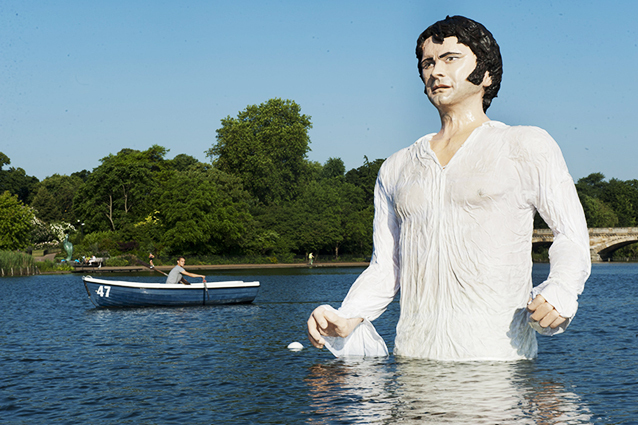
But what’s really interesting about the scene this statue depicts is that it never actually happened. Check out the following clip to see Firth talking about it:
http://www.nbc.com/the-tonight-show/video/colin-firth-never-came-out-of-the-water/2771254
And here’s a clip from the film to prove it:
This mini-series ran in 1995, and now 20 years later, people have mis-remembered a scene from it to such a degree that they’ve voted it the most memorable scene in British television history. Aside from it being an interesting anecdote, why do I bother to bring it up here? Because apologists often tell us that the period of time between Jesus’ death and the first Christian writings (at least 20 years) is not long enough for legends to develop; therefore, Paul’s epistles and the gospels must be recording actual events. Yet in this day of photographic evidence, we have an example of how easily the actual facts can be embellished.
This scene was created simply through the evolution of human memory. No one stood to gain anything by making this up. By the same token, apologists are wrong when they claim that if the gospel accounts aren’t accurate, then they must have been developed by a conspiracy. There’s no reason to believe that at all. Stories change as they pass from one person to another, and 20+ years is an awful lot of time for the telephone game to take its toll.

 Finding Truth
Where’s the evidence, unk, except in the gospels, written at minimum, 40 years after he allegedly lived, by four anonymous authors who never met the man, ?
LikeLike
“Where’s the evidence, unk, except in the gospels, written at minimum, 40 years after he allegedly lived, by four anonymous authors who never met the man, ?”
Hi Arch, I was answering a question about the consensus of scholars. They don’t come to this consensus lightly, but based on detailed study of the historical evidence. If you want to know why they conclude that way, you’d need to read their books. But in very brief summary:
1. 40 years is very close to the events for ancient history.
2. There are multiple independent accounts, passed on in writing and orally, in different locations. If the stories were legendary, it is extremely unlikely that multiple independent accounts from different locations would invent the same legends. This is far better than most ancient history.
3. Scholars see some parts of the existing NT as being credal statements formulated very early (within a few years). Other parts are seen as being translated from early Aramaic originals. This takes us back very close to the events.
4. Casey believes Mark’s Gospel was written about 40 CE, though few other scholars agree with him on that. But even at about 70CE, Mark is still within living memory for many people.
5. The original “authors” or originators of these stories almost certainly met Jesus, but the authors or compilers of the gospels probably didn’t, though this isn’t as certain as you say.
6. Josephus is recognised as a good independent source about the basic facts of Jesus’ life. (Yes I know the text has probably been tampered with, but the evidence is that there is a good solid historical core – and that is the majority view of scholars these days.)
That’s just a brief summary. What we have looks exactly like a series of basically true stories passed on in writing and orally by all different people, the core passed on accurately but with some variation and some details creatively embellished, and then compiled and written down by believers who shaped the material they had to promote their belief.
That’s what the majority of the leading scholars think – if you don’t want to believe me, check out EP Sanders, Maurice Casey, NT Wright, Richard Bauckham, Bart Ehrman, Geza Vermes, Craig Evans, Michael Grant or Craig Keener – all leading scholars I have read on the subject. Some of them are christians, some are not, but all would conclude something like what I outlined. Take Bart Ehrman as an example – he writes about lots of variations in the text, but when you look at the details, they are not very significant, and he still says that we know a lot of good historical information about Jesus. And classical historians sometimes say that NT historians are more sceptical than their classical colleagues.
So that’s a quick summary. I suspect you and most others here know all that. The question is (again) whether we choose to believe the consensus of what the best, most respected, scholars conclude, or choose to believe less respected and more biased scholars or even non-scholars – or even simply what we wish was true. It isn’t just christians who can be very selective!
LikeLike
“1. 40 years is very close to the events for ancient history.”
So if I told you, in 2003, that John Kennedy did or said such and such in 1963, though I wasn’t there and never met the man, but heard it from someone, who heard it from someone, who heard it from someone, you’d accept that as fact —
“2. There are multiple independent accounts, passed on in writing and orally, in different locations. If the stories were legendary, it is extremely unlikely that multiple independent accounts from different locations would invent the same legends.”
Are you kidding? What multiple accounts? Even the four anonymous gospel writers can’t get their stories straight!
3. “credal statements” by whom? “translated from early Aramaic originals” of what? Written by whom?
4. Try at least 72 CE, established by a number of authorities, including Bart Ehrman.
5. “The original ‘author’ or originators of these stories almost certainly met Jesus, but the authors or compilers of the gospels probably didn’t, though this isn’t as certain as you say.”
Bingo!
6. “Josephus is recognised as a good independent source about the basic facts of Jesus’ life.”
To begin with, Josephus didn’t even begin writing about Jesus until about the same time as Mark, after the destruction of the Jewish temple in 72 CE, DID not know Jesus, or to the best of anyone’s knowledge, anyone who did, and was considered by his own people, to have been a traitor – hardly a sterling recommendation.
Interestingly, after he turned traitor, and became a Roman, he was given a captive Jewish woman as a wife – even she left him! But yeah, unk, he’s definitely someone I’d turn to for truth —
Hey, you know what? I have a life! And I intend spending this weekend living it, not refuting your nonsense. Later —
LikeLike
@Arch “And CC, come on, you are FAR too intelligent not to see the concept of “celestial punishment” for what it is, an effort by religious authorities to control the behavior of a population –”
Yes. That’s true. I do see that. But I see more than that. I see that the ACTUAL punishment human beings inflict on one another keeps us all ‘under control’. In fact, I’m likely to “see” us enslaving and being enslaved every minute of every day. Yeah, religious authorities do it all the time. Plenty of evidence for that! But don’t be so sure that you can rid the human species of its inclination to enslave just by abolishing religion.
Look, I like listening to what atheists have to say. You guys complain about things that ought to be complained about. Good for you! But I think you’re all too sure you’ve found the root of the problem.
My own opinion is that a belief in God is actually benign, and a belief that there is no god is also benign. (I’m repeating myself here but I don’t think I’m getting through.) It’s ‘control’ that’s malignant. What, do you imagine that if somebody thinks there’s no god he (or she) is magically going to stop ‘training’ and ‘coercing’ and ‘controlling’ other people through the use of reward and punishment? Our dear friend Mr. Stalin did a pretty good job of pushing folks around without having to resort to a god. It’s not the belief in God that keeps people down, it’s the certainty that the authorities will punish any behavior that threatens their power that keeps people down.
Instead of encouraging people to stop believing in God (which isn’t going to matter at all in the long run), you should encourage people to stop slapping each other around.
Paul
LikeLike
“Hey, you know what? I have a life! And I intend spending this weekend living it, not refuting your nonsense. Later –”
Enjoy your life!
1. One of the basic mistakes in historical study is to apply modern standards to ancient history as you have done. The scholars say what I said, so it is safer to believe them than you. But even on your own terms, people collect reminiscences from holocaust survivors, which is about the same time after the events, and virtually no-one doubts that they are recalling true events.
2. If you don’t know this stuff, why are you arguing so strongly? We have discussed this before. There are many different sources recorded in the gospels – scholars differ about the exact number (it’s probably somewhere between 5 and 8 at least), and all would agree with that statement – plus Paul, James, Josephus, etc. The things the scholars agree on (which is what we are discussing) are preserved in most or all of the sources, though some details vary.
3. Again, if you don’t know about this, why are you so confident? There are several sections in Paul’s letters (written about 15-35 years after Jesus) which scholars identify by their form and wording as early creeds (e.g. Corinthians 15:3-8 Philippians 2:5-11) dated only a few years after Jesus’ death.
The NT is written in Greek, but Jesus probably spoke Aramaic most of the time (he may also have known some Greek). Aramaic scholars like Maurice Casey look behind the Greek text of the gospels and find Aramaic idioms (which are sometimes quite distinctive), which indicate an original Aramaic source for those sayings or stories. Since the christian community spread widely from Palestine into the Greco-Roman world, and most of the NT was written “out there”, an Aramaic original is almost certainly quite close to Jesus in time and place.
4. I find it interesting that you make this confident statement based on one person. We need to consider the consensus. The consensus is divided between pre 70 and post 70 (the date of the final destruction of Jerusalem and the temple), but few believe it is very far from that date either way. 72 CE is no different from 70 CE in practical terms. I used 70 to reflect the mid range of the commonly assigned dates.
5. So we are agreed on something!? I’ll put a mark on the wall! 🙂 And that is a sufficient basis for the scholars to draw “safe” historical conclusions about the matters under discussion.
6. I’m guessing you looked up Josephus in Wikipedia and found this quote. And it has no relevance to the question we are asking, likewise your comments are irrelevant. The historians use all sources with caution for possible biases and the writer’s individual perspective, and they find Josephus generally reliable. For instance Bart Ehrman writes (in ‘Jesus Interrupted’, p150):
“It is certainly worth knowing that the most prominent Jewish historian of the first century knew at least something about Jesus— specifically that he was a teacher who allegedly did wonderful deeds, had a large following, and was condemned to be crucified by Pontius Pilate. This account confirms some of the most important aspects of Jesus’ life and death as recounted in the Gospels. But it doesn’t indicate exactly what he did or said, or what circumstances led to his accusation and death”
So Arch, it seems that far from “refuting” what the scholars say, you have shown that you haven’t read them very much or very well. I’m sorry to have to speak so strongly, but there is no other way to answer what you have written. Whether you wish to learn, by going back to the sources I reference and reading what the experts say, or continue to argue against them, is for you to decide. But I suggest dropping the discussion until you have done some more reading.
Enjoy your weekend!
LikeLike
That’s one thing, about which, you and I are in total agreement. (I never thought I’d hear myself say it!)
LikeLike
Nate,
I heard an interview a while back between Mike Licona and Luke Muehlhauser that I thought was very educational on this topic. As you know Mike is a conservative evangelical who affirms the Chicago Statement of Inerrancy. Those who affirm that always bring up a red flag in my mind and I always hold what they say at arms length. But nevertheless I got the sense in that interview from several things that he said that he was being honest about the list of things that there is consensus on that are relevant to the subject of the resurrection of Jesus, and on top of that I haven’t seen non-Christians try to refute the claim that there is large consensus across scholars of all persuasions on those items he mentioned. As you and I have talked before, contrary to what some might insinuate about me, I don’t believe it is wise for a layperson like myself to claim that those things are false unless I have some incredibly well researched reasons and have made an effort to advance those reasons with other scholars. So all the things that you and I listed cover Mike Licona’s list and if Mike had thought there were other items relevant to his case for resurrection he would definitely have brought them up – if he didn’t then he is not near as smart as I think him to be. So I really don’t know for sure about Unklee’s list and obviously a lot of them aren’t even relevant to the question at hand. But I’m more than willing to accept facts that truly are consensus across the board of persuasions.
Now what I found was that trying to build a case with those minimal facts did not build up a strong case at all for resurrection. It built about as strong or perhaps less of a case than one you could make that the virgin Mary, Saint Joseph and John the evangelist appeared at the Knock Shrine in Ireland. Now I don’t think a lot of people would fault me or say I was being inconsistent or loose with facts for doubting that those appearances were veridical. I really haven’t been convinced why I should be faulted for doubting stuff that was way farther distant in history when the environment was as I described before (near everyone superstitious, little fact checking, etc.)
And frankly if people believe that Mary, Joseph and John showed up at the Knock Shrine I don’t feel a need to convince them otherwise or to suggest they are being dishonest with facts, but I also don’t see the need to feel like I am being dishonest with my own conclusions on the subject.
I also am not quite seeing why any of the things that are being listed here as consensus even if they really are consensus would lead me to believe that the resurrection story is veridical. I’m also not quite seeing how it would lead me to believe that the aspects that you mentioned in the original post did not contribute in the growth of the stories. Is there some core truth to the stories that then grew into bigger stories? Yes I think it likely, but a core of truth that includes a literal resurrection of a human body – I’m doubtful.
Nate or others: any thoughts or constructive (<- keyword) criticism on what I've said here?
LikeLike
Hi Howie,
FWIW, I think you have been quite fair, though of course I disagree with some of your judgments.
1. My reading of the experts is that:
2. All agree Jesus was executed by crucifixion by Pilate.
3. Almost all believe he was buried in a tomb (a few believe his body would have been dumped on a refuse heap and left to be eaten by animals & birds).
4. A number, possibly a majority, believe his tomb was later found empty.
5. About three quarters believe his followers had some visionary experiences of him after his death, though of course several explanations are offered.
6. Most agree that belief in the resurrection was a significant factor in them believing he was son of God and in their vigorous efforts to spread the word.
I would therefore disagree with your statement “It built about as strong or perhaps less of a case than one you could make that the virgin Mary, Saint Joseph and John the evangelist appeared at the Knock Shrine in Ireland.”
Anthony Flew called the resurrection of Jesus the best attested miracle claim in history, and even when he was a strong atheist he and others lost debates on the historicity of the resurrection (debates have been won by both sides). That shows that the stories have at least some credibility beyond what you give them.
But beyond that I wouldn’t argue. Each person has to decide for themselves. But I think yours is a thoughtful and well-based view, even where I disagree.
LikeLike
“even on your own terms, people collect reminiscences from holocaust survivors, which is about the same time after the events, and virtually no-one doubts that they are recalling true events.”
Events that happened to them, and/or their loved ones, not some delusional, itinerant preacher, running around Galilee in a robe and sandals.
“2. If you don’t know this stuff, why are you arguing so strongly? ” Because I DO know this stuff.
“There are many different sources recorded in the gospels – scholars differ about the exact number (it’s probably somewhere between 5 and 8 at least), and all would agree with that statement – plus Paul, James, Josephus, etc.”
Name them.
3. “There are several sections in Paul’s letters (written about 15-35 years after Jesus) which scholars identify by their form and wording as early creeds (e.g. Corinthians 15:3-8 Philippians 2:5-11) dated only a few years after Jesus’ death.”
Written by a man who never met him —
“The NT is written in Greek, but Jesus probably spoke Aramaic most of the time (he may also have known some Greek).”
As the son of a carpenter, I doubt that he could either read or write, much less have linguistic abilities beyond his native Aramaic, brought back from Babylon, which entirely replaced Hebrew as the language of the land.
“Aramaic idioms,” found within Greek, by authors who spoke Aramaic as their day-to-day language, but wrote in Greek, their Lengua Franca of the time? And yet you find this unusual, and indicative that it implied a time, “almost certainly quite close to Jesus in time and place”? I suspect the key word there, is “almost” – at least within a hundred years or so.
“So we are agreed on something!?” – what would that be? If I ever agree with you on anything, just shoot me.
“It is certainly worth knowing that the most prominent Jewish historian of the first century knew at least something about Jesus— specifically that he was a teacher who allegedly did wonderful deeds, had a large following, and was condemned to be crucified by Pontius Pilate.”- your quote from Bart Ehrman.
So what Ehrman is saying, is that a man, at least 42 years after the alleged event, “knew at least something about Jesus— specifically that he was a teacher who allegedly did wonderful deeds, had a large following, and was condemned to be crucified by Pontius Pilate.” How did he know these things, except via hearsay testimony?
“I suggest dropping the discussion until you have done some more reading.” – I’ve done quite enough reading, thank you – I suggest dropping the discussion until you have done some more thinking. Or possibly, even SOME thinking. TTFN!
LikeLike
“4. A number, possibly a majority, believe his tomb was later found empty.” – who would those be?
LikeLike
Hi ARch, let’s remember that we are discussing what the consensus of scholars is, not your or my personal views. So again, you have generally got the experts wrong:
1. What you say is irrelevant to what the experts say, and just a rant (words like “delusional” have no place in this discussion of what the scholars say). So you have offered no further “refutation” about the time period.
2. Again, why do you ask me to name them if you have read this stuff? The ones most commonly agreed on by scholars are these (gospel sources plus 2 non-gospel):
(i) Mark
(ii) Q (some say one source, some say several, very few say this material came from other known sources)
(iii) M – Matthew’s other source(s)
(iv) L – Luke’s other source(s)
(v) John’s ‘sign’ source
(vi) Other material in John
(vii) Paul
(viii) James
3. What you say about Paul has zero relevance to his use of early christian creeds.
As a travelling rabbi, and as the son of a tekton, Jesus probably could read and write in Aramaic, maybe a little in Hebrew and maybe Greek. But that is irrelevant to the question we are discussing. This point is based on Jesus’ spoken language.
You “suspect” here that the Aramaic sources were maybe much later, but on what basis? Scholars such as Casey say it was much closer, and therefore that your “suspicion” is unjustified. Why do you disagree with them?
4. We seem to be agreed on the rough date of Mark’s gospel.
5. You said “bingo” about eyewitnesses. I presumed that meant agreement. If not, perhaps you could explain where and why you think differently.
6. Josephus was a historian who lived in Palestine for much of his life. He would almost certainly have met christians, and he could well have met eye witnesses or people one step removed from eye witnesses. Expert historians believe Josephus wrote reasonable history – why do you disagree with them?
So Arch, what is the substance to your objections? I can’t see any beyond your “suspicion”.
LikeLike
“4. A number, possibly a majority, believe his tomb was later found empty.” – who would those be?”
In 2005 Gary Habermas did a review of all the scholarly papers on the resurrection he could find (1400 in all), They give a pretty good sample. He found about 75% of papers concluded the tomb was empty. He doesn’t mention specific names, but I’m told classical historian Robin Lane Fox accepted the story as genuine, as I imagine most christian scholars would.
That is why I phrased my statement so generally.
LikeLike
“1. One of the basic mistakes in historical study is to apply modern standards to ancient history as you have done. The scholars say what I said, so it is safer to believe them than you. But even on your own terms, people collect reminiscences from holocaust survivors, which is about the same time after the events, and virtually no-one doubts that they are recalling true events.”
BIG difference here unkleE. We have pictures, movies, gas chambers and bones as evidence of the Holocaust.
We have NO original documents or anything original from the NT . We have copies of copies of copies. Ever been to the Holy Land ? ALL of the tour guides use the words “Tradition tells us” NOT “History tells us”. There is a reason for this.
LikeLike
Yeah, maybe Ken, but where do you disagree with the scholars?
LikeLike
Hey Unklee: your list of 6 items in your comment at 9:37pm seems to match pretty close to what I understand. I think the Knock Shrine has some extra evidential support in that there were 2 commissions of inquiry including depositions of witnesses still alive with conclusions that there was not any fraud, that no natural causes could be offered and the testimony of the witnesses was trustworthy and satisfactory. A scholar and historian was involved in one of the inquiries. It also has the extra benefit of having happened in 1876 which was many years after the enlightenment period.
The flew thing isn’t too convincing for me because he was a philosopher and not a historian. I’d wonder more about the consensus of historians regarding his statement about the resurrection. But I don’t think that’s something that can be found out. And people lose debates when trying to affirm evolution but you and I both agree that it is reasonable to place some doubt on evolution denial, so people losing debates is not a great indicator in these kinds of subjects.
I like and I agree very much with what you said here and feel the same toward you: “Each person has to decide for themselves. But I think yours is a thoughtful and well-based view”.
LikeLike
“let’s remember that we are discussing what the consensus of scholars is” – see, a lot of people don’t know how you operate. You appear to seek a “consensus of scholars,” which you have defined as a median view of all of the scholars available, yet you really can’t say that you have reviewed all of the scholars available, so unless one is inclined to do an exhaustive search – and trust me, you’re not worth it – one can never be sure whether you’ve actually done that, or simply cherry-picked.
Let’s take a look at your sources:
(i) Mark – pseudo-Mark never met Jesus, wrote about 72 AD.
(ii) Q (some say one source, some say several, very few say this material came from other known sources) – some say that he MAY have written down some sayings of Jesus, but like pseudo-Mark, pseudo-Matthew, pseudo-Luke and pseudo-John, unidentified, and ergo, unreliable. “Judge, I have a witness, I can’t tell you his name or anything about him, and he can’t be cross-examined, but I’d like the court to take everything he said – which by the way, we also don’t actually have – as being the truth.” I wonder how that would play out in a courtroom?
(iii) M – Matthew’s other source(s) – pseudo-Matthew never met the man, wrote a few years after pseudo-Mark.
(iv) L – Luke’s other source(s) – never met the man, wrote a few years after pseudo-Matthew.
(v) John’s ‘sign’ source – pseudo-John never met the man, wrote sometime between 90 and 150 ADE.
(vi) Other material in John – ditto
(vii) Paul – never met the man
(viii) James – if by this, you mean the Epistle of James, it never mentions Jesus.
“Jesus probably could read and write in Aramaic, maybe a little in Hebrew and maybe Greek.” – you DO have evidential sources, I presume.
You “suspect” here that the Aramaic sources were maybe much later, but on what basis?
I said, “Bingo,” based on your “5. The original ‘authors’ or originators of these stories almost certainly met Jesus, but the authors or compilers of the gospels probably didn’t.” But then we know nothing about the “authors or originators of these stories,” or even that they and the authors and/or compilers of the gospels, weren’t one and the same.
“Josephus was a historian who lived in Palestine for much of his life. He would almost certainly have met christians, and he could well have met eye witnesses or people one step removed from eye witnesses.” – before he turned traitor to his own people, until the destruction of the temple in 72, when he capitulated, Joseph was a member of the resistance, and had little time for the compilation of history. Even so, he never met Jesus, and had no more access to information about him than anyone else, which equates to second-, third-, or fourth-hand information.
LikeLike
So of those 1400, how many were there that morning, and personally witnessed the empty tomb, which is actually irrelevant – were any there, awake, overnight, and watched the tomb to make sure no one stole the body? Or maybe to witness the actual rolling away of the stone.
If not, their testimony is really rather worthless, isn’t it?
LikeLike
<i."So of those 1400, how many were there that morning, and personally witnessed the empty tomb, which is actually irrelevant – were any there, awake, overnight, and watched the tomb to make sure no one stole the body? Or maybe to witness the actual rolling away of the stone.
If not, their testimony is really rather worthless, isn’t it?
"
I have to assume you’re joking. No, no modern day historians have lived for 2000 years, we can agree on that!
Their testimony is of what we can conclude from the historical sources. And their testimony is better than yours or mine on that score. And their testimony is what we are discussing right now.
LikeLike
“Their testimony is of what we can conclude from the historical sources.”
So are you saying there WAS someone there, awake, overnight, and who watched the tomb to make sure no one stole the body? Or maybe to witness the actual rolling away of the stone? And that that person left their name and full credentials, so that we can verify his/her story?
Hey, that’s great, just give me the details, and we’ll go to press!
LikeLike
Or are you saying that there ARE no actual historical sources?
LikeLike
Hi Arch, I think it’s time to take stock.
In our first discussion, I outlined a number of points that the majority of scholars think are well established about the life of Jesus. I can’t recall you offering any evidence that I misrepresented the scholars, only that you had questions about what the scholars concluded. So we can take it that if you haven’t done it by now, you haven’t got any evidence that I have misrepresented the scholars. So let’s tick that off.
But you have offered some questions and critical comments. Here’s the state of play:
1. I said that the gap from events to writings was not large by ancient standards. You haven’t offered any contrary evidence. Tick that one off.
2. I said there were multiple independent accounts./ You haven’t offered any evidence that there weren’t. All you have done is put “pseudo” in front of a few of the names (which means nothing – the debate on the authors is considerably more complex than that!), given a couple of dates (one of which is wrong) and made a few statements about them that are totally irrelevant to what competent scholars say. Tick that one off too.
3. You showed you didn’t understand the importance of early creeds and Aramaic sources, and said nothing to negate what scholars say about those things. Same again.
4. Mark’s gospel date. We agree the scholars say it was probably within a few years of 70 CE. No argument.
5. You have made a lot of comments about eye-witnesses and transmission of information, but none of them show any awareness of how scholars believe information was transmitted, recorded, memorised, etc, nor the fact that there are multiple independent sources. Somehow the scholars seem to have overcome the “problems” (should I put a ‘pseudo’ in front?) you mention – could it be they know more than you do? Again, the scholars’ conclusions stand.
6. Finally you say some disconnected facts about Josephus, none of which add up to evidence that he isn’t a useful historian. Again, tick that one off.
So the scholars’ work stands unchallenged by you, and no wonder, because their conclusions have gone through the usual academic peer review process.
In our second, shorter, discussion on the resurrection, you haven’t really been serious, simply making meaningless but humorous remarks about who was there at the time. But we weren’t talking about who was there – we were discussing the consensus of scholars. And you haven’t really offered any reason to even question my summary of that.
So I think I will stop at this point. I don’t this discussion has proved a lot, but it has shown that you have made statements that are not based on the best available evidence. I understand you disagree with me about belief in Jesus, but that hasn’t been what we were discussing.
Perhaps you and I can now go and enjoy the rest of our weekends. 🙂
LikeLike
“Jesus was born c 4 BCE near the time of the death of Herod the Great;
he spent his childhood and early adult years in Nazareth, a Galilean village;
he was baptised by John the Baptist;
he called disciples;
he taught in the towns, villages and countryside of Galilee (apparently not the cities);
he preached ‘the kingdom of God’;
about the year 30 he went to Jerusalem for Passover;
he created a disturbance in the Temple area;
he had a final meal with the disciples;
he was arrested and interrogated by Jewish authorities, specifically the high priest;
he was executed on the orders of the Roman prefect, Pontius Pilate.”
I think all of this is possible, unkleE. Where is the overwhelming consensus of Jesus’ bodily resurrection and him being divine? I was happy to see you used Geza Vermes as one of your scholars. He didn’t believe in a bodily resurrection however. According to wikipedia, “Vermes described Jesus as a 1st-century Jewish holy man, a commonplace view in academia but novel to the public when Vermes began publishing.[4] Contrary to certain other scholars (such as E. P. Sanders[17]), Vermes concludes that Jesus did not reach out to non-Jews. For example, he attributes positive references to Samaritans in the gospels not to Jesus himself but to early Christian editing. He suggests that, properly understood, the historical Jesus is a figure that Jews should find familiar and attractive. This historical Jesus, however, is so different from the Christ of faith that Christians, says Vermes, may well want to rethink the fundamentals of their faith.
LikeLike
Hi Ken, all we’re talking about here is the consensus of scholars. Someone asked the question, I tried to answer it. I didn’t include “Jesus’ bodily resurrection and him being divine” because that isn’t part of the consensus. I think I will leave christian belief on those matters to another discussion thanks.
LikeLike
“1. I said that the gap from events to writings was not large by ancient standards. You haven’t offered any contrary evidence.”
No reason to, your point means nothing! What does, “not large by ancient standards” even mean? That the human memory was more accurate a couple of thousand years ago, than it is today? That more care was taken then, than now, to preserve chains of evidence? What is my need to refute nonsense? Just look at the four stories told by the Gospel writers, to see how inaccurate “ancient standards” were. Untick that one.
“2. I said there were multiple independent accounts. You haven’t offered any evidence that there weren’t.” Have there been multiple accounts of UFO sightings? Yup. Does that mean UFO’s are real? Nope. What we’re requiring here is multiple CREDIBLE accounts, and you’ve offered none. You’ve offered up only those who weren’t there, or whose credibility can’t be verified. Untick.
“3. You showed you didn’t understand the importance of early creeds and Aramaic sources, and said nothing to negate what scholars say about those things.” And you neglected to establish the relevance of those “early creeds and Aramaic sources” – no need to negate the irrelevant. Untick.
4. You’re only a couple of years off.
5. We keep going back to, “multiple independent sources,” without the inclusion of the word “CREDIBLE.” Again, I must refer you back to the multiple independent sources that give eyewitness UFO accounts.
“6. Finally you say some disconnected facts about Josephus, none of which add up to evidence that he isn’t a useful historian.” Oh, I have no doubt that Josephus is quite useful, to you, as he says what you want him to say. I maintain that due to flaws in his character, to which you refer as “disconnected facts,” and of course the glaringly obvious fact that he wasn’t there and had to rely on multiple-handed information, with no way to verify the credibility of his sources or even any indication that he tried, make him an historian short on credibility. Untick.
LikeLike
Without credible – yeah, there’s that word again – eyewitness testimony, your “consensus of scholars” can only surmise what is “possible,” and in some cases, “probable,” but it cannot tell us what was, no matter how peer-reviewed they may be.
LikeLike