Recently, the ten most memorable moments of British TV were voted on, and Colin Firth coming out of the lake in Pride and Prejudice won most memorable. To commemorate, a huge statue of Colin Firth has been sculpted and has apparently been making the rounds to various lakes in Britain.
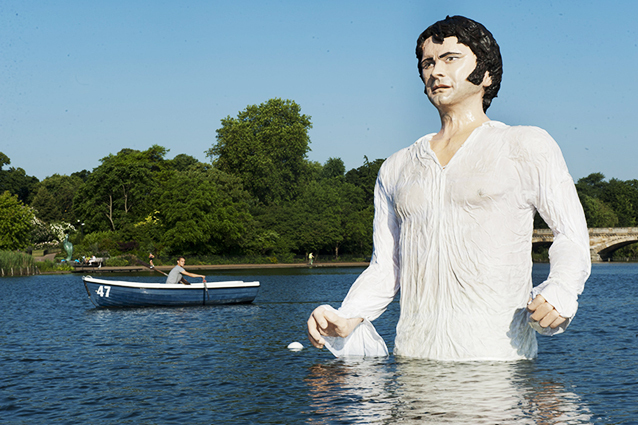
But what’s really interesting about the scene this statue depicts is that it never actually happened. Check out the following clip to see Firth talking about it:
http://www.nbc.com/the-tonight-show/video/colin-firth-never-came-out-of-the-water/2771254
And here’s a clip from the film to prove it:
This mini-series ran in 1995, and now 20 years later, people have mis-remembered a scene from it to such a degree that they’ve voted it the most memorable scene in British television history. Aside from it being an interesting anecdote, why do I bother to bring it up here? Because apologists often tell us that the period of time between Jesus’ death and the first Christian writings (at least 20 years) is not long enough for legends to develop; therefore, Paul’s epistles and the gospels must be recording actual events. Yet in this day of photographic evidence, we have an example of how easily the actual facts can be embellished.
This scene was created simply through the evolution of human memory. No one stood to gain anything by making this up. By the same token, apologists are wrong when they claim that if the gospel accounts aren’t accurate, then they must have been developed by a conspiracy. There’s no reason to believe that at all. Stories change as they pass from one person to another, and 20+ years is an awful lot of time for the telephone game to take its toll.

 Finding Truth
Arch,
Under this line of scepticism what is considered to be credible eye witness testimony?
How about the Great Fire of Rome – Did Rome actually burn?
After all, No one alive now witnessed it, all we have now passed down to us are a handful of secondary accounts by Suetonius, Cassius and Tacitus.
Say someone was to claim – what evidence do we have to suggest that there was such a huge fire in Rome? After all, where is the credible eyewitness testimony?
The primary accounts, which possibly included histories written by Pliny the Elder have been lost. These primary accounts are considered contradictory.
In antiquity, credible eyewitness testimony was written down and collected.
Just would be interested to know, what exactly in archaic times could provide the level of validation you are demanding, we can’t personally ask those who were around in the time of Jesus, just like we can’t verify the accounts made of those who witnessed or were alive during the burning of Rome.
Through these standards could you really even believe that the Great Fire of Rome even occurred?
LikeLike
Arch,
To put the question in another way,
If you used the same standard of scepticism you apply to Christianity on say the Titus become emperor of Rome?
could you really then accept that The Visigoths sacked Rome? or Rome captured city of Veii?
Come to think of it, could you really accept any history of antiquity, whether or not it was supported by a “consensus of scholars”?
Actually, could you be sure anything “really happened” beyond the 17th century onwards?
LikeLike
sorry, meant to write:
If you used the same standard of scepticism you apply to Christianity on say, did* Titus become emperor of Rome?
LikeLike
Smile. I really do have laugh at the tired, worn-out arguments put forward by apologists who repeat the same old diatribe.
For a change, let’s exercise a little common sense and not allow ourselves to get caught up in the utter nonsense being proposed here by the Christian element.
The Resurrection is the key to Christianity. The bottom line is that this is the ONLY aspect that matters.
All the rest is merely smoke and mirrors.
And let’s be very, very clear. The only evidence to work from are the gospel texts. Nothing in Josephus, Tacitus or any other source makes a blind bit of difference to the crucial claims of people like unklee.
There is no evidence to suggest any claims of divinity and this alone is where the conversation needs to be nipped in the bud, and all the Mike Licona’s, William Lane Craig’s, and …unklee’s of the world can stand on their head.
The evidence leads to one conclusion and one alone. The biblical character Jesus of Nazareth as described, is a narrative construct. Period.
LikeLike
Based on the evidence, or rather the lack of it, that you’ve provided me, I would have to say that it can’t be proven conclusively. However, stone chars, and there could well be some archaeological evidence still in existence, though I’ll admit, I haven’t been sufficiently concerned about it to attempt to find any.
LikeLike
Again, much of history is backed by archaeological evidence.
LikeLike
But…but…but…Ark, what about the consensus of scholars….?
LikeLike
Arch,
Fair enough, I didn’t provide a great deal of evidence for The Great Fire of Rome, I honestly don’t know if there is actually a lot available.
the main point I was trying to convey with the example of The Burning of Rome was that:
If the same level of scepticism that some people seemed to have applied to Christianity was extended to be applied in other areas of history, what would they actually accept as historical?
Even considering localised accounts in more recent history, there would be huge gaps of doubt that substantial events even happened,
LikeLike
actually to clarify,
I didn’t provide any evidence for The Great Fire of Rome , I just referenced Suetonius, Cassius and Tacitus as secondary sources, and Pliny the Elder as thought to be a possible primary. The evidence is in their accounts.
LikeLike
Honestly? It really does not matter at all.
The Christian worldview is solely reliant on the character being divine/raised from the dead.
The rest, in terms of point scoring is meaningless.
Let the consensus bleat all it wants.
And you will note that these scholars do not once reference the supposed prophetic Old Testament links to the character Jesus , or discuss his reference to the fictional character Moses and the Law, which brings into the picture the state of mind of Jesus even if one is going to consider him an historical character, which is by no means unanimous.
But crucially, there is no evidence to support a Resurrection as described or believed by Christians.
And there are far more scholars that simply disregard the Christian perspective about the Resurrection.
LikeLike
“Remembrance of things past is not necessarily the remembrance of things as they were.” ~ Marcel Proust
A great post here, Nate. Ark brought it to my attention. A couple of things came to mind. Two being the power of suggestion and mass hysteria. I’ve only skimmed through the first page of comments so I’m not sure if these have been mentioned. But for what it’s worth, I’ll post my two cents.
In 1932, Sir Frederick Barliett conducted an experiment in which his subjects were told a series of stories. Later, they were asked to recall the stories they were told and the subjects embellished the original stories that fit their own pattern of thought (schemas).
One example was a story of a battle. Some subjects claimed — “insisted” — that there were many wounds. Yet the story never mentioned any wounds. Due to their pattern of thought, and the fact that battles tend to inflict many injuries, that part of the story was embellished, and not just by one person.
Professor Elizabeth F. Loftus, from the University of Washington, has done extensive research on the power of suggestion. She showed subjects a video of a car accident. The accident took place at an intersection. Half the subjects were told that the intersection had a yield sign, yet the video clearly showed a stop sign. Later, they were asked to recall details of the accident. The subjects that had been told there was a yield sign indeed recalled having seen a yield sign. The other half remembered accurately. http://southernhoney.hubpages.com/hub/The-Danger-of-False-Memory-A-Psychological-Review
And regarding mass hysteria: I’ll post an abstract of a 1989 study:
——————
“Between April 1968 and May 1971 hundreds of thousands of people reported seeing apparitions of the Virgin Mary over a Coptic Orthodox church in Zeitoun, near Cairo, Egypt. When photographed, these phenomena appeared as irregular blobs of light. Primarily there were two types of events: small, short-lived highly kinetic (‘doves’) and more persistent coronal type displays that were situated primarily over apical structures of the church. More detailed descriptions of the phenomena , such as visions, often occurred as ‘flashes’; their details usually reflected the religious background of the experiment.
The characteristics of these luminous phenomena strongly suggested the existence of tectonic strain within the area. Psychological factors determine more elaborate details of the experiences because there are both direct stimulations of the observers brain as well as indirect contributions from reinforcement history.’ Analysis revealed that ‘luminous phenomena in Zeitoun increased during the month of or the month before an increase in regional seismic activity’
[Derr, John S. & Michael A. Persinger ‘Geophysical Variables and Behavior: LIV. Zeitoun (Egypt) Apparitions of the Virgin Mary as Tectonic Strain-induced Luminosities. Perceptual and Motor Skills 1989, 68, 123-128]”
———————
Anomalous luminous phenomena are generated by brief, local changes in tectonic strain that can precede earthquakes. So basically, they saw a natural phenomena. But because it happened over a church, they associated it with their religious beliefs. All it took was for one person to make the suggestion based on schemas and start mass hysteria. There are many more examples of this. No seismic activity required.
LikeLike
Ooops, the “Danger of False Memories” source didn’t post correctly. My bad. I’ll post it again.
http://southernhoney.hubpages.com/hub/The-Danger-of-False-Memory-A-Psychological-Review
LikeLike
@Victoria
Your “consensus of scholars” makes a whole lot more sense that the biblical ones. Solid evidence always outweighs conjecture.
LikeLike
“Solid evidence always outweighs conjecture.”
I’ll say ‘amen’ to that.
LikeLike
Did unklE send in his nephew?
LikeLike
Some testimony has an agenda, other testimony is mere conjecture or supposition, which is why the credibility of those testifying is important. I always ask what a court would accept. But realizing that we are dealing with people long dead, I also work under the premise of the “death-bed confession” rule – i.e., I work under the assumption that, being religious, they would be more likely telling the truth than not, fearing eternal punishment, and so I allow their testimony, providing that they otherwise fit the criteria of a credible witness – were they there? Did they witness the events for themselves to which they’re testifying, or did they hear it from a friend, who heard it from his cousin, who heard it from his Aunt Mabel? If the latter, witness excused.
Genesis, for example, has Pharaoh giving Abraham camels, in exchange for the lend-lease of his wife in 2300 BCE, while camels, credible archaeologists tell us, weren’t even domesticated until 1000 BCE – gotta go with the archaeologists.
LikeLike
Oh, I know, I was just filling in for unklEgregious, in his absence – he likely won’t be returning until you’re counting sheep or whatever it is you count. This being his Sabbath, he’s probably out knocking on doors, asking people who’d rather be left the hell alone, if they’ve heard the “Good News.”
If I can see them coming, I usually like to answer the door naked, with a can of beer in my hand. They rarely come back.
LikeLike
Fascinating – I’m hanging on to that for future reference. Ya do good work, Kid!
LikeLike
As do you. Thx.
LikeLike
That was my John Wayne, who were you doing, Audrey Hepburn?
LikeLike
The more people such as Unklee are allowed to jam their foot in the doorway of reason, the more they will simply trot out this form of diatribe and attempt to derail any such discussion.
Introducing people like Habermas, who is an outright apologist who teaches at a college that supports Creationism is disgusting. Credibility? It’s laughable! People like Craig and Licona are the same.
Rank apologists and a disgrace.
But again, nothing of what these people say makes any difference to the core issue.
Unklee and his ilk can introduce 10,000 scholars who consider an historical Yeshua really existed.
Before anything they say is afforded any sort of respect at all in this regard, they must be obliged to offer verifiable evidence of their claim pertaining to the divinity of the biblical character, Jesus of Nazareth and the further claim that he is the Creator.
For this is the only reason they are arguing the point of the historicity in the first place.
LikeLike
Nah, I was doing Victoria Neuronotes. =P
LikeLike
“I think the Knock Shrine has some extra evidential support in that there were 2 commissions of inquiry including depositions of witnesses still alive with conclusions that there was not any fraud, that no natural causes could be offered and the testimony of the witnesses was trustworthy and satisfactory.”
Hi Howie. I know nothing about the Knock Shrine, so I assumed your reference was to a rather silly modern miracle claim. I’m sorry, my bad! You were actually saying that both claims were challenging but you nevertheless don’t accept either. Thanks for sorting that out.
LikeLike
I like the analogy, Nate. I never really understood what the 20 or 30 years had to do with a myth creeping in. When thought about logically, that’s why police want more than one eye witness, and even they eye witness accounts differ – sometimes wildly – just mere moments after an event.
Have you ever played the gossip game? You get a group of people in a circle and one whispers a ‘fact’ in the ear of the person next to them. The ‘secret’ gets passed around the entire circle. It’s amazing how much has changed by the time it gets back to the original ‘teller’.
LikeLike
@Ryan, “Under this line of scepticism what is considered to be credible eye witness testimony?
How about the Great Fire of Rome – Did Rome actually burn?”
YES Rome did burn and it matters not who reported it. We have archaeology to thank for the real evidence .
Copied from PBS.com “Archaeologist Andrea Carandini provides the most convincing evidence to corroborate the implication of Tacitus — that Nero circumvented the senate by burning Rome so he could build his palace. Carandini, who has been digging in Rome for twenty years, has examined the ancient layers of ash left behind by the fire. “Everything was destroyed,” he says. “There was not one single house standing.” Specifically, Carandini explains that fire destroyed the portion of the Forum where the senators lived and worked. “All these houses were destroyed, so the aristocracy didn’t have a proper place to live,” he says. The open mall in the middle of the Forum remained, but it became a sort of shopping mall, a commercial center “built on the top of aristocratic Rome … so it’s the end, in a way, of the power of the aristocracy in Rome.”
LikeLike