Recently, the ten most memorable moments of British TV were voted on, and Colin Firth coming out of the lake in Pride and Prejudice won most memorable. To commemorate, a huge statue of Colin Firth has been sculpted and has apparently been making the rounds to various lakes in Britain.
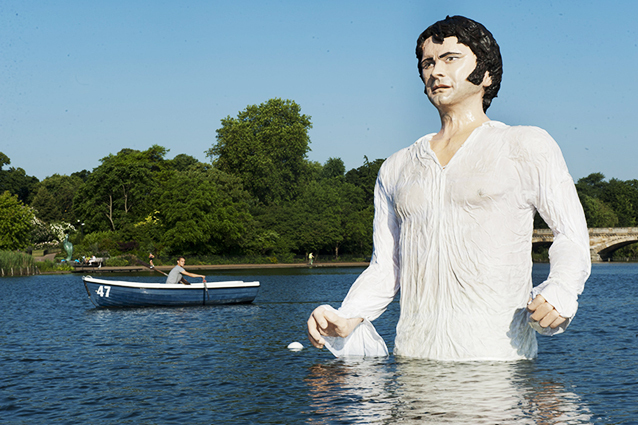
But what’s really interesting about the scene this statue depicts is that it never actually happened. Check out the following clip to see Firth talking about it:
http://www.nbc.com/the-tonight-show/video/colin-firth-never-came-out-of-the-water/2771254
And here’s a clip from the film to prove it:
This mini-series ran in 1995, and now 20 years later, people have mis-remembered a scene from it to such a degree that they’ve voted it the most memorable scene in British television history. Aside from it being an interesting anecdote, why do I bother to bring it up here? Because apologists often tell us that the period of time between Jesus’ death and the first Christian writings (at least 20 years) is not long enough for legends to develop; therefore, Paul’s epistles and the gospels must be recording actual events. Yet in this day of photographic evidence, we have an example of how easily the actual facts can be embellished.
This scene was created simply through the evolution of human memory. No one stood to gain anything by making this up. By the same token, apologists are wrong when they claim that if the gospel accounts aren’t accurate, then they must have been developed by a conspiracy. There’s no reason to believe that at all. Stories change as they pass from one person to another, and 20+ years is an awful lot of time for the telephone game to take its toll.

 Finding Truth
I don’t think Ryan is with us any longer, KC – I believe he realized early on that he’d brought a rock to a gunfight.
LikeLike
Oh Arch, always with the funny business. You keep us all amused. Thought I’d let you know, since demeanor is always an important thing for you, that once you get to know Ryan you’ll find he’s similar to Josh; and we all know Josh is your favorite Christian. You’ll also get used to the fact that he likes to triple, quadruple and sometimes even quintuple post when commenting. @Ryan – it’s ok, we’re all used to it, so no worries, and in fact if you stopped doing it we’d all probably wonder if it was an imposter commenting. 😉
LikeLike
Arch, I think you are right. Further more, I doubt Ryan has spent any time in Rome or he wouldn’t make some of the statements he did. Christians like Ryan want to debate writings because that’s all they have to defend their religion. We have as you have stated many times before, Archaeology in addition to writings.
As I mentioned to unkleE earlier in this post, when you visit the “Holy Land”, the tour guides will use the term, “tradition tells us” 95% of the time. Yes there has been a lot of Archaeology done in Israel but you won’t hear a lot about it on your tour there because it doesn’t always support what the tourists have been led to believe. 🙂 When you visit the British Museum in London, the Louvre in Paris, the Cairo Museum, etc, you are looking at Archaeology not tradition.
LikeLike
Yeah, Josh is alright – CaptainCatholic isn’t bad either, but he does look a little funny in those tights and cape – they just don’t quite mesh with horn-rimmed glasses.
LikeLike
Hey Arch, I’m still here 🙂
Just don’t really have a lot to add at the moment.
kcchief1,
Hows it going? Thanks for the information, I haven’t come across that article before.
“YES Rome did burn and it matters not who reported it. We have archaeology to thank for the real evidence”
I agree that if we have the archaeological evidence then it matters not who reports it, providing that the reporting is accurate.
The archaeological evidence proves there was a huge fire, although can this evidence determine who the fire was started by?
This is where you would have to look at the written accounts available I suppose, if the accounts are reliable.
I have never travelled to Rome, but I’d love to go one day 🙂
LikeLike
Howie,
Thanks 🙂
LikeLike
Sure thing Ryan!
LikeLike
Hope everyone here from US is out of harms way of those tornadoes
LikeLike
Tornadoes have tried unsuccessfully, on three occasions, to get me – I’m beginning to consider myself tornado-proof.
LikeLike
Well I’m glad to read that 🙂
LikeLike
Ryan, you are most welcome and I do hope you get to spend some time in Rome. I have been there 3 times and have just scratched the surface of its ancient history.
LikeLike
The really odd thing about this piece and those who think it shows some point is that there is no question in the story that the Colin Firth Character DOES come out of the water. So as a reflection of the reality of what is in the story its accurate. the only thing it proves is that people will visualize what is real (within the story) even if they do not actually see a particular frame in the film. Not surprising in the least since film is a visual imagination experience
LikeLike
When the first stories were told about the stone being rolled away and an empty tomb was found , you don’t think people could visualize this as well ? Truthful or not ? I would suspect people had more vivid imaginations 2000 years ago . They didn’t have TV, Radio or the Internet to help them. Oral traditions over an open fire surely stirred the imagination.
LikeLike
Kcc you missed the point entirely. Firth coming out of the water WAS FACTUAL to the story. He went in and he comes out. To the extent that viewers polled even had the image in their heads as represented by the statues it would have been a visualization of something factual to the story. As a comparison to the NT it would do nothing but tell us that people visualize what is factual not what wasn’t.
It just doesn’t work logicaly
LikeLike
“As a comparison to the NT it would do nothing but tell us that people visualize what is factual not what wasn’t.”
No you’re missing the point. People visualize what they have been told, not necessarily what is factual.
Nate’s correlation makes perfect sense.
LikeLike
Hey just wanted to throw a question out there,
Since much focus seems to be on looking at arguments why people don’t believe in God
Conversely, what are some of the strongest arguments or cases for God that you have come across? For the sake of balance 🙂
LikeLike
Excellent question! In fact, I think I may add it to my blog!
The only thing I might add is “besides subjective experiences.”
LikeLike
Interesting — not knowing the series, I was glad to hear about it since my daughter and I will be visiting England this summer. Nice to know the myths *floating* around.
LikeLike
@Captain Catholic – sorry I couldn’t leave this directly beneath your comment, as I would have preferred:
With one significant difference, Your Captainship – whatever “historical events” that transpired in Jerusalem that Spring, would have occurred (or not) in “real life,” whereas those “lived experiences” of which you speak, took place only in your collective, subjective, heads.
LikeLike