There’s a passage in Ezekiel that some Christians view as a prophecy that has been fulfilled by modern Israel:
and say, ‘I will go up against the land of unwalled villages. I will fall upon the quiet people who dwell securely, all of them dwelling without walls, and having no bars or gates,’
— Ezek 38:11
How could Ezekiel have foreseen a time in which Israel’s cities would not need walls for protection? It’s true that most modern cities today do not need walls, so does this qualify as an example of a fulfilled prophecy?
I think there are two things we need to look at in examining this. First of all, let’s make sure that Israel really has no walled cities. And secondly, let’s examine the context of this prophecy to make sure we’re not missing anything.
Israel Today
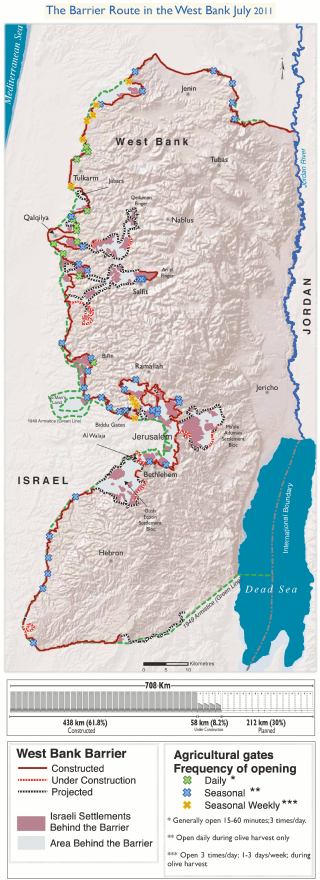 It turns out that Israel actually does use walls today. The West Bank barrier will eventually be about 430 miles long. It’s still being constructed, but as of 2012 it was already 272 miles long.
Most of the barrier is a fence. While that’s not exactly the same as a wall, it serves the same basic purpose. Plus, it uses “bars and gates,” which runs counter to Ezekiel’s prophecy. And some portions of the barrier are indeed tall concrete walls, as shown in these pictures.


Photos courtesy of Wikipedia
In addition to the West Bank barrier, there’s also a barrier between Israel and the Gaza strip. Just like the West Bank barrier, it’s comprised mostly of fence with some concrete sections.
Does the current state of Israel really match Ezekiel’s description?
The Context
If we back up to Ezekiel 37, we see the famous skeleton army that God raised up for Ezekiel. And God tells him (vs 11-14) that the army represents the nation of Israel. Though it seems lost, God will restore it one day — he will be their God, and they will serve him. This is a pretty constant refrain among the prophets, Ezekiel in particular. This refers back to the kingdom of Israel, northern neighbor to Judah. The OT says that Israel and Judah were made up of the original 12 tribes. After the death of Solomon, the northern 10 tribes broke away and formed the nation of Israel (appointing a new king not of David’s line), and the southern 2 tribes formed the nation of Judah. There’s not good archaeological support for this story at this point in time. However, the existence of the two separate kingdoms is quite well attested.
In about 722 BCE, the Assyrian Empire took Israel captive, and the Jewish prophets ascribed this to their failure to serve God faithfully. However, they also predicted that the 10 lost tribes would one day return from captivity. This hasn’t happened.
Ezekiel elaborates even further:
Thus says the Lord God: Behold, I will take the people of Israel from the nations among which they have gone, and will gather them from all around, and bring them to their own land. 22 And I will make them one nation in the land, on the mountains of Israel. And one king shall be king over them all, and they shall be no longer two nations, and no longer divided into two kingdoms. 23 They shall not defile themselves anymore with their idols and their detestable things, or with any of their transgressions. But I will save them from all the backslidings in which they have sinned, and will cleanse them; and they shall be my people, and I will be their God.
Notice that the end of that passage focuses on Israel’s faithfulness to God. Yet that certainly doesn’t match modern Israel. Like most modern nations, its not homogeneous in its religious views. To me, this is one of the first clues that Ezekiel is not talking about today’s Israel. In verses 26 and 27, it says that God’s sanctuary will be in their midst as well. But with the Muslim Dome of the Rock shrine occupying the Temple Mount, it seems unlikely that a Jewish or Christian worship center will ever take its place. Maybe Ezekiel meant that statement figuratively or spiritually, but it’s still something to consider.
In chapter 38, it initially looks like Ezekiel is changing subjects, because he begins talking about Gog, whom he calls a prince of Meshech and Tubal. But this will actually tie right back in to his discussion about Israel. Gog and the other terms are likely being used figuratively in this passage, though it probably doesn’t matter much either way. The point Ezekiel is making is that God will take Israel’s enemies (represented by Gog and those who serve him) and allow them to build up a mighty force to come upon Israel. It’s at this point that Ezekiel refers to Israel as a land of “unwalled villages.”
To me, this does not seem like Ezekiel cares too much about whether the villages literally have walls or not. The point seems to be that Israel will be living in peace and not have any idea that some horrible force might be amassing against them. This allows God to annihilate Gog and his armies, and it will be obvious to all the surrounding nations that God must have been the one to do it, since Israel was in such a defenseless state:
21 I will summon a sword against Gog on all my mountains, declares the Lord God. Every man’s sword will be against his brother. 22 With pestilence and bloodshed I will enter into judgment with him, and I will rain upon him and his hordes and the many peoples who are with him torrential rains and hailstones, fire and sulfur. 23 So I will show my greatness and my holiness and make myself known in the eyes of many nations. Then they will know that I am the Lord.
Again, this does not match today’s Israel. Israel knows that it’s surrounded by nations who are opposed to them, so it seems unlikely that they could be caught unaware. And their level of military might is quite high.
Ezekiel 39 continues the curse against Gog and reiterates much of what we’ve already covered. However, it also says that once God has dealt with Gog’s armies, the people of Israel will take spoils from their remains:
9 “Then those who dwell in the cities of Israel will go out and make fires of the weapons and burn them, shields and bucklers, bow and arrows, clubs and spears; and they will make fires of them for seven years, 10 so that they will not need to take wood out of the field or cut down any out of the forests, for they will make their fires of the weapons. They will seize the spoil of those who despoiled them, and plunder those who plundered them, declares the Lord God.
I suppose language like this could be viewed figuratively, but I find it a bit striking that this language is so obviously suited for the warfare and way of life of Ezekiel’s time, yet some claim that he foresaw a future in which walls would not be needed for cities? If he could foresee that, why wouldn’t he have foreseen technological advances as well?
I feel that these 3 chapters paint a very clear picture. Ezekiel still believed that the 10 tribes of Israel would one day come back. He was certain that his god was the only true God, and he could understand why God might be angry with his people — but abandon them? Surely he would one day restore them. One day God’s people would be mighty and live under his protection — one day they would finally, fully realize those promises that were made to Abraham. I think that’s the future he was looking toward and describing. But even if he meant something else, there’s really no indication that he was imagining anything like the Israel of today.
Some Closing Thoughts
Since Ezekiel gave no timeline for his prophecy, it’s hard to point to it as a failure. In other words, no one would likely point to this passage and say “see, the Bible can’t be inspired because this prophecy didn’t come true.” That’s really a conversation for another post. But can the converse be said? Can someone really point to Ezekiel 38:11 and say that modern Israel is its fulfillment? I just don’t see it. I think the fact that Israel uses barriers today, that its safety and security always seem tenuous, and that the context of this passage seems to be talking about something completely unrelated to modern Israel shows that it is a very poor example of prophecy fulfillment.

 Finding Truth
Mike, it was a bit of fun. I didn’t realise you would be so touchy about it. Let’s not derail the post, shall we?
If it makes you feel better I could apologise?
In the interim, please, I’d like to know, how do you think your god will manifest when he returns?
You do believe he will return at some point, so how do you think will he appear?
LikeLike
” If you come back over and over under different emails and IPs, I guess that’s a game we can play. But I’ll eventually realize it’s you and just ban you all over again. We both have better things to do.”
Honor my request and I see no issues
LikeLike
I think it needs to be realized that Zeke was one of the exiles deported to Babylon in 597 by Nebuchadnezzar. His “prophecies” represented his hopes for a restored Israel, and his last eight chapters were a utopian vision of the Israel of his future – even his “‘dem bones” vision of 37 expressed a firm belief in a forthcoming (in his time) restoration.
No prophecy, just wishful thinking.
LikeLike
Ruth,
I think your questions are right-on. In my bible-reading days (and even since then), I always felt that God was speaking to the Jewish people throughout the OT. Any promises or threats were directed to “his” people. But, as you asked, in today’s world does this apply to only those who are true “Jews” (by race) or to those who are, perhaps, only “half-Jewish” because of intermarriages.
This is just one of the reasons why I find it difficult to accept various bible interpretations. Everything within its pages was written for certain people who lived during a certain time. When we try to interject modern-day thinking into the events and words of age-old scriptures, we frequently misconstrue the actual meaning/message the original writer was trying to convey.
I also feel it’s stretching the point when believers try to claim the cryptic images and events described throughout the bible (especially in Revelations) are relevant in today’s world. It was not at all uncommon for the writers to use imagery to emphasize their message. But when we try to interpret it so as to “make sense” to us today, it’s really about forcing the scripture to fit our preconceived beliefs.
This could be said related to the “walls” and “fences.” I think we need to look at the reason Ezekiel was writing his message. IMO, he was talking about protection. If we look at it from that perspective, does it really matter whether it’s walls … or fences?
LikeLike
It’s official, folks. Mike is now gone. This is part of the comment I left on the current “Kathy” post:
We can now carry on with the conversation.
Thanks, and sorry for the disruption.
LikeLike
[– comment removed for content issues –]
LikeLike
Nate, I just saw this:
“In my opinion, TBlacksman, Ark, and Arch have all stepped over the line in this thread already.” – At the point of this comment, Nate, I had made one – count ’em, one – comment in which I called you a “silly man” in jest, stating, again, jokingly, that you didn’t realize that the “ten lost tribes” of Israel had built boats and sailed to the Americas to become Indians. At that point, that was the ONLY comment I had made on this thread, which really doesn’t hold my interest. I fail to see how that “stepped over the line.”
LikeLike
I’ve gone back and re-read your comment, and I think you’re right that it wasn’t very fair of me to include you in that group. Your comment was a dig against Mormons, but it wasn’t a bad one. I was being hyper vigilant at the time because of how things were going with Mike.
Sorry about that.
LikeLike
Sabio, could you explain why you think nate’s critique of Ezekiel was stretching it?
LikeLike
Has anyone here visited Jerusalem? I have not. I found this interesting:
http://en.wikipedia.org/wiki/Old_City_%28Jerusalem%29
LikeLike
I’m sorry, I meant to quote part of that which I found most interesting:
During the era of the crusader Kingdom of Jerusalem, there were four gates to the Old City, one on each side. The current walls, built by Suleiman the Magnificent, have a total of eleven gates, but only seven are open. Until 1887, each gate was closed before sunset and opened at sunrise. As indicated by the chart below, these gates have been known by a variety of names used in different historical periods and by different communities.
LikeLike
I honestly fail to see how Ezekiel 38 contains fulfilled prophecy. Who still conducts a ground war with horsemen and swords to plunder livestock in an era of long range missiles and stealth bombers? Had Zeke mentioned drones, Tomahawks, Cobras and F-16s being used to secure oil fields and fissile materials, I might take notice. To me, the prophecy fails precisely for what it doesn’t mention.
LikeLike
@ william,
The cities in Israel are not walled — instead, one border with the West Bank. Certainly, compared to old days, Israel is now “the land of unwalled villages”.
So Nate was trying to say, “No, no, look there is a wall!”
That appears a desperate stretch — very desperate.
Look, I don’t believe in prophecy at all, be they Ezekiel’s or anyone elses.
But we have so many good argumentations, we should not throw up our desperate ones.
Just because those who argue FOR these prophecies use desperate stretching, fuzzy arguments, should not tempt us to do the same.
It is as if we are craving for as much solid proof they are wrong, as the opponents want to show that they are obviously right.
They are fuzzy, vague and thus open to all this stretched interpretations.
Actually, it is exactly fuzziness that makes astrological predictions so satisfactory to many folks.
Even the I-Ching (I wrote about here), has that quality.
Fortune Tellers and Prophets no how to do their stuff — keep it fuzzy or do hot or cold reads.
Thanx for asking, william. I hope I answered your question.
Too bad I can’t click on your name to learn anything about you (as you can for me).
Please consider this post.
LikeLike
@ Ron,
I totally agree. There are so many obvious ways to show what these “prophesies” are made of. Well stated.
LikeLike
Ron, I agree with you. In order for this to be “fulfilled” in modern day, you’d have to say that Zeke was speaking literally about walls, but figuratively about everything else. If you can arbitrarily pick and choose when something is literal and when something is literal to match current affairs, then it wasnt a very good prophecy in my mind.
And maybe it is all true, but it was written for the believer and not for purpose of convincing the non-believer… but if that was the case, it shouldn’t be used as evidence for fulfilled prophecy.
LikeLike
Thanks Sabio. I get you and see your point. Thanks for the links as well – i will check them out.
LikeLike
“Sorry about that” – See Ark? TOL’ja I was the good one –!
LikeLike
Wow, that is an idea. Instead of just scolding, chastizing and instructing the habitual, reflexive offenders, I have a suggestion for Nate.
Make some badges ! Awards showing “great tact”, “informative & respectful” or more.
Nate could open up a comment, and put the little .png file right next to the comment section.
Just think Arch, Ark, Mike and more of you then could compete for awards.
Oh yes, a obvious fake rhetoric would be deleted.
Ah, what fun it is to think of sites without the ………. (I’m afraid to say it) 😉
LikeLike
Hmm, that’s actually a pretty cool idea, Sabio! I might work on that…
LikeLike
You couldn’t possibly know, Sabio – ya had to be there – but Ark and I have had a running joke going for the past year, since he got us both kicked off a Christian website – the little girl said she hated to have to include me, because I was the “good one,” but we both had to go. There is NO animosity between the Ark and myself, believe me – except he talks funny.
LikeLike
Oh, arch, I meant to imply no such thing.
And Nate: looking forward to the badges ! 🙂
LikeLike
My take on Ezekiel 38:11 is a little bit different and I’m curious to hear what others think.
When I read the passage and verse a few weeks ago I thought that it sounded like it was saying that the evil plan of verse 10 would be to take the easier attack plan of unwalled villages rather than the typical strategy of going after the big walled cities. Verse 11 says “the land of unwalled villages” which sounded to me like “a place that has a lot of unwalled villages”. But it’s true that a lot of the bigger cities in ancient Israel had walls around them, so I wasn’t sure if there were unwalled villages, let alone a significant amount.
But a little searching seems to confirm my suspicion. While not a strong point, Leviticus 25:31 talks about villages without walls around them at least confirming that there was such a thing back then. More to the point, this document seems to have a lot of information that confirms this viewpoint:
http://discoverarchive.vanderbilt.edu/bitstream/handle/1803/3793/Village%20Law%20and%20the%20Book%20of%20the%20Covenant.pdf?sequence=1
most especially pages 168-169.
Here’s some quotes that most definitely apply here:
From these quotes, it looks like the phrase “a land of unwalled villages” would have definitely applied in Ezekiel’s time. In fact that verse is even mentioned in the above document.
LikeLike
@ Howie,
I agree with you. That seems the most plausible of the interpretations/explanations to me. It seemed to me that some of the explanations were asserting that “all” of the cities would have no walls and that that particular interpretation asserted that the walls had to be “all the way around” the cities where the text doesn’t say “all”.
LikeLike
I misunderstood – sorry, Sabio. But between Ark and me, I AM the good one —
LikeLike
Howie,
You bring an interesting perspective I hadn’t thought of. I just finished re-reading Ezekiel 38 with your idea in mind, and it does seem to fit rather well. I’m currently reading the article you referenced, and I find it really fascinating. Not finished yet, but enjoying it! If I have any further thoughts when I finish, I’ll post another reply.
LikeLike