There’s a passage in Ezekiel that some Christians view as a prophecy that has been fulfilled by modern Israel:
and say, ‘I will go up against the land of unwalled villages. I will fall upon the quiet people who dwell securely, all of them dwelling without walls, and having no bars or gates,’
— Ezek 38:11
How could Ezekiel have foreseen a time in which Israel’s cities would not need walls for protection? It’s true that most modern cities today do not need walls, so does this qualify as an example of a fulfilled prophecy?
I think there are two things we need to look at in examining this. First of all, let’s make sure that Israel really has no walled cities. And secondly, let’s examine the context of this prophecy to make sure we’re not missing anything.
Israel Today
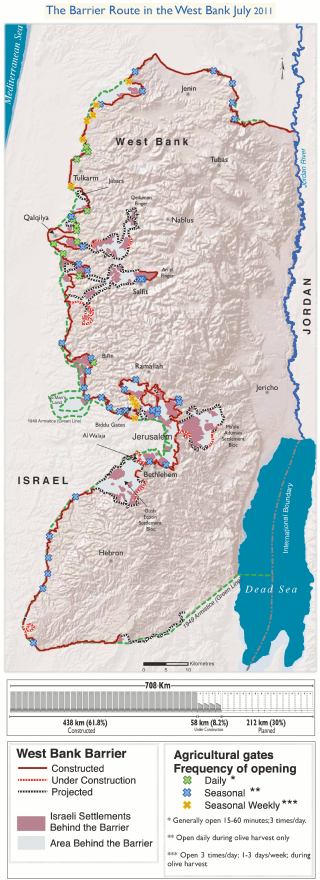 It turns out that Israel actually does use walls today. The West Bank barrier will eventually be about 430 miles long. It’s still being constructed, but as of 2012 it was already 272 miles long.
Most of the barrier is a fence. While that’s not exactly the same as a wall, it serves the same basic purpose. Plus, it uses “bars and gates,” which runs counter to Ezekiel’s prophecy. And some portions of the barrier are indeed tall concrete walls, as shown in these pictures.


Photos courtesy of Wikipedia
In addition to the West Bank barrier, there’s also a barrier between Israel and the Gaza strip. Just like the West Bank barrier, it’s comprised mostly of fence with some concrete sections.
Does the current state of Israel really match Ezekiel’s description?
The Context
If we back up to Ezekiel 37, we see the famous skeleton army that God raised up for Ezekiel. And God tells him (vs 11-14) that the army represents the nation of Israel. Though it seems lost, God will restore it one day — he will be their God, and they will serve him. This is a pretty constant refrain among the prophets, Ezekiel in particular. This refers back to the kingdom of Israel, northern neighbor to Judah. The OT says that Israel and Judah were made up of the original 12 tribes. After the death of Solomon, the northern 10 tribes broke away and formed the nation of Israel (appointing a new king not of David’s line), and the southern 2 tribes formed the nation of Judah. There’s not good archaeological support for this story at this point in time. However, the existence of the two separate kingdoms is quite well attested.
In about 722 BCE, the Assyrian Empire took Israel captive, and the Jewish prophets ascribed this to their failure to serve God faithfully. However, they also predicted that the 10 lost tribes would one day return from captivity. This hasn’t happened.
Ezekiel elaborates even further:
Thus says the Lord God: Behold, I will take the people of Israel from the nations among which they have gone, and will gather them from all around, and bring them to their own land. 22 And I will make them one nation in the land, on the mountains of Israel. And one king shall be king over them all, and they shall be no longer two nations, and no longer divided into two kingdoms. 23 They shall not defile themselves anymore with their idols and their detestable things, or with any of their transgressions. But I will save them from all the backslidings in which they have sinned, and will cleanse them; and they shall be my people, and I will be their God.
Notice that the end of that passage focuses on Israel’s faithfulness to God. Yet that certainly doesn’t match modern Israel. Like most modern nations, its not homogeneous in its religious views. To me, this is one of the first clues that Ezekiel is not talking about today’s Israel. In verses 26 and 27, it says that God’s sanctuary will be in their midst as well. But with the Muslim Dome of the Rock shrine occupying the Temple Mount, it seems unlikely that a Jewish or Christian worship center will ever take its place. Maybe Ezekiel meant that statement figuratively or spiritually, but it’s still something to consider.
In chapter 38, it initially looks like Ezekiel is changing subjects, because he begins talking about Gog, whom he calls a prince of Meshech and Tubal. But this will actually tie right back in to his discussion about Israel. Gog and the other terms are likely being used figuratively in this passage, though it probably doesn’t matter much either way. The point Ezekiel is making is that God will take Israel’s enemies (represented by Gog and those who serve him) and allow them to build up a mighty force to come upon Israel. It’s at this point that Ezekiel refers to Israel as a land of “unwalled villages.”
To me, this does not seem like Ezekiel cares too much about whether the villages literally have walls or not. The point seems to be that Israel will be living in peace and not have any idea that some horrible force might be amassing against them. This allows God to annihilate Gog and his armies, and it will be obvious to all the surrounding nations that God must have been the one to do it, since Israel was in such a defenseless state:
21 I will summon a sword against Gog on all my mountains, declares the Lord God. Every man’s sword will be against his brother. 22 With pestilence and bloodshed I will enter into judgment with him, and I will rain upon him and his hordes and the many peoples who are with him torrential rains and hailstones, fire and sulfur. 23 So I will show my greatness and my holiness and make myself known in the eyes of many nations. Then they will know that I am the Lord.
Again, this does not match today’s Israel. Israel knows that it’s surrounded by nations who are opposed to them, so it seems unlikely that they could be caught unaware. And their level of military might is quite high.
Ezekiel 39 continues the curse against Gog and reiterates much of what we’ve already covered. However, it also says that once God has dealt with Gog’s armies, the people of Israel will take spoils from their remains:
9 “Then those who dwell in the cities of Israel will go out and make fires of the weapons and burn them, shields and bucklers, bow and arrows, clubs and spears; and they will make fires of them for seven years, 10 so that they will not need to take wood out of the field or cut down any out of the forests, for they will make their fires of the weapons. They will seize the spoil of those who despoiled them, and plunder those who plundered them, declares the Lord God.
I suppose language like this could be viewed figuratively, but I find it a bit striking that this language is so obviously suited for the warfare and way of life of Ezekiel’s time, yet some claim that he foresaw a future in which walls would not be needed for cities? If he could foresee that, why wouldn’t he have foreseen technological advances as well?
I feel that these 3 chapters paint a very clear picture. Ezekiel still believed that the 10 tribes of Israel would one day come back. He was certain that his god was the only true God, and he could understand why God might be angry with his people — but abandon them? Surely he would one day restore them. One day God’s people would be mighty and live under his protection — one day they would finally, fully realize those promises that were made to Abraham. I think that’s the future he was looking toward and describing. But even if he meant something else, there’s really no indication that he was imagining anything like the Israel of today.
Some Closing Thoughts
Since Ezekiel gave no timeline for his prophecy, it’s hard to point to it as a failure. In other words, no one would likely point to this passage and say “see, the Bible can’t be inspired because this prophecy didn’t come true.” That’s really a conversation for another post. But can the converse be said? Can someone really point to Ezekiel 38:11 and say that modern Israel is its fulfillment? I just don’t see it. I think the fact that Israel uses barriers today, that its safety and security always seem tenuous, and that the context of this passage seems to be talking about something completely unrelated to modern Israel shows that it is a very poor example of prophecy fulfillment.

 Finding Truth
So I’m sorry I missed all the drama. Of course I got the part where “The BIRD” claimed to be the good one… Again. Anyway:)
I thought I should mention, just winging this out there. Spitballing the idea as they say. You now the primary job of a Prophet is to provide hope. He doesn’t actually have to be accurate or correct in any sense.
Just a little background color.
Don’t ban me when you ban Ark.
LikeLike
@ Haydendliner,
There are lots and lots of flavors of Christianity — yours, perhaps, is OK if the scripture is not literal.
Were’nt the prophets suppose to WARN, instead of give HOPE, btw.
Just a little background color.
LikeLike
Hey. Hey. No stealing my terms. I totally made up background color. But seriously, yeah. Their job is to exhort and rebuke depending on what was needed. warnings usually fell under the category of Rebuke sooooo YES Sabiio you’re right. I hope you’re happy.
What’s the back story on this prophesy from Ezekial? What was it’s intended purpose? Anyone?
LikeLike
“I hope your happy.”
Nah, I am not trying to win something, just improve knowledge — for both of us.
As far as the Sunday School lesson (purpose of Ezekiel), why don’t you tell us.
Oh, yes, and to improve knowledge, please tell us your flavor of Christianity.
Because, depending on the sect of Christianity, the story changes a bit.
LikeLike
Sabio! I don’t want to read Ezekiel!
As for what flavor I am, you wouldn’t like it.
LikeLike
Oh, btw, hay, as you know, Ezekiel is a Jewish book, and for Jews has a Jewish message.
But I know Christians find allusions to their Jesus in the Tanakh, so I am wonder if you be telling us that Ezekiel is really telling us about Jesus and Mary and getting to heaven.
As for anticipating my likes and dislikes of flavors of Christians, I am surprised at your clairvoyance.
I have a whole chart here on the types of Christianity I like more than others. Read there and you can relax your ESP for a while:
http://triangulations.wordpress.com/2009/10/24/my-favorite-type-of-christians/
LikeLike
RE: “Don’t ban me when you ban Ark.” – Yeah, ’cause Hayden is the “not-so-bad one —
RE: “As for what flavor I am, you wouldn’t like it.” – whatever it is, it has nuts in it.
LikeLike
Oh, dear noblest-of-commentors, arch:
I agree, every flavor of Christian I know has nuts in it. But then, every flavor of Atheist I know (and there are lots there too) have nuts in them too.
I’ve been to Skeptic/Atheist meetups where you can find them pretty easily — or on the web, for sure.
Well, I guess it all depends on how you define “nuts” — I actually try to avoid speaking in such general terms.
Arch-birdy: Do you have any intelligent, kind Christian friends? I certainly do. I imagine you do, but I thought I’d ask.
LikeLike
“Oh, dear noblest-of-commentors, arch” – NOW you’re just making FUN of me!
Yes, of course I have – the “nuts” remark wasn’t for all Christians, just for Hayden!
LikeLike
I resent that, you old fossil. With my teeth in I do not sound funny at all. In fact, I sound perfectly normal … for any given value of normal.
Pee Ess. What does animosity mean?
@Nate
What must I do to receive one of Sabio’s badge award things?
Will it be like those little stick-on gold and silver stars we used to get at kindergarten?
Will you be hiring Sabio as your PR officer in the near future?
LikeLike
RE: “In fact, I sound perfectly normal …” – if one can stretch the imagination sufficiently as to consider being a Brit, “normal” —
LikeLike
Ruth’s husband is a Brit. If she reads this, I suspect you are edging out over the thin ice, Arch.
And remember, your ancestors probably came from Mud Island or environs at some point in the distant past – or maybe they were aboard the Mayflower?
LikeLike
Reminds me of this:
LikeLike
“…maybe they were aboard the Mayflower” – nah, it was a rowboat called the Christmas Cactus.
LikeLike
Well, as long as they weren’t the result of some dubious canoodling aboard that ship Noah built.
LikeLike
It might have been a kayak. Or an innertube. It’s been so long ago —
LikeLike
RE: “RE: “In fact, I sound perfectly normal …” – if one can stretch the imagination sufficiently as to consider being a Brit, “normal” –
Normal?!? What’s that?
LikeLike
I want a badge! I want a badge! I haven’t insulted anyone … well, except maybe for Kathy. But she feels insulted by all us “liberals.”
LikeLike
But she feels insulted by all us “liberals.”
I think you’re right, Nan. I think our very existence is an insult to her (even if we aren’t “liberals”).
LikeLike
Her use of “liberals” is, I think, a good illustration of one her problems. If we can define anything how we want, with an arbitrary standard, then we can make any point, to suite any end.
Being completely without bias is difficult if not impossible, yet many of us have changed from one firm position to another. This does not mean we’re right now or that we were incorrect before, but it does show that we have been capable of stepping outside bias, evidence of being truly objective.
There are many positions that I have come upon that i do not agree with, but I can see how or why the individuals with those positions see things that way. I think this is at least a step toward objectivity. of course, there are others that i do not understand at all…
But like the use of “liberals” I think Kathy may have her own definition for “Objective” as well; and to her, “objectivity” means, from what i can tell, “believing in the bible.” In this since she is right, just like her meaning for liberal, being “one who rejects the bible,” is correct with that definition.
It gets confusing because those words don’t really mean those things, but i think redefining words gets easier once you’ve been trying to resolve all the issues in the bible and with christianity for so long, while maintaining that it’s inerrant.
LikeLike
And even though mike is no longer with us, I do hope that we can move on into the other prophecies that he believed were so compelling.
The “prophecies” of the bible were one of the bigger internal problems that eventually helped be leave the faith, once I really began to look at them closely.
I used to focus so much on jesus and his teachings, that didnt even realize that I had never really looked closely at he prophecies that supposedly spoke of him.
I guess i used to view them like the way an idiot teenager views algebra, who’d look at a formula like, .
X + 6 = 52 and say, “who cares what “x” is when I already know the answer.
52 wasn’t really the answer, just part of the question.
The questions are, do these prophecies really point to the actual outcome, were they actually given prior to the “foretold event,” and do they really appear to have come from god?
The outcome of a prophecy isn’t necessarily the answer…. if any of that made sense to anyone…
LikeLike
Being completely without bias is difficult if not impossible, yet many of us have changed from one firm position to another. This does not mean we’re right now or that we were incorrect before, but it does show that we have been capable of stepping outside bias, evidence of being truly objective.
I agree. I’ve even copped to being biased. The challenge to Nate’s integrity over his statements that he would “never go back” because he’s seen too much is unfair, IMHO. You can’t un-ring a bell. I’ve seen his blog as a progression over time. That doesn’t mean that he didn’t examine the evidence with any measure of objectivity. It simply means that at the end of that examination he’s come to some fairly certain conclusions. At least that’s the way I took it. I’m not at all certain why that’s an insult to a Christian.
So if he has examined the evidence, barring some new evidence coming to light, and come to a conclusion maybe he is a bit biased at this point. Biased by his perception and evaluation of the evidence presented.
That doesn’t mean that he, or any of the rest of us, shouldn’t be challenged to stretch our thinking, but there are better ways of doing that than to exchange barbs and insults under the guise of constructive criticism. That’s not what that phrase means.
LikeLike
…and a lot of people defend prophecy by saying that prophecies are poetic, figurative, etc by nature, so it’s unfair to expect very literal language… but why is that?
Maybe it’s because prophecy isnt real, and the only way to pass them off is by presenting vague and riddle like predictions that offer enough leeway to be argued as true or fulfilled under a number of actual eventualities.
Making a very detailed, literal and specific prophecy is much harder to pull off when it comes be guaranteeing fulfillment.
LikeLike
@Nan
Best ask Sabio if you deserve one. but you’ve got my vote 😉
LikeLike
I don;t think Sabio gets my sarcasm. So I’m scewered on getting badge. Where are we on the prophesy argument in Ezekial about the city without walls?
LikeLike