There’s a passage in Ezekiel that some Christians view as a prophecy that has been fulfilled by modern Israel:
and say, ‘I will go up against the land of unwalled villages. I will fall upon the quiet people who dwell securely, all of them dwelling without walls, and having no bars or gates,’
— Ezek 38:11
How could Ezekiel have foreseen a time in which Israel’s cities would not need walls for protection? It’s true that most modern cities today do not need walls, so does this qualify as an example of a fulfilled prophecy?
I think there are two things we need to look at in examining this. First of all, let’s make sure that Israel really has no walled cities. And secondly, let’s examine the context of this prophecy to make sure we’re not missing anything.
Israel Today
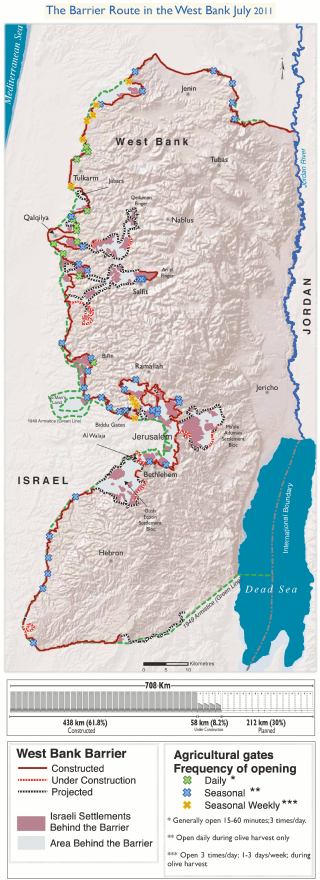 It turns out that Israel actually does use walls today. The West Bank barrier will eventually be about 430 miles long. It’s still being constructed, but as of 2012 it was already 272 miles long.
Most of the barrier is a fence. While that’s not exactly the same as a wall, it serves the same basic purpose. Plus, it uses “bars and gates,” which runs counter to Ezekiel’s prophecy. And some portions of the barrier are indeed tall concrete walls, as shown in these pictures.


Photos courtesy of Wikipedia
In addition to the West Bank barrier, there’s also a barrier between Israel and the Gaza strip. Just like the West Bank barrier, it’s comprised mostly of fence with some concrete sections.
Does the current state of Israel really match Ezekiel’s description?
The Context
If we back up to Ezekiel 37, we see the famous skeleton army that God raised up for Ezekiel. And God tells him (vs 11-14) that the army represents the nation of Israel. Though it seems lost, God will restore it one day — he will be their God, and they will serve him. This is a pretty constant refrain among the prophets, Ezekiel in particular. This refers back to the kingdom of Israel, northern neighbor to Judah. The OT says that Israel and Judah were made up of the original 12 tribes. After the death of Solomon, the northern 10 tribes broke away and formed the nation of Israel (appointing a new king not of David’s line), and the southern 2 tribes formed the nation of Judah. There’s not good archaeological support for this story at this point in time. However, the existence of the two separate kingdoms is quite well attested.
In about 722 BCE, the Assyrian Empire took Israel captive, and the Jewish prophets ascribed this to their failure to serve God faithfully. However, they also predicted that the 10 lost tribes would one day return from captivity. This hasn’t happened.
Ezekiel elaborates even further:
Thus says the Lord God: Behold, I will take the people of Israel from the nations among which they have gone, and will gather them from all around, and bring them to their own land. 22 And I will make them one nation in the land, on the mountains of Israel. And one king shall be king over them all, and they shall be no longer two nations, and no longer divided into two kingdoms. 23 They shall not defile themselves anymore with their idols and their detestable things, or with any of their transgressions. But I will save them from all the backslidings in which they have sinned, and will cleanse them; and they shall be my people, and I will be their God.
Notice that the end of that passage focuses on Israel’s faithfulness to God. Yet that certainly doesn’t match modern Israel. Like most modern nations, its not homogeneous in its religious views. To me, this is one of the first clues that Ezekiel is not talking about today’s Israel. In verses 26 and 27, it says that God’s sanctuary will be in their midst as well. But with the Muslim Dome of the Rock shrine occupying the Temple Mount, it seems unlikely that a Jewish or Christian worship center will ever take its place. Maybe Ezekiel meant that statement figuratively or spiritually, but it’s still something to consider.
In chapter 38, it initially looks like Ezekiel is changing subjects, because he begins talking about Gog, whom he calls a prince of Meshech and Tubal. But this will actually tie right back in to his discussion about Israel. Gog and the other terms are likely being used figuratively in this passage, though it probably doesn’t matter much either way. The point Ezekiel is making is that God will take Israel’s enemies (represented by Gog and those who serve him) and allow them to build up a mighty force to come upon Israel. It’s at this point that Ezekiel refers to Israel as a land of “unwalled villages.”
To me, this does not seem like Ezekiel cares too much about whether the villages literally have walls or not. The point seems to be that Israel will be living in peace and not have any idea that some horrible force might be amassing against them. This allows God to annihilate Gog and his armies, and it will be obvious to all the surrounding nations that God must have been the one to do it, since Israel was in such a defenseless state:
21 I will summon a sword against Gog on all my mountains, declares the Lord God. Every man’s sword will be against his brother. 22 With pestilence and bloodshed I will enter into judgment with him, and I will rain upon him and his hordes and the many peoples who are with him torrential rains and hailstones, fire and sulfur. 23 So I will show my greatness and my holiness and make myself known in the eyes of many nations. Then they will know that I am the Lord.
Again, this does not match today’s Israel. Israel knows that it’s surrounded by nations who are opposed to them, so it seems unlikely that they could be caught unaware. And their level of military might is quite high.
Ezekiel 39 continues the curse against Gog and reiterates much of what we’ve already covered. However, it also says that once God has dealt with Gog’s armies, the people of Israel will take spoils from their remains:
9 “Then those who dwell in the cities of Israel will go out and make fires of the weapons and burn them, shields and bucklers, bow and arrows, clubs and spears; and they will make fires of them for seven years, 10 so that they will not need to take wood out of the field or cut down any out of the forests, for they will make their fires of the weapons. They will seize the spoil of those who despoiled them, and plunder those who plundered them, declares the Lord God.
I suppose language like this could be viewed figuratively, but I find it a bit striking that this language is so obviously suited for the warfare and way of life of Ezekiel’s time, yet some claim that he foresaw a future in which walls would not be needed for cities? If he could foresee that, why wouldn’t he have foreseen technological advances as well?
I feel that these 3 chapters paint a very clear picture. Ezekiel still believed that the 10 tribes of Israel would one day come back. He was certain that his god was the only true God, and he could understand why God might be angry with his people — but abandon them? Surely he would one day restore them. One day God’s people would be mighty and live under his protection — one day they would finally, fully realize those promises that were made to Abraham. I think that’s the future he was looking toward and describing. But even if he meant something else, there’s really no indication that he was imagining anything like the Israel of today.
Some Closing Thoughts
Since Ezekiel gave no timeline for his prophecy, it’s hard to point to it as a failure. In other words, no one would likely point to this passage and say “see, the Bible can’t be inspired because this prophecy didn’t come true.” That’s really a conversation for another post. But can the converse be said? Can someone really point to Ezekiel 38:11 and say that modern Israel is its fulfillment? I just don’t see it. I think the fact that Israel uses barriers today, that its safety and security always seem tenuous, and that the context of this passage seems to be talking about something completely unrelated to modern Israel shows that it is a very poor example of prophecy fulfillment.

 Finding Truth
@Hayden
I think it’s safe to say that Nate did a good job demonstrating the fallacious nature of this prophecy (as with all others) but Sabio and Mike have enjoyed taking him to task for not being 100% accurate ( according to their somewhat pedantic standards) possibly alluding that Nate should go and become fully acquainted with all the subtleties and idiosyncrasies of Hebrew, including the difference between a fence and a wall. How Nate missed this is beyond me…really.
Disgraceful!
Bottom line, it (like the bible in general) simply lacks the words Once upon a time.
LikeLike
Ahhhhhhhhhhh. So, New Post Nate? Hop hop.
LikeLike
Thanks for the compliment, Ark, but I don’t feel like Sabio was taking me to task about anything. I had trouble with Mike because he couldn’t seem to moderate his tone, but I’ve appreciated every one of Sabio’s comments. I’m actually glad that he feels he can disagree with me on a particular point without things getting ugly — I like to have various points of view represented here, and I think he made some excellent points.
Anyway, I just wanted to take the opportunity to say that comments like his are exactly what I’m hoping to encourage here. If we let the blog become too much of an echo chamber, it won’t be worth that much. So I’m glad he posted here, and I hope he continues. I want to make sure we don’t run people off just because they might disagree with us. All this recent business with Mike has made me much more sensitive to the tone that’s set here — I don’t see why we can’t be kind, considerate, and sympathetic, so that’s what I’ll be shooting for.
You know, Kumbaya and all that… 🙂
LikeLike
Kumbaya and all that is cool, but hopefully we don’t have to hold hands – do we Nate? 😉
I’m totally with you on not wanting echo chambers. I also like Sabio’s critiques because they get me thinking.
LikeLike
Only when we pray 😉
LikeLike
Ditto. I spent too many years in a group that tended to shut you out if you didn’t “hold the party line.” One of the things I like about being non-religious is that people are free to hold different opinions on all kinds of things without being ostracized. And I know that some religions are far more open-minded than the one I was in, so despite being an atheist, I actually don’t have too much of a problem with those.
LikeLike
I don’t trust that Sabio. What with his badges and all.
LikeLike
Is Nate going to have a sheriff’s badge? He might need one. And a big stick. 😀
LikeLike
Oh, the gods, I hope not, otherwise he’ll need a deputy and I can already see jumping up and down Sabio waving his hand crying, “Pick me, Nate, pick me!”
LikeLike
can I be executioner?
Although, I am considering holding elections for despot.
LikeLike
I thought you were “William the Conqueror?”… YEAH!!!! Got it!
William the Conqueror. Can I call you WtC for short?
LikeLike
do it.
LikeLike