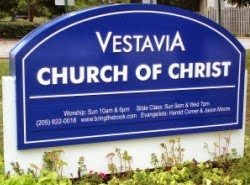
 Last night, my friend Matt and I had an opportunity to go to one of the church services that I talked about in my last post. As I mentioned there, this is a series of lessons surrounding the topic “Can We Believe the Bible?” by an evangelist / college professor / apologist that I corresponded with several years ago, named Doy Moyer. I was excited about going, but also nervous. It had been almost 5 years since I was last inside a conservative Church of Christ, and I knew I would probably see a couple of people that I knew. It was really nice having Matt along for the adventure.
Once we came in and got seated (last row, stage left, which I guess placed us firmly in the “goats” section), I noticed my in-laws sitting in the center section as well as the preacher from their congregation — the same one who was there when I attended. Let me state upfront that I still care deeply for all three of them. My wife’s parents are genuinely great people, and I couldn’t have gotten better in-laws. Granted, things aren’t as good now as they once were, but they’re just as hurt by all that as we are. And the preacher is a great guy as well. We were pretty close, once upon a time.
Anyway, while we waited for the service to begin, the PowerPoint was showing the topics that they plan to cover each night:

- 3/30/15 — How Is Bible History to Be Perceived?
- 4/6/15 — Can We Trust the Gospels?
- 4/13/15 — Have the Gospels Been Hopelessly Corrupted?
- 4/20/15 — Can We Use the Bible to Prove the Bible?
- 4/27/15 — What About God and the Slaughter of the Innocents?
- 5/4/15 — How Can the Bible Really Be Understood?
Those are interesting topics. And though there’s no way I’ll be able to make each one of them in person, I plan to listen to them all. But last night was the second topic, “Can We Trust the Gospels?” It more or less went the way I expected it would.
Moyer started by quoting Simon Greenleaf, who once said something to the effect that every witness should be considered credible until proven otherwise. He then spent some time talking about presuppositions — and this is apparently something he talked about at length during the first session as well. He said that atheists (I don’t remember if he implied “all” or “most”) start with the presupposition that miracles are impossible, so of course they don’t accept the Bible. He also said that when examining the Bible we should avoid modern biases. In other words, he implied that some parts of the Bible might look problematic, but that’s only from our modern mindset. He pointed out that the authors of the gospels displayed historical intent and referenced Luke 1:1 as evidence for that. He also mentioned that CS Lewis was convinced that the accounts did not bear the markers of legend. Moyer stated that the authors seemed to know what they were talking about. And he said that their bias was not a reason to discount their testimony, since we all have bias of some kind or another.
All in all, I didn’t disagree with much of his introduction. I wish he had pointed out that presuppositions can run both ways, but I can’t say I was surprised by that omission. Of course, I disagreed with his assertion that the main reason people reject the gospels is because they’ve eliminated the possibility of miracles. But the rest of his points were decent, in my opinion, though I could tell he was going to take some of them in directions I wouldn’t agree with.
He then got into the guts of his presentation, laying out several arguments that supported his belief that the gospels can be trusted. Much of his information came from Lord or Legend?, by Gregory Boyd and Paul Rhodes Eddy, and Can We Trust the Gospels?, by Mark D Roberts. I’ve read the latter, but not the former. The rest of Moyer’s presentation went as follows:
Were the authors in a position to know?
According to Moyer, some of the gospels make eyewitness claims. This was one of the first statements that really stood out to me. Is that true? I don’t really think it is, but I haven’t looked into it for a while and haven’t had a chance to since last night. I’d be interested in anything you readers might have to say about this claim.
Moyer also asked, if the gospels were fabricated, then why were the names Matthew, Mark, Luke, and John chosen for them? He pointed out that pseudonymous works typically used names that were well known and carried weight: like the Gospel of Thomas, the Gospel of Peter, etc. Why would anyone have used Mark and Luke, since neither of them were eyewitnesses or knew Jesus? In fact, Moyer argued, the anonymity of the gospels suggests legitimacy, since they didn’t feel the need to claim the names of well-known disciples.
But I didn’t find this point particularly compelling. First of all, his point would only hold true for Mark and Luke, since Matthew and John were both very well known disciples. Furthermore, he made it sound as though we didn’t really know why the names Mark and Luke were assigned to these, suggesting that the Christians who began using those names must have known something. But we do know why those gospels are named as they are. Mark carries its name, because Papias said (about 100 years after Jesus’ death) that Mark was simply transcribing dictation from Peter. But the majority of modern scholars don’t accept that claim. And the Gospel of Luke and the Book of Acts are said to be written by Luke, because of some pronoun usage in Acts (Luke was a companion to Paul). But again, most modern scholars don’t accept that position, since parts of Acts are not in agreement with statements made in Paul’s epistles.
Moyer also made it sound like the authorship of the gospels was pretty settled, which is definitely not true, unless he’s only considering the opinions of ultra-conservative scholars.
In all, I didn’t think this point was particularly strong.
Are the copies reasonably close to the originals?
Here, Moyer went through the typical points about the number of manuscripts, how the textual attestation for the Bible is better than any other document from antiquity, etc. These points were pretty accurate, but a little misleading. For instance, while he mentioned that the Greek manuscripts date from about 50 years after the originals to about 1500 years, he didn’t point out that about 94% of those manuscripts date from the 9th century or later, or that the oldest manuscripts are just fragments. Nevertheless, the actual facts he referenced were pretty accurate.
He did point out that he’ll cover this in more detail in the next meeting. And for what it’s worth, I do think that the biblical texts are likely very close to the originals — at least in most cases. In some ways, this is actually a problem for Christianity, in my opinion, since it makes it very hard to claim that all discrepancies are the result of copying errors.
Are the reports consistent with eyewitness testimony?
Here, Moyer referenced things like Aramaisms (the recording of an Aramaic saying in another language, like “Lama, Lama sabacthani”) and references to places and people. Here, he referenced another book, Richard Baukham’s Jesus and the Eyewitnesses.
These points have never seemed especially strong to me. Maybe they should, I don’t know. But when a Spider-Man comic references Barack Obama, or Michael Bloomberg, I don’t suddenly think it must be true. And Aramaic was still being spoken at the time the gospels were written — would it be weird for Greek-speaking Christians who were educated enough to write these gospels to know some Aramaic as well?
The gospels contain self-damaging material
Moyer pointed out that if the gospels were being invented, surely the authors would want to portray the protagonists in the best possible light. Yet the gospels talk about the disciples being inadequate at times, they reference some people thinking Jesus was crazy or demon-possessed, and they show his disciples either betraying or abandoning him in the end. On top of that, the first people to find Jesus after his resurrection were women, who were considered unreliable back then.
But I don’t know many skeptics who think the gospels were pure inventions. Most believe (like most scholars) that the gospel story began as oral traditions that circulated among the believers. I think each gospel was written by someone who believed the bulk of what they were writing. And is there really no value in having stories that show the weaknesses of the disciples? It’s a great way to illustrate the supremacy of Jesus’ wisdom, as well as provide a compelling character arc for the disciples.
Do the gospels demonstrate reasonable consistency?
This was probably the one that bugged me the most. You have to remember that this was being presented in a Church of Christ, and every member of the CoC that I know believes in biblical inerrancy. Yet you can see from the wording of this heading that Moyer was playing it safe with phrases like “reasonable consistency.”
Moyer again stressed that the gospels weren’t written from a modern point of view. He also stressed that there was a difference between a “difficulty” and a “contradiction” and that the bar for proving an actual contradiction was extremely high. He referenced the synoptic problem, but complained that when the gospels differ people say they’re contradictory, yet when they agree people claim it’s evidence of collusion. This is a false dichotomy, of course. Otherwise, no one would ever be able to recognize plagiarism. The simple fact is that parts of the synoptics are direct copies of one another, while other portions of the gospels are diametrically opposed.
Moyer also showed his hand on the subject of inerrancy a bit by stressing that “for core historical events, it’s not necessary to prove flawlessness.”
Is there other literary evidence?
Moyer ended things by talking about the references to Christ and Christians in ancient sources like Tacitus, Seutonius, Josephus, Thallus, Pliny, Trajan, Hadrian, and the Talmud. He didn’t go into details, but did acknowledge that none of these sources corroborate things like the resurrection, etc. But he felt that they did demonstrate some basic things, like Jesus being a real individual, that he died by crucifixion under Pontius Pilate’s authority, and that Christians believed in the resurrection.
I didn’t have any real problems with his points here.
Conclusion
He didn’t say much in the conclusion, other than again stressing the problem with an a priori position that miracles are impossible.
He opened the floor up for questions, and he got a few. Nothing major. I couldn’t pass up the opportunity to jump in. I didn’t want to be a jerk — that would have been the wrong move with my in-laws, and they were the only real reason I was there. At the same time, I figured that most people in the audience hadn’t realized how soft Moyer’s position on inerrancy is. And while I think that’s appropriate for a Christian who’s aware of all the information, I knew that he was essentially pulling one over on everyone there. Most of them view inerrancy as a major piece of evidence for Christianity, but that’s not how Moyer sees it.
So I raised my hand (I was pretty nervous, I have to admit), and when he called on me, I asked, “It seems like the authors you’re quoting from imply that inerrancy isn’t very supportable… am I understanding that correctly?”
To me, he seemed uncomfortable, and he didn’t really answer the question. He talked about first needing to determine what the gospels were trying to say. Then, based on their historical reliability, one could think more about things like inerrancy. As a Jesus follower, he would need to establish what Jesus thought about scripture and inerrancy and then follow that.
As you can see, he didn’t really say what he believed Jesus’ position on that was. He was trying his very best to be noncommittal on the subject of inerrancy. I’m not sure how noticeable that was to everyone else, but maybe they picked up on it.
After the service, Matt and I walked over and spoke to my in-laws and the preacher from my old congregation. Matt knows all of them as well. The interaction was friendly — a little awkward maybe, but still friendly. I also introduced myself to Moyer, but I don’t think he remembered me from our previous correspondence.
All in all, I’m glad I went. My in-laws are obviously attending all of these, and I want to know what they’re hearing. We should get an opportunity to discuss all of it at some point, and I’m looking forward to that. It was still weird being in a church, though. 

 Finding Truth
Yeah Gary, I think that’s the case for a lot of Christians. Some nuance this and accept that miracles happen across all religions. That obviously can get a little tricky though as well.
Also, I think the bar location is so imprecise that it’s not too clear where it even lies, and that’s where a lot of discussions on it end up being somewhat fruitless. Not completely fruitless, which is why I’m still out here, but enough to be frustrating.
LikeLike
The conservative/orthodox Christian belief system rests entirely on the historicity of one miracle: the Resurrection of Jesus.
Mormons have 13 signed affidavits of known men who testified to being eyewitnesses to their miracle claim. Christians have four anonymous books that testify to a walking/talking dead man. Yet, the better Mormon evidence does not meet the “bar” for Christians.
Bottom line: the Christian belief in their miracles is not based on a standard or bar but on the desire to confirm what one has already chosen to believe.
LikeLike
Our Good Friday post has a link to a newly revised Scriptures from Jesus if you are interested, love and light Scott.
LikeLike
unkleE, “I don’t think Papias is the reason why the gospels have the traditional names. I think Bauckham and others say that while the names aren’t in the text, they were most likely written on the outside of the scroll. So the names, right or wrong, were quite likely those by which they were popularly known even before Papias.”
If the names were most likely written on the outside of the scroll, why did these copyists who most Christians claim were so attentive to detail , FAIL to copy these names as well ?
Either the copyists were human Xerox machines (as many Christians like to claim) or they were just human.
LikeLike
Hi Scott, what do you mean ‘newly revised Scriptures from Jesus’? Are you referring to new revelation that is not in the Bible?
LikeLike