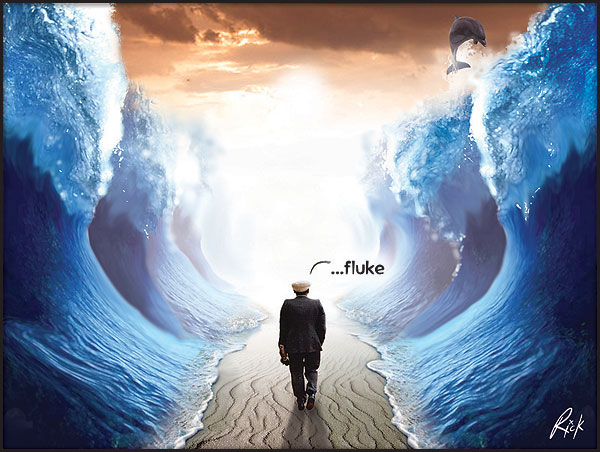
I like the above image, because it’s so absurd. Not that the miracle itself is absurd, but that someone could see such a thing and still dismiss it.
A while back, we had a discussion on this blog about the effectiveness of miracles. Not the “oh, my aunt has a friend that knows someone who had back pain until it was prayed over and now it’s gone” variety, but amazing, in-your-face miracles that simply can’t be explained. Like seeing a man walk on the sea. Or seeing someone whose legs are atrophied because he was lame from birth suddenly begin running and jumping on legs that have been fully restored. Or seeing an ocean separate before you so that you could walk on dry land between two walls of water. In other words, the kinds of miracles talked about in the Bible.
What would it be like to witness something like that?
Before we tackle that question, let’s consider the actual purpose of miracles in more detail. Take, for example, the account of Peter and John healing the lame man in Acts 3. Here, Peter and John encounter a man at the gate of the temple who had been lame from birth. He asked for alms, but Peter replied that he had no silver or gold; instead, he commanded the lame man to walk in the name of Jesus. Of course, the lame man was then able to leap up and run around. This was a marvelous thing to do for a lame person — and obviously, one of the main reasons Peter and John healed him was because they had compassion on him.
But it’s also apparent that the miracle served another purpose:
And all the people saw him walking and praising God, and recognized him as the one who sat at the Beautiful Gate of the temple, asking for alms. And they were filled with wonder and amazement at what had happened to him.
While he clung to Peter and John, all the people, utterly astounded, ran together to them in the portico called Solomon’s. And when Peter saw it he addressed the people…
— vs 9-12
Peter suddenly had the attention of everyone who saw the miracle or recognized the lame man. And that’s no surprise. Just imagine how you’d feel if you had witnessed such a thing — if you had seen the atrophied legs grow and take shape. Wouldn’t you be inclined to listen to whatever Peter and John might have to say? You’d already be inclined to believe something fantastic, because there’s no natural explanation for what you would have witnessed with the lame man. And as we see in verse 4 of the next chapter, many of the witnesses believed what Peter and John said and became Christians.
The Bible is actually fairly consistent in its use of miracles. For instance, John 20:30-31 says this:
Now Jesus did many other signs in the presence of the disciples, which are not written in this book; but these are written so that you may believe that Jesus is the Christ, the Son of God, and that by believing you may have life in his name.
In Genesis 41, when Joseph has an opportunity to decipher the meaning behind Pharaoh’s dreams, he first recounts the dreams back to Pharaoh (something he couldn’t have known on his own) as a sign that God is speaking to him. Centuries later, when God tells Moses to go to Egypt and deliver the Children of Israel, God performs miracles so Moses will have faith in his power. During Moses’ discussions with Pharaoh and the subsequent Exodus, miracles are used many times to show people God’s will. Gideon was shown miracles so he would trust in God’s instructions. In the New Testament, Jesus performed many miracles to show people that he had been sent from God, and his apostles later followed suit. Thomas was allowed to touch the wounds in Jesus’ hands and side, since he was having trouble believing what he was seeing. Paul was given a miracle on his way to Damascus to show him that his persecution of Christians was wrong.
Throughout the Bible, miracles are used as evidence. They are used to convince people who were not convinced by other means.
So if that’s how God operated in the Bible, why don’t we see miracles today? Again, I’m not talking about the anecdotes you hear about someone’s back pain going away. I’m talking about real, immediate miracles that can be witnessed. There’s a book and website called Why Won’t God Heal Amputees? It’s a great question. Just imagine what a game-changer it would be if you turned on the major news networks one day and saw a person’s limb grow back through the power of prayer. And not just that person’s, but many others as well. How could such an event be explained away?
So why doesn’t God do that? If he performed miracles in the past so that people would believe, why doesn’t he do it now?
Some believers will say God doesn’t do those kinds of miracles today, because they don’t convince many people. To illustrate this, they point to the episodes in the gospels where Jesus performed a miracle, but it failed to convince the Pharisees and other religious leaders of the day. But really, how likely is this? If you were to witness an amputee’s leg grow back, would you really deny it? What would you have to gain by doing so? If someone demonstrated that kind of power, wouldn’t you want to know whatever message they had to give?
And if that were true about the Pharisees and chief priests, etc, why did Jesus bother doing the miracles? And why does the Gospel of John say that the miracles were performed so that people could believe? Obviously, the miracles must have been at least somewhat effective — and if God wants everyone to be saved, wouldn’t even one additional person’s belief be worth doing those kinds of miracles today?
In fact, if you really think about it, when the gospels repeatedly say that Jesus’ miracles failed to convince the religious leaders of the day, it probably says much more about the quality of the “miracles” being performed than it does the mindset of those who weren’t convinced.
When it comes down to it, most people are not obstinate enough to deny reality when it’s staring them in the face. Think of every movie you’ve ever seen where one character is trying to convince another of something fantastic. Let’s take Back to the Future as an example, since most people should be familiar with it. When Marty was trying to convince Doc Brown that he was from the future, Doc was very skeptical. Even when Marty tried to prove it by saying who was President in 1985, etc. Those were all details that could have been made up. But once Marty could explain how Doc Brown got the bump on his head, Doc realized Marty could not have known that through sheer intuition. And finally, the most logical explanation for everything was that Marty was telling the truth and had actually come from the future. But if Doc had held out and refused to believe even if Marty showed him the DeLorean and took him on a trip through time, the story would have lost its believability — and not because of the time travel premise.
In the same way, if it became a known fact that prayer could visibly heal people of egregious injuries, there would be no rational reason to dis-believe it. In other words, to answer our original question, miracles would be very convincing. And there doesn’t seem to be any good reason why God would refuse to use them. So the fact that they don’t happen is very good evidence to me that the Christian god is simply imaginary.

 Finding Truth
Here’s the humorous version.
If you still believe Santa is going to drop down your chimney and bring you presents, you are in Stage 3.
If you have found out there is no Santa and you’re still mad at your parents for lying to you, you’re in Stage 4.
If you have started playing Santa for your children, you’re in Stage 5.
If you’ve set up a National Charity through which parents are able to access gifts and necessities for their children, called it Santa’s Workshop, and donated your income to it, you’re in Stage 6.
LikeLike
Nice! 🙂
LikeLike
I think this also goes along with the Topic we have been discussing . It’s from a book I am currently reading.
The most constant threat to a Worldview carefully constructed of “revealed truth” is reason. In a reasoned world, the idea of truth is dynamic. It hasn’t been revealed once and for all, and so opening up the doors to new ideas and concepts is part of every day life. Reason distrusts revelation in the same measure as it is distrusted by revelation. It relies on observation, reflection, critical thinking, and testing by experimentation, and it builds on what is learned in this way from generation to generation to expand knowledge and understanding.
LikeLike
Hi kcchief1,
Hopefully this comment will tidy up some loose ends.
“I honestly feel this case along with 1000′s of others do parallel Dr Krandall’s. They are all pronounced dead by qualified Medical Professionals only to actually be alive.”
I wonder whether this is true. Can you offer any examples of such cases? The one you did offer proved not to be a parallel at all. After all, we are talking about evidence.
“Where does your Dr Krandall say ,”but deterioration had indeed begun” ? “Pitch black” is a skin condition which usually occurs later than 40 minutes.”
He is quoted in this source. I too was surprised that he was turning black after 40 minutes or whatever, but that is what he said. Note I didn’t say “decomposition” had begun, just “deterioration”, which is my choice of word and hopefully fairly represents the situation.
“You can finds lots of miracle stories outside of Christianity. Islam claims many miracles. Since they claim Abraham as their Father as well, are their miracles any less valid than Christianity’s ?”
I do not suggest we dismiss Muslim miracle stories. I suggest we treat all stories as evidence. Once investigated, they may become evidence of fraud, or mistake …. or of something highly unusual.
“I used to be a hard core believer like you unkleE and Josh and Kent. That was until I started reading the Bible with an open mind and started verifying what I read. If you haven’t already, read “Farwell to God” written by Charles Templeton.”
Is your implication that because I have remained a christian, I cannot have read the Bible with an open mind? For the record, I have been a christian for 50 years, I have read the Bible right through several times, I have done a degree in theology, I read widely both christian and non-christian scholars, I have changed and adapted my beliefs many times and in many ways. I am aware of Templeton but haven’t read his book.
But I can say that I have read (in books or on the web) many, many ex-christians’ stories, and I think they almost all left christianity over matters that I don’t actually believe either. Most, including Nate here (on his own admission), followed a form of christianity that was “fundamentalist”, in some senses anti-intellectual (i.e. they didn’t follow the views of the best scholars) and ultimately untenable. In many cases, I would say it is good they left that form of christianity. Some later return to a (in my view) better understanding and a renewed faith.
“I’m really not trying to Poo Poo Miracles. They have merely vanished with reason.”
And as I have said before, I am not trying to convince you of their truth – simply trying to make the evidence clear and clear away the factually wrong ideas.
The miracle reports haven’t gone away at all. It has been estimated that about 300 million people around the world claim to have experienced or observed a miracle. Many, many reports have plausibility (i.e. we can be sure something unusual occurred, and there is no natural explanation). If a person is determined not to believe, they can always find a reason. If a person is determined to believe, they will. But I suggest a middle course, of investigating and concluding, supported by the evidence, that genuine miracles are a possible explanation.
Thanks for the discussion. I think I have said pretty much all I want to say (and more besides! 🙂 )
LikeLike
unkleE, I have always believed you are sincere with your comments. I also have never doubted you to be a well educated Christian with far more formal education on the subject than I will ever have.
Having said this, we have shared our thoughts on a controversial subject to which there is no definitive answer at this time. It is my belief that Medical Science will eventually explain this phenomenon .
As far as evidence, I think I have provided evidence during my comments as well. I provided a link which showed the Doctors at Lourdes do not use “Miracle” but leave that to the local Catholic Bishop to do. There a numerous articles on the Internet about people being pronounced dead and being revived. You surely didn’t mean the contrary.
I too came from a Fundamentalist background. Yes it had its quirks, but are you really able to tell Nate, Me, and the World which form/s of Christianity is/are the “Right One/s” and which ones to avoid ? If it has come down to this, shouldn’t Christianity just be avoided all together ?
I really would encourage you to read Charles Templeton’s book, Farewell to God. He would be more on your educational level and I think you would better understand why some of us left Christianity.
Thank you as always for taking the time to address my comments. I wasn’t a big fan of yours in my early days on this blog, but I am understanding you a little better and do have a respect for your opinions. You would make a good Deist ! 🙂
LikeLike
I thought I was done with this topic but had to share an article I just now found. This was published in April of 2013 so it’s very recent.
Sam Parnia, head of intensive care at the Stony Brook University Hospital in New York, is working to convince the medical establishment that if death is managed properly, it’s possible to bring people back to life hours after current techniques would have failed.
“It is my belief that anyone who dies of a cause that is reversible should not really die any more,” Parnia told The Guardian’s Tim Adams. “That is, every heart attack victim should no longer die. I have to be careful when I state that because people will say, ‘My husband has died recently and you are saying that need not have happened.’ But the fact is heart attacks themselves are quite easily managed. If you can manage the process of death properly then you go in, take out the clot, put a stent in, the heart will function in most cases. And the same with infections, pneumonia or whatever. People who don’t respond to antibiotics in time, we could keep them there for a while longer [after they had died] until they did respond.”
Parnia, who has written a book titled, “The Lazarus Effect,” believes advances in resuscitation like cooling the body to preserve brain cells and keeping the level of oxygen in the blood up can give doctors more time to fix the underlying problem. If doctors move away from CPR and toward these types of resuscitation steps, he said they can double survival rates and prevent people from coming back with brain damage.
Although Parnia willingly uses the word “soul” to describe the individual self of the person needing to be resuscitated, he said he does not have a religious way into either his science or his ongoing research into near-death experiences, or what he calls, “actual death experiences.”
“I don’t have any religious way into this,” Parnia said. “But what I do know is that every area of inquiry that used to be tackled by religion or philosophy is now tackled and explained by science. One of the last things to be looked at in this way is the question of what happens when we die. This science of resuscitation allows us to look at that for the first time.”
According to Parnia, the longest dead time he knows of happened in Japan, where a girl had been dead for more than three hours, was resuscitated for six hours and is now “perfectly fine.”
LikeLike
Hey kcchief1-
What is true Christianity?
“Now, brothers, I want to remind you of the gospel I preached to you, which you received and on which you have taken your stand. By this gospel you are saved, if you hold firmly to the word I preached to you. Otherwise, you have believed in vain. For what I received I passed on to you as of first importance: that Christ died for our sins according to the Scriptures, that he was buried, that he was raised on the third day according to the Scriptures, and that he appeared to Peter, and then to the Twelve.” -1 Cor 15:1-5
Anyone who teaches this is teaching true Christianity. Anyone who teaches something different is not teaching true Christianity.
LikeLike
Josh, you need to ask unkleE. He was the one who said,”Most, including Nate here (on his own admission), followed a form of christianity that was “fundamentalist”, in some senses anti-intellectual (i.e. they didn’t follow the views of the best scholars) and ultimately untenable. In many cases, I would say it is good they left that form of christianity.”
I simply asked unkleE, “are you really able to tell Nate, Me, and the World which form/s of Christianity is/are the “Right One/s” and which ones to avoid ?”
Since you’re quoting scripture, I’ll stick with Jame’s no frills definition of religion.
James 1:27
New International Version (NIV)
27 Religion that God our Father accepts as pure and faultless is this: to look after orphans and widows in their distress and to keep oneself from being polluted by the world.
LikeLike
kcchief1-
I don’t need to ask unkleE to answer your question about what is true Christianity. If you are “pure and faultless” in what James describes in that verse, then you don’t need the Gospel and don’t need to be Christian. I am not, so I will stick with the Gospel.
LikeLike
Josh, I’m not reading James the way you are. He is describing the “religion” that God accepts as pure and faultless NOT people who are pure and faultless. You need to read that again or tell me where I am wrong in the way I am reading it.
LikeLike
I certainly wasn’t saying I was pure and faultless. I was saying that I agree with James that to follow a religion that God considers pure and faultless one would need to help the widows and orphans and not let the world pollute you first and foremost.
LikeLike
kcchief1-
I read that differently, yes. I read it in the context of what the Gospels and other NT writers taught. You can read that verse of James on its own, but that is not the way I read it.
LikeLike
Josh, with all do respect, I don’t how you could read it any other way than it was written.
27 Religion that God our Father accepts as pure and faultless is this:
pure and faultless are only attached to the word “Religion”
He goes on to say in order to follow this pure and faultless Religion, “people” need to look after orphans and widows and to keep from being polluted from the World.
James was an “Actions speak louder than words” kinda guy and that’s why I like and agree with him.
Sorry for the confusion and thanks for your comments/
LikeLike
I’m just saying I don’t read James in a vacuum. I was using his words – which, yes, are connected to “religion” – to express a point that is taught throughout the NT: that we miss the mark and need Jesus for reconciliation with God. Even if you do read James in a vacuum I think you’d see that the implication is that you must keep this “religion” perfectly in order to earn any rewards. Later in his letter he writes that the man who keeps the whole law except one part will be found guilty of breaking the entire law. He’s definitely teaching that we need to keep the guidelines perfectly in order to reap the rewards.
LikeLike
Josh, you’re reading a whole lot more into this than I am capable of following. Sorry.
I am a simple man with a simple mind. That’s one of the reasons why I gave up Christianity, it just became way too complicated.
And now you tell me I can’t just hold onto James 1:27 and live happily ever after…….
LikeLike
“Thank you as always for taking the time to address my comments. I wasn’t a big fan of yours in my early days on this blog, but I am understanding you a little better and do have a respect for your opinions. “
Thank you kcchief1, this is a nice and peaceful way to wind our discussion down, and I appreciate it.
” You would make a good Deist ! “
🙂 That’s a nice thought, for I think I am only an indifferent christian.
“It is my belief that Medical Science will eventually explain this phenomenon .”
That’s fine, I was never trying to change your opinion, only wanting you to base your opinion on as good an understanding of the evidence as possible.
“There a numerous articles on the Internet about people being pronounced dead and being revived. You surely didn’t mean the contrary.”
I’m sure there are, but I am not arguing that they are genuine miracles, only that this one appears that it might be. And before we can extrapolate from them to the Crandall case, we have to show that they are similar, which the previous example appeared not to be.
Best wishes.
LikeLike
kcchief1-
The foundational truth of Christianity is a simple one: the good news of Jesus’ life, death and resurrection. If you take each letter and read it as if it has no connection to the rest of the story I can see why it would seem complicated. If you take them as pieces of a whole much of it becomes clearer. At least that’s what I’ve found. But, even then, we humans only see “as through a cloudy mirror”. I’m ok with not being able to comprehend, explain, and defend everything about God. Frankly, if I could do that I’d wonder if God was really a being worthy of worship. If I can fully comprehend him, he can’t be that great.
LikeLike
unkleE, here is an interesting article from a British Doctor who specializes in resuscitation. He says,”The longest I know of is a Japanese girl I mention in the book,” Parnia says. “She had been dead for more than three hours. And she was resuscitated for six hours. Afterwards, she returned to life perfectly fine and has, I have been told, recently had a baby.”
Now you can accuse me of “Flogging that horse” 🙂
http://www.guardian.co.uk/society/2013/apr/06/sam-parnia-resurrection-lazarus-effect
LikeLike
Josh and kc,
I’m pretty interested in the direction the conversation is headed regarding “true” Christianity. I’ve just put up a new post to kick off a discussion about it, and I’d love to hear what you think over there…
https://findingtruth.wordpress.com/2013/07/11/discussion-what-did-jesus-teach/
LikeLike
For a Christian to deny the possibility of miracles is tantamount to denying their god, Yashua.
Have faith(sic), all things pass and the rubbish of religion will eventually do so too.
Much has happened in the drive towards universal common sense and the eventual implosion of this nonsense and look how far we have come since the arrival of the Internet.
Let us remember that once upon a time it was punishable by torture for reading the bible in English. Good old Thomas Moore, bless him.
That there was such a thing in the statute books as The Blasphemy Act that forbade any professing Christian from stating that the bible was fallible or deny the Trinity.
I feel confident that only a few years ago Nate would have recoiled in horror at the mere thought of becoming an Atheist. it would have driven him into a fit of depression.
And now look? Atheist as they come.
So, as daft as the likes of Unklee and Josh are we must be patient with them , I guess, for ignorance is curable.
Lets just hope and pray they are not suffering from terminal stupidity.
Bless their cotton socks.
Dominoes Spirits and Sanctions…or whatever it is the Catholics say, Right?
Ah…men and women too of course.
LikeLike
Very true. The times, they are a-changin’.
Nice… 😉
LikeLike
Hi kcchief1, just as I thought we were laying this discussion to rest! 🙂
I too have been interested in Sam Parnia for a while, though I haven’t read his book. I think this example comes a lot closer to the point you want to make than your previous example, but still misses the point.
1. My point has never been that miracles, or any particular miracle, can be proven. I have always said that many alleged miracles were almost certainly natural phenomena or fakes. And I have said that some are plausible, and show that something very unusual happened. So there are so many plausible miracle claims, that it strains credulity (and statistics) to believe that they all have a natural explanation, in many cases as yet unexplainable. (See Miracles and probability.)
So even if the Crandall story did have a natural explanation, it is just one of dozens I referenced. How many times can someone say credibly that there is a natural explanation but we just don’t know what it is?
2. But the Parnia example fails as a comparison, just as your previous example did. Parnia says that “the drastic cooling of the corpse to slow neuronal deterioration and the monitoring and maintenance of oxygen levels to the brain” can allow patients to survive for hours of brain death if they are treated in the way he recommends.
Now the Japanese girl you refer to was “dead for more than three hours” and “resuscitated for six hours”. I don’t quite know how that sequence of events worked, but clearly she was given intensive treatment that continued. Quite possibly it included “drastic cooling”.
That wasn’t the case for Crandall and the emergency team. There is no mention of any cooling, and resuscitation was discontinued after 40 minutes or so, following what seems to be normal practice. (This was in 2008, and Parnia admits that even now his ideas “have not yet become accepted possibilities in the medical profession”.) So Parnia’s conditions were not fulfilled.
You might be able to argue that had Parnia’s procedures been followed, Jeff Markin would have recovered naturally, but that is hypothetical.So what we have is a team using conventional procedures being unable to revive a patient who suffered a massive heart attack, stopping the resuscitation, the man’s skin beginning to turn black, and then after the man is prayed for, he recovers remarkably.
Yes, it was medical science that did it, but medical science that had failed for 40 minutes, and then worked when all hope was lost, but the doctor prayed. As Craig Keener comments after investigating thousands of apparent miracles, unusual recoveries seem to cluster around people who pray for them.
3. Parnia is interesting also for his investigation of near death experiences (NDEs), which he prefers to call After Death Experiences. He says that it is clear that the mind has experiences even when the brain is dead, a ‘fact’ also identified by neuroscientist Mario Beauregard. This seems to challenge everything we are told about the physical world. This won’t bother you as a deist or me as a christian, but may challenge other readers here.
4. Finally, I want to challenge your approach here (hopefully without offending you). You have argued all along that miracles cannot occur, especially the Crandall miracle story. When confronted with the evidence I offer, you appeared not to approach it in an open-minded way (am I right in observing that?). Instead you quickly brought up one, and then another, apparent counter-example. Except both proved to not make the point you hoped to make. That leaves us back at the start with the multiple examples I have referenced. But your mind seems to be made up regardless of the evidence.
Doubtless the same could be said about me. But it isn’t so. I could still believe in God if all miracle claims were proved to be false – I have many other reasons to believe. So I feel quite free to examine each case, reject most, accept as probably true (but not certain) a few.
So it seems to me that you as a deist refuse to look at the evidence open-mindedly, but offer evidence which you expect me to consider. How does that work? I suppose it is a complement to me that you would have that expectation, and I hope I live up to it. But my challenge is that you consider the evidence as openly as you would like me to in stead of rushing to point to cases which appear to prove your scepticism, but don’t.
Best wishes, and thanks for the interesting matters raised.
LikeLike
unkleE, yes this could go on and on. And yes, I think I could say many of the same things about you. I think your definition of evidence is different than mine. I have seen some of your posts in other blogs and you tend to feel if you provide lots of reports and say that there is an overwhelming concensus , that provides all the evidence you need. It is my opinion Dr Krandall wouldn’t be your “Poster Boy” if we wasn’t a Christian. I did notice in your attempt to prove miracles , there were no examples provided unless Christians or Christianity was involved. (Lourdes, Krandall, etc)
I think we can agree on something even more important than miracles since even you admit you don’t need miracles to believe in God. I don’t either.
Thank you for your comments.
LikeLike
unkleE, I should have said most not all of your miracle evidence featured Christians as I don’t recall reviewing every link you provided.
I also tend to agree with Nate, if Dr Krandall was so confident to pray for Jeff, why did he also feel compelled to order a technician to pick up the paddles and have science assist him ? God didn’t need the paddles , did he ?
LikeLike
Hey Nate,
I became weary with Pentecostalism, and tried out the Southern Baptist denomination throughout my last few years of Christianity. Like you, the churches in the SBC that I affiliated with did not believe in tongues, miracles, and other signs. I have had other former Southern Baptists tell me that their churches believed in deliverance. Personally, I’m a little surprised by that.
Regardless of what type of church I attended, Pentecostal, Southern Baptist and many different ones in between, I had a great trust in God. I continued to pray earnestly in tongues. I believed that He always had my best interest at heart. I prayed for many, many years for Him to give me better eye sight, we’re talking about 30 years here. Desperately, I sought Him for healing in so many areas of my life. Yes, at one time, a miracle would have given me great encouragement in my faith. However, in the last couple of years of my Christianity I probably would have just had the attitude of “well, it’s about time”.
I have only been an atheist since Easter of last year, and I would have to admit that a miracle would more than likely not re-convert me into Christianity. As a non-believer yourself you understand that we can’t unlearn what we’ve learned. The Bible itself was more than enough for me to leave Jesus, and it it’s absolutely more than enough to keep me away. If I were to see a so called miracle now I would probably just attribute it to the amazing healing nature of our bodies, medicine or the mastermind of a scientist who applied specific methods catered to that individual’s mental or physical needs.
When I considered the many flaws of the Bible, the drama I experienced for years as a church goer, and the silence on the other end of my prayers I realized that there was nothing to keep me as a Christian. I seriously doubt if there will ever be anything to draw me back into the fold.
LikeLike