Virtually everyone knows that it’s hard to square the differences between the Genesis account of creation and what we now know through science. For centuries, people believed that the earth was less than 10,000 years old, because the Bible doesn’t seem to go back any further than that. Now, geology, biology, chemistry, anthropology, archaeology, and astronomy agree that the earth (and our universe) is far, far older than that. Now, it’s certainly possible that God spoke everything into existence 10,000 years ago, but with the appearance that it had been here for billions of years. That’s what I believed when I was a Christian. Others think that the “6 days” spoken of in Genesis is figurative for simply “periods of time.” But even if one of those theories could answer some of the problems, it can’t solve them all.
The average person living at the time Genesis was written did not know that the earth is a sphere, or that the sun is a star, or that the earth is just one of at least 8 planets circling the sun. Of course, if God miraculously inspired the writing of Genesis, then it doesn’t matter what people understood at the time it was written, because God knew everything we know now, and more. But that’s the thing: Genesis has more problems than just the age of the universe. When you read Genesis carefully, you get a view of the universe much like the one depicted by these images:
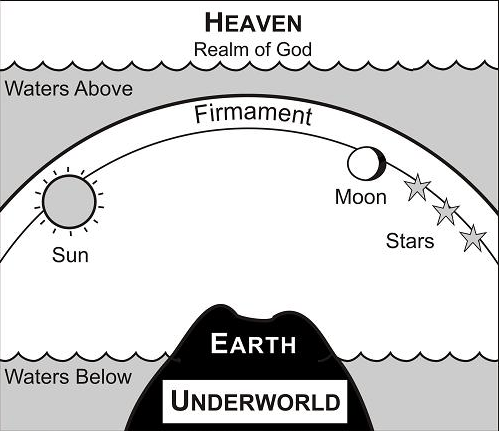

Let’s look at some passages, and I think you’ll see the similarities. Take Genesis 1:6,7, for instance:
And God said, “Let there be an expanse in the midst of the waters, and let it separate the waters from the waters.” And God made the expanse and separated the waters that were under the expanse from the waters that were above the expanse. And it was so.
What? This is probably one of the most confusing passages in this chapter if you’re trying to apply it to what we know of the cosmos. What does it mean to separate the waters from the waters? And what’s this “expanse” that it talks about? Well, verse 8 answers that for us:
And God called the expanse Heaven.
In other words, the expanse is the sky. It’s not “Heaven” in the spiritual sense, as we’ll see from some of the other verses. But how does the sky separate waters? We learn more starting with verse 9:
And God said, “Let the waters under the heavens be gathered together into one place, and let the dry land appear.” And it was so. God called the dry land Earth, and the waters that were gathered together he called Seas. And God saw that it was good.
So the waters under the expanse (sky) are oceans, rivers, etc. What are the waters above the sky? We can’t say it’s water vapor for two reasons: One, it doesn’t make sense in the context of the passage. But the second and more important reason is explained here (vs 14-18):
And God said, “Let there be lights in the expanse of the heavens to separate the day from the night. And let them be for signs and for seasons, and for days and years, and let them be lights in the expanse of the heavens to give light upon the earth.” And it was so. And God made the two great lights—the greater light to rule the day and the lesser light to rule the night—and the stars. And God set them in the expanse of the heavens to give light on the earth, to rule over the day and over the night, and to separate the light from the darkness. And God saw that it was good.
According to this passage, the sun, moon, and stars are stuck in the sky — the same sky that keeps back the “waters above.”
Now look again at the two images I posted above. Genesis is describing a system in which the sky acts as a dome around the earth. This dome has pretty lights stuck in it to help us see, even when it’s night. The business about water being above the sky makes sense when you think about it — why else is the sky blue? And where do you think rain comes from? We see this in Genesis 7:11-12, when God decides to flood the earth:
In the six hundredth year of Noah’s life, in the second month, on the seventeenth day of the month, on that day all the fountains of the great deep burst forth, and the windows of the heavens were opened. And rain fell upon the earth forty days and forty nights.
For people living at the time Genesis was written, this was not a bad job of explaining things. It explained why the sky was blue, where rain came from, and why we have the sun, moon, and stars. We can easily understand why they held these beliefs. However, in today’s age, the Genesis account is absurd. Efforts to make it fit with what we now know about the universe is a bit like trying to rationally argue for the existence of Santa Claus. Why not just put an end to all the mental gymnastics and accept that like every other religious text in the world, the Bible is just the product of mankind’s imagination? It may be a difficult proposition to accept, if you’re a firm believer. But I can tell you from experience that the whole thing makes a lot more sense when you stop assuming God had anything to do with the Bible.

 Finding Truth
Nate, don’t leave out all of the blind alleys he created to test our faith, such as burying dinosaur bones so deeply we’d think they were millions of years old!
LikeLike
LaurieLove, prithee tell me why there are fossils of short-necked giraffes?
LikeLike
That’s a primary difference, Laurie, between you theists and we people of reason – we’re OK with filling gaps in our knowledge with, “I don’t know,” whereas you (pl) feel the need to fill the gaps in yours with, “Goddidit!”
LikeLike
I think it goes like this: “When god created man, how old did he look? Adam looked full gown, so I’m sure he made the earth to appear ‘full-grown’ too.”
The questions I have, like others, is if god did indeed make the earth appear to be older than it is, then why would he be upset that people think it’s older than it is? It’s like installing a stop sign on a street and then ticketing people for stopping… “Sure there’s a stop sign there, but you should have known that you’re not supposed to stop there.”
And one more step further, it seems as though it isn’t enough for people to live morally, but that god also wants to people to acknowledge him. I can’t help but think that portrays god as selfish and self-centered – a “do as I say and not as I do” god. According to the bible, the biggest thing is to acknowledge god – the moral stuff comes second.
You can live morally but go to hell if you don’t recognize god. You can live fairly morally but go to heaven if you believe in god. It just doesn’t seem to be the winning example of a merciful, forgiving father.
LikeLike
Laurie, does that include a 3000-year old T-Rex?
LikeLike
No, no, William, you’re not wrong, you were earnestly quoting the King James, it’s the translators of the KJV who are at fault, not you. You can’t be expected to be conversant with the Hebrew Torah, the Greek Septuagint, the Latin Vulgate and the English KJV.
LikeLike
LikeLike
yeah, i thought i was wrong once, turns out that was the mistake, i guess…
LikeLike
Hey Laurie,
I’m not sure what to make of this statement you’ve made.
I look at science to learn what is true, simple and plain. I do not look at science to prove a preconceived idea that I think or want to be true.
At work I look at the scientific findings in electronics in order to figure out how to build the things that I build. I use the consensus findings of scientific studies to do this – I can’t prove and do lab research for everything that relates to solid state circuit design because that would take inordinate amounts of money and time – and even if I did I’d still need others to perform those analyses to make sure I’m not injecting my own biases into it. I need to rely on what the consensus of scientists have found and then use that to build my views about what is true so that I can put things together at work. Is it possible that there is a conspiracy going on and they are feeding me lies about the way transistors work – sure why not, anything is possible, but this seems very unlikely, and when I try to apply their findings, then the things I build actually work the way they predicted they would.
Are you suggesting that I apply a different approach to finding out what is true about evolution? Should I change my view just for that particular field of science and then go against what the consensus (and again we’re talking 99+ percent from what I have read) of experts in the field agree to? I know you think you have found reasons why their findings are wrong, but you are not an expert in the field and everything you have brought up as problems have been answered by many who study this stuff every day and are experts in the field.
Again, I am not looking at science with the express goal to prove evolution is correct…. the consensus of scientists have already shown that and there are tons of materials that have been written to show the evidence they have found to support this.
Besides – William is right – this whole thing was a diversionary tactic to take us off the topic of the even more obvious fact that Genesis 1 simply doesn’t square at all with science.
LikeLike
Howie, if you would scroll back up to the top you would see that I answered William before he ever made the comment that you say alluded to me using “diversionary tactics”. He must have been typing when my post came through.
And as for not trying to prove “preconceived ideas” that is exactly what evolution is, an idea that Darwin had, and we now try to prove. If the evidence doesn’t support it, it gets swept under the rug. Just like the fossil record, and layers of strata. Tomorrow I will have a computer for a couple hours, and will submit my evidence
LikeLike
Laurie, when did you answer William? I went through your last several comments and didn’t see anything, unless it was where you said that the flood changed things around.
I think I’ve seen you state that you believe a substantial amount of water was in the atmosphere, but it was released at the time of the flood, and this is what you think is meant by “waters above.” Is that right?
LikeLike
Ya know Laurie if you feel that there is some kind of conspiracy within the scientific community about evolution then I won’t have much to say except that we disagree and I can respectfully move on. I’ve said many times that we all have to do our best to figure out what is true given our experiences and whatever information we have so I can leave it at that. And I believe you are trying your best to honestly come to conclusions. We simply disagree.
But when you go and say something like “I just happen to look at it from both sides, while you seem to only look at it to prove evolution correct” then things start to look a bit off and I wonder if you’ve considered if the opposite might be true. You can peruse my blog and find out that I am very open to the idea of the supernatural as well as the existence of gods, but I just doubt their existence. I have no doctrinal beliefs about that – it’s just my current conclusions and if the consensus of scientific evidence were to disprove my current beliefs I’d change right away.
You are going against 99+% consensus of experts in the field. And the thing is that many of these scientists are Christians – and not only of the liberal type but the evangelical type – biologos.org and godofevolution.com are just 2 websites that prove this. I know you don’t agree with their doctrinal beliefs but that is not the point – the point is that these people all have a vested interest to disprove evolution because that would help fit better with their beliefs but they have conceded because the evidence is becoming more and more overwhelming as the years pass on. Francis Collins, an evangelical, has said that the genetic evidence alone proves evolution’s truth.
400 years ago you would have been having this same kind of argument with people about the sun going around the earth but that one finally died out.
How is quote mining Stephen Jay Gould (when he believes evolution is fact) like you did in the last post going to counter the 99% of experts in the field? Are you suggesting that I should trust your opinion over all of these experts? Are you an expert in this field?
Laurie, again this is my own perspective and if you disagree that’s cool, but when you start to suggest these strange ideas that I am starting with the belief that evolution is correct and then from there I am trying to grab whatever I can to support that then I have to say that you are way off base.
LikeLike
I’d like to add a little to what Howie has just said.
I can’t speak for anyone else in this discussion, but for me, evolution has nothing to do with my position of atheism. I stopped believing Christianity long before I ever spent any time learning about evolution. If the Theory of Evolution were overturned tomorrow, that would be fine with me — I’d be very interested to see what the new leading theory was! But I have a strong feeling that whatever the new discoveries uncovered, it wouldn’t support the Bible’s creation account; therefore, I still wouldn’t believe in the god of the Bible.
So the only reason I view evolution as the likely scenario that got us to this point is because the current accumulation of scientific evidence supports that idea. I don’t have a personal stake in it, so there’s no real bias for me to confirm…
Also, it’s extremely difficult for conspiracies to actually work, especially when they involve the kinds of people that like to search for answers. Scientists are not usually the kind of people interested in maintaining the status quo or hiding information.
LikeLike
Do you mean to tell me you are finally going to tell us the details of the 3000-year old T-Rex? Be still, my beating heart —
LikeLike
Nate, Even though you have rejected the Christian God, and the gods of other religions, I still suspect that you harbor a concept of a creator.
LikeLike
Let me try and translate that for you, Marc –
LikeLike
Hi Marc
I acknowledge that there could be one. I think it was Descartes that asked why was there something rather than nothing. I think it’s a good question. However, I also acknowledge that it might be the wrong question. It’s possible that “nothing,” as we think of it, doesn’t actually exist.
But aside from that, this is what it comes down to for me. I haven’t personally experienced anything that couldn’t be explained naturally. Maybe there is a supernatural realm, but I’ve never encountered anything to actually make me believe in it. Also, I know the universe is complex, which is why so many people believe it must have been created by an intelligent being. But if that’s the case, then it seems to me that the creator would have to be even more complex than the universe we see around us. So if I have to see one of those as having always existed, or having never been created, then I have to opt for the simpler one.
That, in a nutshell, is why I don’t believe in a god, even though I can see why others do.
LikeLike
Thanks, Nate.
I have great respect for you and your honesty, patience, and kindness. I believe that God also respects and loves you, so what ever happens after death you will be OK. Even though you disagree with folks like me, I never sense any negative judgment on your part. I suspect that is why I would prefer your company to that of many Christians.
LikeLike
Thanks, Marc! 🙂 I really appreciate the considerate tone of your comments, too!
LikeLike
Laurie,
I disagree with your assertion that my observations about the Genesis writer’s narrative are illogical. (Imagine that…) Your comments about the increased knowledge of mankind serve as a fine example: increased knowledge (the world is round, there are more than 1100 stars, etc…) are observations of things that are also found in the scriptures (Job, for instance, addresses both of those topics, calling the earth a sphere and the stars numberless). However, when human knowledge completely refutes biblical observation, the fault does not lie with the science, it lies in the disproven biblical observation.
Observation is only the beginning of science, but it is the foundation of literature. And, as has been noted ad nauseum in this conversation (seriously, it’s a full-time job keeping up with you people), the bible is a work of (deeply moving and beautiful) *literature*. I love the bible, and the King James is seriously the most beautiful text of any genre that I’ve ever had the privilege to read. But, it is not, nor is it trying to be, a scientific text. It is a *story*, and should be read and analyzed as such. There are huge amounts of vitally important truths contained in the Biblical story, but they are truths of the heart and the soul, not science. The story itself and the details contain therein are. not. facts.
Part of the problem is the text itself, which archaeopteryx has kindly done the legwork and study in order to illustrate so vividly: we’ve got copies of poorly translated copies, reworked and re-marketed a zillion times over, and some schools of thought are betting the farm on the information contained therein, even if it’s unclear, muddled, impossible to understand, or just flat wrong, simply because it make the audacious claim to be the “written voice of God.”
If you need the Bible to be a *factually accurate* brief history of the beginning of time in order to believe in the God found within its pages, you’re going to encounter some hard struggles. I speak from experience here, and know how deeply these conversations can cut into one’s faith. But, if you can let it be a story (which is not to diminish its worth at all; in fact, it increases it in my view: our great stories are some of the most powerful and enduring things humans have created), and believe in the truth of that, then these issues regarding the science can be observed as they are without taking away from the other more important truths one can and does find in the bible.
(And, dude, Arch: bonus point for use of the word “prithee.”) 🙂
LikeLike
Thanks, I’ll take all the points I can get —
LikeLike
Nate,
Because I subscribe, I got a notification email right when you posted this ten days ago. As soon as I read the title of your post I knew I was going to have a lot to say about it. It’s taken me all this time to calm down sufficiently to form my thoughts into a comment. I did, of course, read the entirety of your post and — as other commenters have mentioned — I was completely amazed at your patience, working your way through all these points. I appreciate the effort you took but I wonder if you needed to belabor the point as much as you did. Before I got halfway through I had the feeling you were beating a dead horse.
Why is this even an issue? You proved that we human beings have learned a great deal about science over the past 3500 years and, well, “Duh!”
Let me begin by bringing up the objection I made as soon as I read your title. You set about to describe how ‘Genesis’ views our universe. At the risk of belaboring my own point, I shall take note of the fact that ‘Genesis’ is a book. It’s ink on paper, bound between two covers. In other words, it is ‘non living’. It’s a thing, it’s not a person. A person — or more likely — many people put the book together (and I will get back to that); but the book itself is a ‘thing’ — incapable of learning, incapable of protesting that it’s being misunderstood, incapable of correcting any misstatements, incapable of admitting that it offered a confusing rendition and begging for another chance to explain itself.
You have a ‘view of the universe’, so do I; but we are human beings and we can do all the things I just listed that a book cannot do. Stephen Hawking has a view of the universe and his books on cosmology are breathtaking accomplishments. Hawking is alive, but his book is dead. More likely than not he will eventually say something along the lines of, “there have been a lot of scientific discoveries since I wrote my book and I now see that what I wrote on page 73 isn’t true at all. Blah. Blah. Blah.”
When he makes this statement nobody will lose his faith in science, or in Hawking, or even in his book — since we’ll all allow for the fact that a book is only a book and overlook the shortcomings that books have in comparison to living things. Who knows how many scientific discoveries we’ll make in the next 3500 years. Would you like to guess how many mistakes the people of that time will find in “A Brief History of Time.”
But even these great-great-so many greats-grandchildren of ours will be respectful of the book for what it actually is and they will respect Hawking’s accomplishment and his contribution to science. If someone, at that time, were to write a post and call it “How ‘A Brief History’ views the universe” he’d be able to do as good a job of making that book ridiculous as you’ve done here with Genesis — but that future poster would be picking a fight with somebody (actually something) that can’t fight back. How fair is that?
As highly as we all regard any of Hawking’s many great books, our “faith” isn’t the books themselves. Our faith is in actual, living, scientists — and human organizations such as universities or professional societies. At some later date if people want to understand something about our universe they’ll turn to the living people, and the ongoing organizations that have demonstrated expertise in science. Anyone who were to say, at that future time, “ah, but look what it says in the book! How can you defend that? Everyone knows such-and-such is wrong! You scientists are a bunch of boneheads!!” — anyone who said that would be a perfect ass. He wouldn’t be debunking science — he would simply be demonstrating his willful ignorance about how science works.
And you seem to me to be demonstrating willful ignorance about how the Church works.
🙂
Captain Catholic
LikeLike
Stephen Hawking isn’t using his book to tell me how to live my life. When he does, he will share my criticism.
LikeLike
Thanks Cap’n.
I think instead of demonstrating ignorance about how the church works, I’m attacking a particular perspective — the same perspective I grew up with: that the Bible is the infallible Word of God, perfect in every way. That may be a naive point of view, but it’s one that’s still very much alive, especially here in the southeastern US.
I actually agree with your take on Genesis, now that I no longer believe the Bible was divinely inspired. I don’t think the people who wrote it should be demonized or patronized for what they knew at the time. As you said, people a century or two from now will be able to do the same with us. All I was trying to do was show was that the Bible (and specifically Genesis, in this case) has too many inaccuracies for it to literally be the words of God.
But I’m sorry if I struck a nerve. Thanks for your feedback!
LikeLike
Nice response Nate, I agree with you all the way. The difference between Stephen Hawking and Genesis is that Hawking, mortal that he is, can certainly be mistaken. God, as the purported author/inspirer of Genesis, should not need and cannot sustain such a critique. As long as we agree that Genesis is merely human in authorship, with no divine layer, all is well. It takes is place nicely beside the Akkadian, Mesopotamian, and Egyptian creation myths.
And as you say, the problem is that people do not and will not regard Genesis that way.
As much as I appreciate the Captain’s sentiments, they can only stand if he is willing to admit that Genesis and Enuma Elish are dead equals to one another. Rescind the claims that people really are made in the image of god; drop the notion that Adam is any more historically real than Hansel and Gretel; and treat its insights about human nature as we do those of the Odyssey or any other literature. If those concessions are made, then I think the analogy of Hawking has validity. Human knowledge will grow and be surpassed. No sacred cows (or texts).
LikeLike