Virtually everyone knows that it’s hard to square the differences between the Genesis account of creation and what we now know through science. For centuries, people believed that the earth was less than 10,000 years old, because the Bible doesn’t seem to go back any further than that. Now, geology, biology, chemistry, anthropology, archaeology, and astronomy agree that the earth (and our universe) is far, far older than that. Now, it’s certainly possible that God spoke everything into existence 10,000 years ago, but with the appearance that it had been here for billions of years. That’s what I believed when I was a Christian. Others think that the “6 days” spoken of in Genesis is figurative for simply “periods of time.” But even if one of those theories could answer some of the problems, it can’t solve them all.
The average person living at the time Genesis was written did not know that the earth is a sphere, or that the sun is a star, or that the earth is just one of at least 8 planets circling the sun. Of course, if God miraculously inspired the writing of Genesis, then it doesn’t matter what people understood at the time it was written, because God knew everything we know now, and more. But that’s the thing: Genesis has more problems than just the age of the universe. When you read Genesis carefully, you get a view of the universe much like the one depicted by these images:
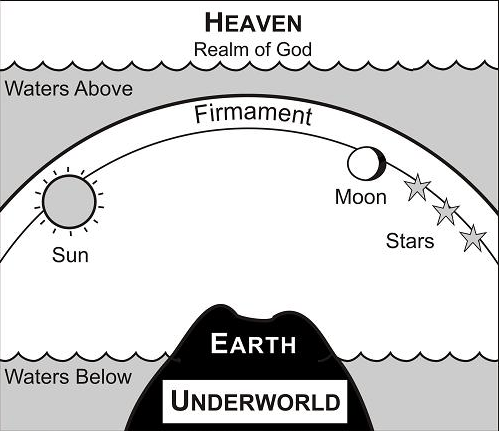

Let’s look at some passages, and I think you’ll see the similarities. Take Genesis 1:6,7, for instance:
And God said, “Let there be an expanse in the midst of the waters, and let it separate the waters from the waters.” And God made the expanse and separated the waters that were under the expanse from the waters that were above the expanse. And it was so.
What? This is probably one of the most confusing passages in this chapter if you’re trying to apply it to what we know of the cosmos. What does it mean to separate the waters from the waters? And what’s this “expanse” that it talks about? Well, verse 8 answers that for us:
And God called the expanse Heaven.
In other words, the expanse is the sky. It’s not “Heaven” in the spiritual sense, as we’ll see from some of the other verses. But how does the sky separate waters? We learn more starting with verse 9:
And God said, “Let the waters under the heavens be gathered together into one place, and let the dry land appear.” And it was so. God called the dry land Earth, and the waters that were gathered together he called Seas. And God saw that it was good.
So the waters under the expanse (sky) are oceans, rivers, etc. What are the waters above the sky? We can’t say it’s water vapor for two reasons: One, it doesn’t make sense in the context of the passage. But the second and more important reason is explained here (vs 14-18):
And God said, “Let there be lights in the expanse of the heavens to separate the day from the night. And let them be for signs and for seasons, and for days and years, and let them be lights in the expanse of the heavens to give light upon the earth.” And it was so. And God made the two great lights—the greater light to rule the day and the lesser light to rule the night—and the stars. And God set them in the expanse of the heavens to give light on the earth, to rule over the day and over the night, and to separate the light from the darkness. And God saw that it was good.
According to this passage, the sun, moon, and stars are stuck in the sky — the same sky that keeps back the “waters above.”
Now look again at the two images I posted above. Genesis is describing a system in which the sky acts as a dome around the earth. This dome has pretty lights stuck in it to help us see, even when it’s night. The business about water being above the sky makes sense when you think about it — why else is the sky blue? And where do you think rain comes from? We see this in Genesis 7:11-12, when God decides to flood the earth:
In the six hundredth year of Noah’s life, in the second month, on the seventeenth day of the month, on that day all the fountains of the great deep burst forth, and the windows of the heavens were opened. And rain fell upon the earth forty days and forty nights.
For people living at the time Genesis was written, this was not a bad job of explaining things. It explained why the sky was blue, where rain came from, and why we have the sun, moon, and stars. We can easily understand why they held these beliefs. However, in today’s age, the Genesis account is absurd. Efforts to make it fit with what we now know about the universe is a bit like trying to rationally argue for the existence of Santa Claus. Why not just put an end to all the mental gymnastics and accept that like every other religious text in the world, the Bible is just the product of mankind’s imagination? It may be a difficult proposition to accept, if you’re a firm believer. But I can tell you from experience that the whole thing makes a lot more sense when you stop assuming God had anything to do with the Bible.

 Finding Truth
One of the beauties of science lies in the fact that those involved with it can guiltlessly say, “I don’t know.”
LikeLike
Like it
LikeLike
Thanks, Bris – i like what you write too!
LikeLike
Yeah, that’s an excellent quote!
And thanks for your comment, Brisancian. Yep, the issues in the Bible are all very human. If it’s a human book, then no big deal — it’s when people attach the “authored by God” attribution that we have a problem.
LikeLike
@archaeopteryx1
@Nate
@Brisancian
Thank you for responding to my comment. Sometimes, on my own blog, http://reflectionsofacatholicchristian.wordpress.com/, I feel as if I’m talking to myself. The great appeal of Nate’s blog — to me, anyway — is that one can actually get into a conversation (which, according to my values, is a far more gratifying experience than that of talking to oneself.)
Comments, comments, comments. You’ve commented on what I said and now I will comment on what you all have said. I hope you won’t be disappointed when you find that I am not going to contradict you or decorate this string with “evidence” that you are all mistaken. I gather that Christians, when they visit this ‘site, are expected to play the role of ‘foil’ or even ‘straw dog’ and I’m afraid I’ll be next to useless for that function.
Aaah, I won’t comment on everything. I’m not willing to put out the effort, not on somebody else’s blog (sorry Nate). I’ll just respond to one of arch’s remarks: “Stephen Hawking isn’t using his book to tell me how to live my life. When he does, he will share my criticism.”
I agree that there are lots of people who use the Bible to tell everybody else how to live their lives, and I agree that Hawking has never used his book to achieve that end — but now we’re talking about people rather than books. I certainly never use the Bible to tell people how to live or what to do (quite the opposite, as you will see when I get myself up into a lather about it.) With a determined effort, I suppose, somebody could figure out a way to marshall Hawking’s book in service to her/his plan to make other people do as s/he says; but that is not the fault of either the Bible or of “A Brief History…” — it’s the fault of the people USING the book.
Quick example: a lot of folks are upset with Paul and particularly upset with his comment in the letter to the Ephesians that wives ought to subordinate themselves to their husbands. They note (quite rightly, I will agree) that female subjugation has long been a scourge on our culture, a source of unending misery and injustice
The folks who are upset are barking up the wrong tree! Paul is dead nearly 2,000 years ago — he did a lot of good and he did a lot of bad but he did those things a long, long, long time ago. He has zero power now and, thus, zero responsibility. Those of us who are alive, who still have some power, are the only ones who can take credit or blame or responsibility for anything. Let poor Paul rest in peace!
The responsibility for the injustices against women doesn’t lie with Paul. It lies with all the assholes who quote Eph 5, 22; the pinheads who preach sermons on it; the ya-ya’s who drag it into every conversation we have about women, or marriage, or family life. They are under no compulsion to do this! Surely you realize that there are huge portions of the Bible that nobody quotes, portions that virtually nobody even knows about (except, of course, atheists who scour the Bible from top to bottom looking for anything that’s entirely fucked in the head).
Anyway, we could all do the same with that passage. We could let it rest in peace in the same cold grave its author currently resides.
Now I’m going to sound exactly like one of those 2nd Amendment loving gun nuts (so feel free to criticize me for that) but there really is merit in the observation that “the Bible doesn’t foster injustice — the people who QUOTE the Bible do.”
Aaah, I have more to say and you all deserve a more thorough response to your thoughtful comments but I’m getting tired of and, quite frankly, a little bored with my own line of thinking. Allow me to rest a few days and I’ll come back to it later.
Be happy,
Be well,
Captain Catholic
LikeLike
RE: “one can actually get into a conversation, which, according to my values, is a far more gratifying experience than that of talking to oneself.”
Oh, I don’t know, I often engage in such an activity while walking down a crowded city street while wearing my aluminum foil hat – sure, I get stares, envy is everywhere!
RE: “I certainly never use the Bible to tell people how to live or what to do” – Ah, but it isn’t YOUR book —
Many sources are convinced that Paul did not write Ephesians.
Allow me to join you, Captain C (not to be confused with Captain Crunch):
LikeLike
Hi Cap, thanks for the reply. It actually sounds like we all view the Bible pretty similarly. It was just a collection of writings by people, much like today’s commentaries. Do you believe it was divinely inspired in any way? And what role do you think the Bible is supposed to play in the lives of Christians?
LikeLike
@Nate,
Where is ‘divine inspiration’? Is it in the scriptures, or in the capacity to make sense of them?
Read my latest, http://whatisthisthingcalledgod.wordpress.com/2013/11/04/they-wandered-the-desert-because-their-guide-was-lost/#more-8 and tell me whether I’m starting to make it clear what I mean when I talk about “making sense of the scriptures”.
I look forward to your critique!
Paul
LikeLike
Thanks Cap. I read your post, and I think I see where you’re coming from. I’ll continue the conversation over on your blog.
LikeLike
Religious Experience Linked to Brain’s Social Regions
* Posted by Eric Allen Bell on October 3, 2009 at 7:00am
Brain scans of people who believe in God have found further evidence that religion involves neurological regions vital for social intelligence.
In other words, whether or not God or Gods exist, religious belief may have been quite useful in shaping the human mind’s evolution.
“The main point is that all these brain regions are important for other forms of social cognition and behavior,” said Jordan Grafman, a National Institutes of Health cognitive scientist.
In a study published Monday in Public Library of Science ONE, Grafman’s team used an MRI to measure the brains areas in 40 people of varying degrees of religious belief.
People who reported an intimate experience of God, engaged in religious behavior or feared God, tended to have larger-than-average brain regions devoted to empathy, symbolic communication and emotional regulation. The research wasn’t trying to measure some kind of small “God-spot,” but looked instead at broader patterns within the brains of self-reported religious people.
The results are full of caveats, from a small sample size to the focus on a western God. But they fit with Grafman’s earlier work on how religious sentiment triggers other neural networks involved in social cognition.
That research, published in March in the Proceedings of the National Academy of Science, suggested that the capacity for religious thought may have bootstrapped a primitive human brain into its current, socially sophisticated form.
Grafman suspects that the origins of divine belief reside in mechanisms that evolved in order to help primates understand family members and other animals. “We tried to use the same social mechanisms to explain unusual phenomena in the natural world,” he said.
The evolution of our brains continues, said Grafman. “The way we think now is not the way we thought 3,000 years ago,” he said. “The nature of how we believe might change as well.”
LikeLike
Oh, the gods, Arch, you would post this…
What are the odds this is posted over the interweb thicker than the manure on my roses?
And all the religious will be saying..”Caveats? What caveats?”‘
LikeLike
OK, not sure, Ark, of exactly what you’re saying, but let me tell you my take on it, and perhaps you can tell me if we’re saying the same thing, only phrasing it differently – I understood it to be saying that evolutionarily, we developed certain social skills that allowed us to survive as a species, and that religion piggy-backed on those social skills to establish and entrench itself.
LikeLike
Think of a virus infecting an otherwise sound computer program —
LikeLike
An article some might find interesting:
Did A Supreme Court Justice Just Admit To Being An Atheist?
LikeLike