Virtually everyone knows that it’s hard to square the differences between the Genesis account of creation and what we now know through science. For centuries, people believed that the earth was less than 10,000 years old, because the Bible doesn’t seem to go back any further than that. Now, geology, biology, chemistry, anthropology, archaeology, and astronomy agree that the earth (and our universe) is far, far older than that. Now, it’s certainly possible that God spoke everything into existence 10,000 years ago, but with the appearance that it had been here for billions of years. That’s what I believed when I was a Christian. Others think that the “6 days” spoken of in Genesis is figurative for simply “periods of time.” But even if one of those theories could answer some of the problems, it can’t solve them all.
The average person living at the time Genesis was written did not know that the earth is a sphere, or that the sun is a star, or that the earth is just one of at least 8 planets circling the sun. Of course, if God miraculously inspired the writing of Genesis, then it doesn’t matter what people understood at the time it was written, because God knew everything we know now, and more. But that’s the thing: Genesis has more problems than just the age of the universe. When you read Genesis carefully, you get a view of the universe much like the one depicted by these images:
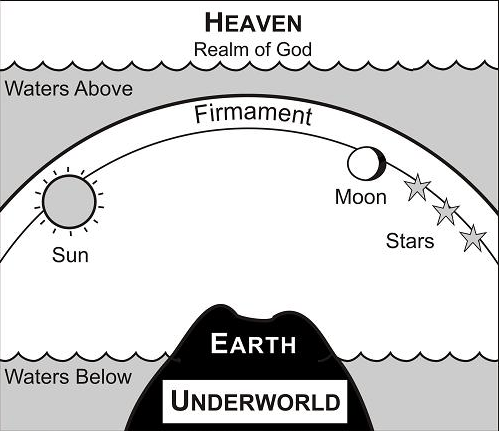

Let’s look at some passages, and I think you’ll see the similarities. Take Genesis 1:6,7, for instance:
And God said, “Let there be an expanse in the midst of the waters, and let it separate the waters from the waters.” And God made the expanse and separated the waters that were under the expanse from the waters that were above the expanse. And it was so.
What? This is probably one of the most confusing passages in this chapter if you’re trying to apply it to what we know of the cosmos. What does it mean to separate the waters from the waters? And what’s this “expanse” that it talks about? Well, verse 8 answers that for us:
And God called the expanse Heaven.
In other words, the expanse is the sky. It’s not “Heaven” in the spiritual sense, as we’ll see from some of the other verses. But how does the sky separate waters? We learn more starting with verse 9:
And God said, “Let the waters under the heavens be gathered together into one place, and let the dry land appear.” And it was so. God called the dry land Earth, and the waters that were gathered together he called Seas. And God saw that it was good.
So the waters under the expanse (sky) are oceans, rivers, etc. What are the waters above the sky? We can’t say it’s water vapor for two reasons: One, it doesn’t make sense in the context of the passage. But the second and more important reason is explained here (vs 14-18):
And God said, “Let there be lights in the expanse of the heavens to separate the day from the night. And let them be for signs and for seasons, and for days and years, and let them be lights in the expanse of the heavens to give light upon the earth.” And it was so. And God made the two great lights—the greater light to rule the day and the lesser light to rule the night—and the stars. And God set them in the expanse of the heavens to give light on the earth, to rule over the day and over the night, and to separate the light from the darkness. And God saw that it was good.
According to this passage, the sun, moon, and stars are stuck in the sky — the same sky that keeps back the “waters above.”
Now look again at the two images I posted above. Genesis is describing a system in which the sky acts as a dome around the earth. This dome has pretty lights stuck in it to help us see, even when it’s night. The business about water being above the sky makes sense when you think about it — why else is the sky blue? And where do you think rain comes from? We see this in Genesis 7:11-12, when God decides to flood the earth:
In the six hundredth year of Noah’s life, in the second month, on the seventeenth day of the month, on that day all the fountains of the great deep burst forth, and the windows of the heavens were opened. And rain fell upon the earth forty days and forty nights.
For people living at the time Genesis was written, this was not a bad job of explaining things. It explained why the sky was blue, where rain came from, and why we have the sun, moon, and stars. We can easily understand why they held these beliefs. However, in today’s age, the Genesis account is absurd. Efforts to make it fit with what we now know about the universe is a bit like trying to rationally argue for the existence of Santa Claus. Why not just put an end to all the mental gymnastics and accept that like every other religious text in the world, the Bible is just the product of mankind’s imagination? It may be a difficult proposition to accept, if you’re a firm believer. But I can tell you from experience that the whole thing makes a lot more sense when you stop assuming God had anything to do with the Bible.

 Finding Truth
Laurie, a few additional thoughts beyond the excellent content supplied above…
One reason the documentary hypothesis is *necessary* and inevitable is that the record of where the Penteateuchal texts came from is so woefully inadequate.
They do not declare an author.
They do not declare a date of origin.
The versions that we have are decidedly not written in the language extant in Moses’ day.
All references to Moses are third person and past tense, often distant past tense.
At a minimum then, it cannot be said that there is any firm footing on which to say that Moses drafted these books. Perhaps the best explanation for the traditional view is an incremental conflation. They contained the Law of Moses. They were the books of the Law of Moses. They therefore were the books of Moses. And they did need an authoritative author to wield authority. Being honest about their anonymity simply wouldn’t do.
So we cannot – unfortunately – given any airtight case for when or where these books originated. And that is odd, for God’s Word. Instead, we must quite simply do the best we can with the little we’ve got. And the documentary hypothesis does well given the meager data we have.
LikeLike
Brisancian — great points. The “books of Moses” also contain his death and burial, which he obviously couldn’t have written. Also, they record the different times that Moses wrote things, which means he was writing something other than what we’re reading.
LikeLike
Hi Nate. The atmosphere of the early earth would not have allowed the Sun, moon, planets and stars to be seen from its surface which is the point of reference in the creation account. The vegetation created on the third day reduced the CO2 levels and produced the oxygen that cleared the atmosphere so that the heavenly bodies became visible on the fourth day. It is also interesting to note that until the 20th Century is was assumed that the Cosmos was eternal, yet Genesis 1:1 confirms it had a beginning and that agrees with our current science. To get so much right in such an ancient document gives it much credibility.
LikeLike
Furthermore, I’ve already pointed out the many, many Mesopotamian events the Bible has either plagiarized outright, or reworded and rehashed, the most famous of which was the “Flood.” It’s also believed by many that not only was Moses not an historical figure, the fictional figure was modeled after a combination of the great Akkadian leader and subsequently ruler of all Mesopotamia, Sargon, son of a temple priestess, who placed him in a basket, caulked with bitumine, and released him in the Euphrates, where he was found by a gardener, and the other most notable of Mesopotamian leaders the great Amurrite king and lawgiver, Hammurabi.
LikeLike
Marc and Chialphagirl,
I suggest looking to several sequencing points for the real trouble points. The sequence of appearance of (1) fish and birds, followed by (2) land creatures, simply does not bear out per the evidence. Fish, land creatures, then birds. This is an argument from evolutionary development.
The second point I would make is that the oldest Homo Sapien skull that we have in hand is 195,000 years old, which ante-dates Adam by about 189,000 years. Now, we can propose a 97% genealogy compression, but there is no precedent for doing so, and more to the point, there is no *biblical* basis on which to justify doing so. Note that this is *not* an argument from evolutionary development… we simply have human remains that are that old. So it is an argument from anthropology, but there is no need to assume evolutionary development to have difficulty here.
Likewise with the third point: we are left with Hitchens’ observation of absurdity. Human remains this old would mean that anatomically and cerebrally modern people existed for about 190,000 years before God finally began interacting with humanity. We would be left to accept that he just watched us and our hominid ancestors live in ignorant squalor and terror for a very long time. And that seems rather absurd.
As Nate said, gymnastics follow… I look forward to seeing what explanations may come.
But one thing is certain: the text informed us not at all about any of these problems. It manifests not the slightest insight about the actual cosmos in scale, in age, or in development. And it hints in no way about how long people have actually been here, or how we actually came to be here.
LikeLike
Marc,
How many origin myths believe the cosmos had a beginning? All of the ones from that region do (to my knowledge).
We need to start giving equal credit to all of them, on your argument. I’m quite serious. If this is a good argument, given that the cosmos either having or not having a beginning was 50/50 odds either way, then we need to take Enuma Elish very seriously. It made the same 50/50 gamble and also hit jackpot.
LikeLike
Nate, agree. I was aware (of course) of the death of Moses being recorded, and the associated gymnastics of explanation. But I actually hadn’t realized it recorded him as writing the way you described. Coolio.
LikeLike
That’s not entirely true either, Marc – while science does indicate that the known universe had a beginning, there is no indication that it has an end, and since we don’t know what, if anything came BEFORE the BB, there may well have been something else, the ingredients for the BB may well BE eternal, but we can never know for certain.
There’s no way a Jewish priest, writing in a mud hut in the middle of Bronze Age Iraq, with a bird-quill pen on a piece of sheepskin or mashed papyrus reed, is going to have any acquaintance with science as we know it.
LikeLike
Not to pile on, but I think Brisancian and arch are right. There’s nothing in the text to indicate the scope, age, or layout of the cosmos as we now know it. And as has been mentioned, if we’re going to go to such lengths to save the Bible’s version of things, why aren’t we going to same lengths to salvage other religious works?
As I said before, I understand the desire to make all of it work out. Rethinking one’s worldview is scary and painful. But surely you feel the stretching you’re having to do to accommodate these texts?
LikeLike
The first five entire pages of my own website consists of creation stories from various cultures, and I listed only the biggie – all of them believe the universe had a beginning, nothing miraculous about that!
Amazingly – and theists are quick to point this out – the majority of them had flood stories as well, which theists use to say, “SEE! There really was a Noah’s flood!” but most areas flood from time to time, and there is no indication that these stories all refer to the same occasion.
LikeLike
Well, I know it speaks of him writing the Law when he’s on Mt Sinai, and we obviously don’t have that, since it’s been woven into the narrative. I think there are some other places that talk about him writing something, but I can’t think of them right now, and I could be wrong about those.
LikeLike
Exactly so. Excellent point – glad to know your site catalogues the myths. I’ve said elsewhere thy one of the biggest problems facing bible backers is an honest ignorance of other contemporary and antecedent accounts.
LikeLike
Nate, I’ll keep an eye out, but interesting to consider. Doesn’t really tilt anything, but it would not surprise me. I think your boil down in the “pile on” was apt. Good distillation and an honest challenge… I’ve mentioned before that the biblical community always manages to find further “stretch room” in the texts to accommodate what we learn elsewhere. But always a posteriori. If left to the texts, we would still be quite misled – and misled due to misleading…
LikeLike
I think one of the things that helped me come out of Christianity was being raised in a very conservative denomination. We were taught to see the way that other denominations would twist certain passages to get the end result they wanted. Not to say those people have nefarious intentions, but confirmation bias plays a big role in making passages say what you need them to say. We’ve already had some examples in this thread. Language like “you’re not reading it from the proper perspective,” or “the passage really means…” tend to give it away.
Once I got used to seeing those kinds of arguments, it got real easy to recognize them when my own group began using them to “explain” the problems I was finding with the Christian religion as a whole.
Like you’ve said before, questioning a religious text is not the same thing as questioning God. It’s like the Old Testament story of the young prophet that was misled by an older prophet and died because of it. He should have tested the old prophet’s claims. That’s what we’re doing. I just wish more people saw it that way.
LikeLike
Knowing that any theist readers would automatically anticipate me making fun of their religion, I thought it might be a good idea to get them laughing at the religions of others, before I began laughing at theirs.
LikeLike
It just allows me to make sure that people who I don’t know don’t say wildly inappropriate things. Once you have commented and been approved your comments go on automatically so you are all good.
LikeLike
I didn’t mean to “spam and run”. I only get notified if some one actually hits reply to me. So I went about my day doing other things, came back to check on this and there were 40 comments. Sorry that I missed everything.
LikeLike
I answered this more extensively in my posts if you want to check them out. It is a lot to put in a comment discussion.
LikeLike
The bible says that the earth and the water should bring forth the animals in their kinds. It doesn’t say that they all magically appeared at once. This is the beginning of intro level species. I believe the bible is addressing what was happening on the earth – that evolution had worked to the point where animals were starting to appear.
Adam was not the first man, he was the first representative just like Jesus was a representative. Paul explains this in romans. So when adam existed has no bearing on how anything is dated.
LikeLike
The first paragraph does not answer. The very first birds – or pterosaurs, etc – appeared long after the very first land creatures. The latter are derivative of the former.
Please provide chapter and verse for the second paragraph.
The representative/headship format that you speak of is derivative of covenant type theology. But this is without question a late innovation, and post Christian – arguably post reformation.
At any rate, you cannot prove Genesis from Paul – the latter is derivative of the former. And Paul never states that he thought Adam was not the first man.
In order to have any merit, you have to be able to demonstrate that ancient Jews saw Adam in this way. I’m not aware of a good pre-Hellenism source for such a view.
But I’d like to point out the tactic that’s being employed here: you’re arguing not to lose. You’re not arguing that the text actually gave us any insight as to where people or the earth came from. You’re simply trying to say that the evidences of science have not completely disconfirmed Genesis.
This is pretty a meager corner to fight from, given that this is the one revelation from the creator who was there. And these are all recent reinterpretations of the text that do not actually stand up to the tests of consistency or antiquity.
LikeLike
In order to have any merit, you have to be able to demonstrate that ancient Jews saw Adam in this way.
No I don’t. I have to be able to demonstrate that it is possible to biblically see him this way. Jesus himself saw a lot of things differently than the ancient Jews.
Here are the reasons I do not think that the Bible indicates that Adam was the first man: http://fluidtheology.wordpress.com/2013/09/06/adam-and-eve-were-not-the-first-people/
LikeLike
She wants to generate some traffic out of this too, Nate – I can’t blame her, can you?
LikeLike
I don’t actually. I have more than enough atheist comments. 🙂 I just don’t like typing lengthy replies when I have already written posts about them.
LikeLike
Uh-oh – you said the dreaded “P” word!
Ever see the cartoon character, the Tasmanian Devil? This is what our pet theist, Laurie, becomes, whenever she hears Paul’s name – she believes him to be the anti-christ, or a prophesied false prophet, or some such nonsense. Personally, I just think of him as having hijacked Christianity from those originally involved with it.
Good luck, or better yet – run!
LikeLike
Enter Copy/Paste!
LikeLike