Virtually everyone knows that it’s hard to square the differences between the Genesis account of creation and what we now know through science. For centuries, people believed that the earth was less than 10,000 years old, because the Bible doesn’t seem to go back any further than that. Now, geology, biology, chemistry, anthropology, archaeology, and astronomy agree that the earth (and our universe) is far, far older than that. Now, it’s certainly possible that God spoke everything into existence 10,000 years ago, but with the appearance that it had been here for billions of years. That’s what I believed when I was a Christian. Others think that the “6 days” spoken of in Genesis is figurative for simply “periods of time.” But even if one of those theories could answer some of the problems, it can’t solve them all.
The average person living at the time Genesis was written did not know that the earth is a sphere, or that the sun is a star, or that the earth is just one of at least 8 planets circling the sun. Of course, if God miraculously inspired the writing of Genesis, then it doesn’t matter what people understood at the time it was written, because God knew everything we know now, and more. But that’s the thing: Genesis has more problems than just the age of the universe. When you read Genesis carefully, you get a view of the universe much like the one depicted by these images:
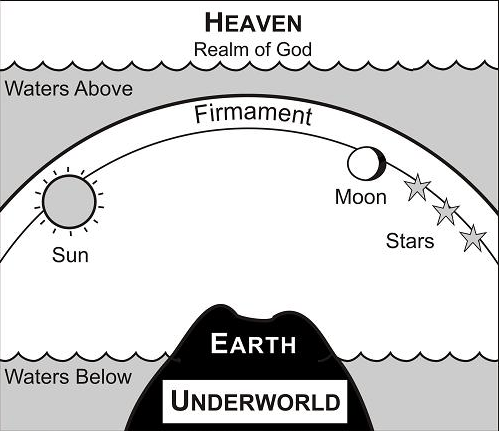

Let’s look at some passages, and I think you’ll see the similarities. Take Genesis 1:6,7, for instance:
And God said, “Let there be an expanse in the midst of the waters, and let it separate the waters from the waters.” And God made the expanse and separated the waters that were under the expanse from the waters that were above the expanse. And it was so.
What? This is probably one of the most confusing passages in this chapter if you’re trying to apply it to what we know of the cosmos. What does it mean to separate the waters from the waters? And what’s this “expanse” that it talks about? Well, verse 8 answers that for us:
And God called the expanse Heaven.
In other words, the expanse is the sky. It’s not “Heaven” in the spiritual sense, as we’ll see from some of the other verses. But how does the sky separate waters? We learn more starting with verse 9:
And God said, “Let the waters under the heavens be gathered together into one place, and let the dry land appear.” And it was so. God called the dry land Earth, and the waters that were gathered together he called Seas. And God saw that it was good.
So the waters under the expanse (sky) are oceans, rivers, etc. What are the waters above the sky? We can’t say it’s water vapor for two reasons: One, it doesn’t make sense in the context of the passage. But the second and more important reason is explained here (vs 14-18):
And God said, “Let there be lights in the expanse of the heavens to separate the day from the night. And let them be for signs and for seasons, and for days and years, and let them be lights in the expanse of the heavens to give light upon the earth.” And it was so. And God made the two great lights—the greater light to rule the day and the lesser light to rule the night—and the stars. And God set them in the expanse of the heavens to give light on the earth, to rule over the day and over the night, and to separate the light from the darkness. And God saw that it was good.
According to this passage, the sun, moon, and stars are stuck in the sky — the same sky that keeps back the “waters above.”
Now look again at the two images I posted above. Genesis is describing a system in which the sky acts as a dome around the earth. This dome has pretty lights stuck in it to help us see, even when it’s night. The business about water being above the sky makes sense when you think about it — why else is the sky blue? And where do you think rain comes from? We see this in Genesis 7:11-12, when God decides to flood the earth:
In the six hundredth year of Noah’s life, in the second month, on the seventeenth day of the month, on that day all the fountains of the great deep burst forth, and the windows of the heavens were opened. And rain fell upon the earth forty days and forty nights.
For people living at the time Genesis was written, this was not a bad job of explaining things. It explained why the sky was blue, where rain came from, and why we have the sun, moon, and stars. We can easily understand why they held these beliefs. However, in today’s age, the Genesis account is absurd. Efforts to make it fit with what we now know about the universe is a bit like trying to rationally argue for the existence of Santa Claus. Why not just put an end to all the mental gymnastics and accept that like every other religious text in the world, the Bible is just the product of mankind’s imagination? It may be a difficult proposition to accept, if you’re a firm believer. But I can tell you from experience that the whole thing makes a lot more sense when you stop assuming God had anything to do with the Bible.

 Finding Truth
Yeah, or copy and paste a link 🙂
LikeLike
Thanks Arch!
Chialphagirl, as I am sure you have realized already, you can’t believe most of the crap that comes out of his mouth.
It is true, I am not a christian, but some how he thinks that makes me a Catholic.
Yes Arch, I am going to make you provide evidence for that statement.
LikeLike
Chialphagirl,
Perhaps I should rephrase… in order to have a *tractable* solution, you must demonstrate Genesis intent/claims/scope/validity sans the NT, and sans Paul. Paul gives some first century commentary on Genesis, but he does this mostly as a fulcrum for his Christology. But Israel was God’s chosen people, and Genesis must have stood quite well on its own for them, else we have a major character problem for the Divine.
Further, Genesis – and Genesis alone – provides a creation narrative. If the Bible includes a *history* of creation (and I’m not entirely sure you’re endorsing that it does), then we must discuss from Genesis. There is no other historical material on the table. Paul is not talking history; he’s talking Christology. The who-what-when-where is covered only in Genesis. On the traditional view of scripture, it had to stand for well over a millennia on its own (not that I endorse an inception that far back personally). And given that it is the only narrative account of creation to speak of, it has to stand today as well.
Anything from the NT can shed additional light on it perhaps, can provide a second and deeper layer of meaning perhaps, but it cannot redraft or alter the original meaning. It cannot contract or expand the claims of the narrative. If Genesis was written by a 12th-14th century BC Moses, then we have to go back to that context to talk about what it meant, and more importantly, what it *claimed*.
I’ve read the leading lights on all of this… Remembrance model, Wisdom model, Homo Divinus model, etc. Biologos, Walton, Enns, Collins, the other Collins, Lennox, McGrath, etc., etc. If you’re sort of dangling that you have a new slant on it, then you’ll have to give some type of taste before I’ll be willing to plow through longer blog posts. So far I’m not seeing that… the answers thus far are fairly cookie cutter and seem to dismiss the actual complexities of the subject.
Biblical defenders of Genesis continue to ever play a game of redefinional catch-up with science. A couple thousand years of Christian scholars generally believed that Adam was the first man. You’re proposing that the quite plain meaning of the text is otherwise. I’ve seen that “abdication of former claims” before. You’re going to find yourself quite short of any clear and unambiguous passages to support it. On the other hand, we have many passages and church scholars that plant the regressing ancestral terminus squarely on Adam. As Nate has said, it is easy to find confirmation bias.
So, three questions before I cruise the blog post:
(1) Is Genesis – either 1 or 2/3 – a historical account or not?
(If they are principally theological, then I think we have nothing to debate)
(2) Who is Adam’s biological father?
(3) If creature/hominid/human suffering ante-dates the Fall with Adam, how then do we have tractable theodicy, and how does the groaning of creation find its source in the recently arrived humanity?
LikeLike
Caveat, I have not read all the other comments so sorry for any redundancy.
I fully agree with everything in this article about how Genesis sees the world. In fact I was taught this exact view during my coursework at a Southern Baptist seminary (which also strongly taught biblical inerrancy). It only undermines people’s faith because well meaning though ignorant Christians set up a dichotomy between faith and science. The reality is the belief dictated by orthodoxy on this matter is simply that God is “maker of heaven and earth.” No creed or council in any era mentions 6 literal days.
Here is a good, quick-read article summing up this understanding from a Christian perspective: http://www.internetmonk.com/archive/why-i-am-not-a-six-day-creationist
LikeLike
One rarely sees it mentioned that it is the rotation of the Earth within the light of the sun, upon which we base our clock, and hence, our day. Yet in the very first chapter of Genesis, we find that the sun wasn’t even created until the fourth day, which as anyone can surmise, implies that the “days” in question were not based on the earth’s rotation within the light of the sun.
I once had a lady (to whom I may not have entirely confided that I was an atheist) stop emailing me because I even DARED to suggest that those Genesis “days” weren’t normal, 24-hour Earth days!
LikeLike
Hi Brisancian. You have great communication skills, and are very interesting to read.
Because knowledge increases continually, I do not think it unreasonable that a written revelation meant to speak to people over time could have newly discovered facets.
Genesis is a historical narrative
Adam has no biological father. He was created with a body, soul, and spirit.
Any animals that shared that same anatomical design of Adam, did not suffer anymore than any other creature. Physical death is a manifestation of entropy, yet Adam and Eve were created with the potential to exist in the material and spiritual realm. How the physics of the material realm may change remains to be seen.
LikeLike
Ever have a song stuck in your head, you just can’t seem to get rid of? While reading the above re-Marc, I kept hearing a rousing chorus of “Bippity, Boppity, Boo” – I wish it would go away.
LikeLike
@ Chi
Oi! I do read , you know?
LikeLike
True, many Christians will die on the 6 literal day hill. But they are in the minority historically. In fact, it seems in my judgement and limited experience at least, literal creationism is primarily found only in fundamentalist US circles. You don’t really find this tension elsewhere around the world.
LikeLike
Arch, Maybe your fairy godmother can do for you what Cinderella’s did for her.
LikeLike
Fairy god-mother/fairy god-father – either way, it’s gettin’ awful Disney up in here! Yours has a talking snake and donkey, and I have talking mice! Either way it sounds like Coke and popcorn time.
LikeLike
Marc,
According to scripture, you don’t have a soul, you are a soul. Body + breath = soul.
Also, I know you said this on a different post, but the people that are left behind are not the unsaved, as Tim LaHaye would have you believe.
If you believe in YHWY, is there something wrong with believing in a literal 6 day creation? If miracles are real, what makes that any harder to believe? You seem to be well versed on the science side of things, and I really enjoy your posts!
LikeLike
Laurie,
You are correct. We are living souls with bodies because we have the breath of life. This is also true of other creatures. It is the spirit that makes us unique and able to sustain the life of the soul after the breath of life departs from the body (see 1 Thessalonians 5:23).
We are all saved, but there is a sequence to the general Resurrection that will take place as the events of the Day of the Lord unfold. Those who desire to be with the Lord, and have made some preparation in this life, will be harvested first. The need for tough love will determine the time of Resurrection harvest for the balance of mankind. Those who go kicking and screaming at the end will be more likely to decide to join Satan and the demons in annihilation.
Well because day can mean a period of daylight, 24 hours, or a time specific to one’s actions, I believe I am understanding the first chapter of Genesis literally as the time specific to God’s creative actions. This approach in born out by Genesis 2:4 when the whole creation process is spoken of as one day.
LikeLike
Why yes, as a matter of fact, there is!
First of all, it’s “YHWH,” not “YHWY,” but even with that error aside, if one believes in YHWH/YHWY, one must believe that the sun wasn’t created until the fourth “day” (1:16), without which, no Earth day is possible, nor a Mercury day, a Venus day, a Mars day, a Jupiter day, a Saturn day, a Uranus day, nor a Neptune day, not to mention a Sun-day, a Moon-day, a Tewes’-day, a Woden’s-day, a Thor’s-day, a Fria’s-day, or a Saturn’s-day – no sun, no day – no how, no way!
It’s difficult to believe that even a celestial Professor Albus Percival Wulfric Brian Dumbledore would want his mighty works erroneously chronicled, otherwise, why bother with the book?
LikeLike
Oh no, you di-n’t!
Thessalonians was written by that nefarious PAUL, and we ALL know how Lady Laurie feels about the nefarious Paul!
Better cross yourself, Marc – you are SO in trouble now!
LikeLike
Arch, This fourth day dog does not hunt. The sun, moon, and stars were not visible from the surface of the earth until the atmosphere was cleared by the plant life created on the third day producing O2 and reducing CO2. The narrative is from the surface of the earth. Hope you are enjoying the show along with the Coke and popcorn, and that you will live happily ever after.
LikeLike
Marc,
As far as dogs not hunting, it looks to me like it might be your view that fits that bill. I’ve just been re-reading Gen 1 in 3 different respected translations and the plain reading says that God not only made 2 great lights but he also set them in the firmament on the fourth day. I don’t see your interpretation anywhere in the text. And the fact that the moon is a light is also not correct. I understand when people say it is a minor point, but again if there was an all knowing God who inspired the writing of these texts it really would have been very simple for Him to make this clearer and correct. Otherwise the text simply looks like writings written entirely by humans just like the creation stories of all the other religions of the time.
LikeLike
As I’ve previously mentioned, Gen 1 was written during the Babylonian Captivity, c.526 BCE, by the Priestly (P) Source, intended to replace the more anthropomorphic Gen 2, written by the Yahwist (J) Source in Judea, c.950 BCE, but left in by the Redactor, around 400 BCE, so one shouldn’t look to Gen 2, to back up Gen 1 – you people should really learn something about the HISTORY of the Bible, before attempting to intelligently discuss the Bible.
This, from the notes in The New American Bible (p. xxix):
Certainly words to live by —
LikeLike
My phone auto corrected that Arch, and I neglected to change it back, but thanks the snarkey comment none the less.
Marc, the Messiah tells several parables about this, and it is the wicked who are taken, and the righteous who are left behind. I cannot copy and paste unfortunately, but look into it if you feel so compelled! 😉
Also, I do not believe that Paul was an apostle, so I do not consider any of his writings when I study
LikeLike
Marc, just really quickly if you would, please give us the chapter and verse where that atmosphere thing can be found —
LikeLike
Howie, The Sun was created on the first day (see Genesis 1:3).
LikeLike
Just wanted to make sure nobody missed that – and this, from a book approved by the freakin’ POPE!
LikeLike
Arch, Not everything we need to know is in the Scriptures. The Holy Scriptures, the material Creation, and the Incarnation are all revelations necessary for us to have a balanced understanding of reality. If you only rely upon the material Creation, your understanding is not balanced.
LikeLike
You KNOW that snarkey comment was meant in only the most loving way – goat hugs!
LikeLike
So we should believe the pope?
LikeLike