Virtually everyone knows that it’s hard to square the differences between the Genesis account of creation and what we now know through science. For centuries, people believed that the earth was less than 10,000 years old, because the Bible doesn’t seem to go back any further than that. Now, geology, biology, chemistry, anthropology, archaeology, and astronomy agree that the earth (and our universe) is far, far older than that. Now, it’s certainly possible that God spoke everything into existence 10,000 years ago, but with the appearance that it had been here for billions of years. That’s what I believed when I was a Christian. Others think that the “6 days” spoken of in Genesis is figurative for simply “periods of time.” But even if one of those theories could answer some of the problems, it can’t solve them all.
The average person living at the time Genesis was written did not know that the earth is a sphere, or that the sun is a star, or that the earth is just one of at least 8 planets circling the sun. Of course, if God miraculously inspired the writing of Genesis, then it doesn’t matter what people understood at the time it was written, because God knew everything we know now, and more. But that’s the thing: Genesis has more problems than just the age of the universe. When you read Genesis carefully, you get a view of the universe much like the one depicted by these images:
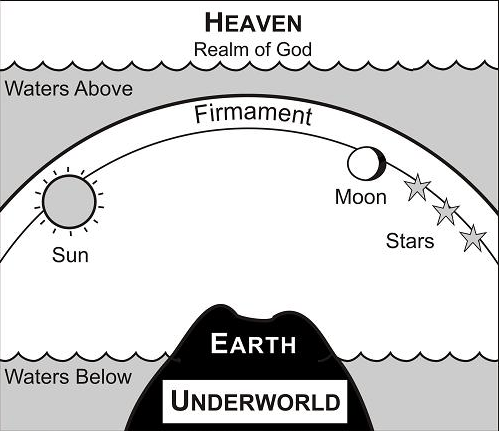

Let’s look at some passages, and I think you’ll see the similarities. Take Genesis 1:6,7, for instance:
And God said, “Let there be an expanse in the midst of the waters, and let it separate the waters from the waters.” And God made the expanse and separated the waters that were under the expanse from the waters that were above the expanse. And it was so.
What? This is probably one of the most confusing passages in this chapter if you’re trying to apply it to what we know of the cosmos. What does it mean to separate the waters from the waters? And what’s this “expanse” that it talks about? Well, verse 8 answers that for us:
And God called the expanse Heaven.
In other words, the expanse is the sky. It’s not “Heaven” in the spiritual sense, as we’ll see from some of the other verses. But how does the sky separate waters? We learn more starting with verse 9:
And God said, “Let the waters under the heavens be gathered together into one place, and let the dry land appear.” And it was so. God called the dry land Earth, and the waters that were gathered together he called Seas. And God saw that it was good.
So the waters under the expanse (sky) are oceans, rivers, etc. What are the waters above the sky? We can’t say it’s water vapor for two reasons: One, it doesn’t make sense in the context of the passage. But the second and more important reason is explained here (vs 14-18):
And God said, “Let there be lights in the expanse of the heavens to separate the day from the night. And let them be for signs and for seasons, and for days and years, and let them be lights in the expanse of the heavens to give light upon the earth.” And it was so. And God made the two great lights—the greater light to rule the day and the lesser light to rule the night—and the stars. And God set them in the expanse of the heavens to give light on the earth, to rule over the day and over the night, and to separate the light from the darkness. And God saw that it was good.
According to this passage, the sun, moon, and stars are stuck in the sky — the same sky that keeps back the “waters above.”
Now look again at the two images I posted above. Genesis is describing a system in which the sky acts as a dome around the earth. This dome has pretty lights stuck in it to help us see, even when it’s night. The business about water being above the sky makes sense when you think about it — why else is the sky blue? And where do you think rain comes from? We see this in Genesis 7:11-12, when God decides to flood the earth:
In the six hundredth year of Noah’s life, in the second month, on the seventeenth day of the month, on that day all the fountains of the great deep burst forth, and the windows of the heavens were opened. And rain fell upon the earth forty days and forty nights.
For people living at the time Genesis was written, this was not a bad job of explaining things. It explained why the sky was blue, where rain came from, and why we have the sun, moon, and stars. We can easily understand why they held these beliefs. However, in today’s age, the Genesis account is absurd. Efforts to make it fit with what we now know about the universe is a bit like trying to rationally argue for the existence of Santa Claus. Why not just put an end to all the mental gymnastics and accept that like every other religious text in the world, the Bible is just the product of mankind’s imagination? It may be a difficult proposition to accept, if you’re a firm believer. But I can tell you from experience that the whole thing makes a lot more sense when you stop assuming God had anything to do with the Bible.

 Finding Truth
If there is a personal God that guides and directs people above understanding or goes beyond our capacity to reason, then it would be unreasonable to not to seek after this personal God.
And if a conviction or revelation is given by this God, then it would also be unreasonable not to follow.
But I don’t think a conviction can be measured or observed by others, it is really what goes on within each person. And only each person really knows what it is that is going on inside of themselves.
thats what I think anyway.
LikeLike
Welcome back Portal! It’s been a while.
Using the word unreasonable may cause some confusion here because you suggested that the guidance from this personal God would go beyond our capacity to reason (perhaps unfair might be a better word). We’re all here trying to reason through things. Even the believers are using reason to figure things out – in fact Marc and Laurie are using reason to prove that each of the other’s conclusions aren’t correct.
When conviction begins to contradict reason and evidence (and I realize it’s a bit tricky to try and figure out whether the source of the “evidence” is a trustworthy source) then people should try and re-evaluate whether their conviction is correct or not.
If someone wants to get closer to truth it’s also important for a person to try and figure out where these “convictions” come from. In many cases these are things that have been ingrained in the person’s psyche by either family or cultural upbringing or caused by a very charismatic and influential person or group of people in their life. In those cases these convictions may actually be causing them to get farther from the truth.
LikeLike
Arch & Marc
I have a belt buckle which was worn by a Nazi Soldier in WW II. It reads , “Gott Mitt Uns”. Meaning God With Us. Yes Hitler told his soldiers God was with them.
LikeLike
@Arch: I’m curious where you have gotten that value from. I’ve seen other studies have that number quite a bit lower.
LikeLike
Marc,
A matter of authority, you may be right. But the question is, who is your authority, is it Paul or Yeshua? Do me a favor, if you would, and read everything that Yeshua said. After you have done that, read everything that Paul said, and compare the two. Most people won’t do this out of stubbornness, but if you do, it may give you a clearer picture.
In Revelations 2 Yeshua said that not only are these people claiming to be apostles when they are not, but also that they are liars. If I could show you a few places where he lied in the scriptures, would you consider the idea that maybe he is the one Yeshua was talking about?
Don’t you find it odd that He taught all of his apostles while he was here, and then told them “if anyone says they have seen me in the desert, or in the wilderness, go not after them” and then several years after he left here comes Paul saying he saw Messiah in the desert, on the road to Damascus, which was the wilderness? John the revelator didn’t see Messiah, he was in vision. Why? Yeshua said that nobody would see him until every eye saw him at his coming.
Paul created Christianity. Yeshua was a Jew. Yeshua said “freely I have given, now go and freely give” “do not call any man father, or teacher, or pastor, or Shepherd, for you are all brethren”. But Paul sets up this church hierarchy, and even says that the people at the top are due double. This is not scriptural. Tithe is not scriptural.
Quoting from memory, cause I can’t cut and paste, so forgive me if I botched any of that, but you get the picture.
Yeshua came preaching the law, and the very fact that Paul preached against it proves he was a false prophet.
LikeLike
Me too! Hi Howie!
LikeLike
Marc: The 90 plus percent of us who share a belief in a higher power …”. Whoops. You haven’t done your research. Only about one-third of the world (33%) and only about 75% in the U.S. are believers. And that figure has gone down from previous years. Of course, this is assuming (rightly so, I would venture) that by “us,” you mean Christians and by “higher power” you mean “God.”
Laurie: If there is one thing I agree with you on, it’s Paul. I wrote about him extensively in my book and essentially came up with similar conclusions. Although I never actually considered him a “false prophet,” he did go against nearly everything that Yeshua taught. Of course, this is all dependent on whether Yeshua even existed. I do tend to think he did, but the arguments against his existence are worthy of more study.
Ark: I couldn’t agree more with the two paragraphs in your comment above that starts right after, “Ask Nate,” Coming from a fundamentalist background, I fully agree — especially about the ingrained mental blind spot being so enmeshed in the psyche. (I believe it’s called being “brainwashed.”)
LikeLike
LikeLike
Marc gave us a bit of a history lesson, asking how I could “cross the line” and ask (I didn’t tell, I asked) how people with religious delusions, such as believing in “lakes of fire,” have escaped straight jackets. He explained that three generations of his family had fought for free speech, to which I must respond – thank you for giving me the freedom of speech, that allows me to ask that question.
LikeLike
These are the quotations I was trying to post last night, when a nearby lightening strike temporarily knocked out my I’net connection:
How did that middle one get in there –?
LikeLike
Thanks Nan, one area of agreement is more than none! I also believe that the grass in my yard is green, so we probably can agree on more than we disagree on! Silver linings ya know! 🙂
Arch
Are you a bit cranky today or what? Cheer up bub!
LikeLike
I read so much stuff, Howie, that I can’t recall where I read everything, and if I made notes of everything I read, as well as their locations, I wouldn’t have time for anything else, nor space on my computer. If it was really essential, I could certainly spend a couple of hours and look it up, but until the theists present me with independent, verifiable proof of everything in the Bible that they maintain is true, I see no real need. My statement is easily as likely to be accurate, as theirs.
LikeLike
I know, because we’ve had this conversation before, Laurie, that you know that I agree with you that Paul hijacked the “Christian” religion – of course, you also know that I don’t agree that Yeshua “prophesied” this or that, because I have no belief in supernatural abilities.
That said – and you KNOW I have no reason to defend any of the biblical characters – if you’re going to point out lies that Paul told in his letters, you should be aware – and I realize that the actual history of the Bible, OT or NT, is not your strong suit – that some of the letters ascribed to Paul are forgeries. You should be aware of which ones, before you assert that Paul was deliberately lying.
Virtually all scholars agree that seven of the thirteen Pauline letters are authentic: Romans, 1 & 2 Corinthians, Galatians, Philippians, 1 Thessalonians, and Philemon. These seven cohere well and appear stylistically, theologically, and in most every way to be by the same person, the author of which is claimed to be Paul. Though we can never know for certain, there is no concrete evidence to engender significant doubt – or, from my perspective, that it even matters.
The other six differ in significant ways from this core group – three of them, 1 & 2 Timothy and Titus, are so much alike that most scholars are convinced that they were written by the same person, and that that was not Paul. The other three, 2 Thessalonians, Ephesians, and Colossians, are usually assigned to separate, different authors.
If you’re interested in researching this (and we know that will never happen, as cognitive dissonance will make your head explode), know that the doubts began as early as 1807, with the German scholar, Fredrich Schleirmaccher – as for pronunciation, I generally just sneeze, then glare accusingly at my listener, as though I can’t believe he/she didn’t understand what I said.
If you write and tell me, on a stack of goats, that you have honestly researched what Schleirmaccher had to say, and are eagerly awaiting more sources, I will provide them, but until then, Schleirmaccher will have to suffice.
LikeLike
Cranky? After a hearty breakfast of goat livers and scrambled eggs, who could be cranky?
LikeLike
Laurie,
I enjoyed reading your thoughts about Paul. My perspective is obviously much different than yours. I see in the first council of Jerusalem revealed in chapter 15 of the Book of Acts, the acceptance of Paul as an Apostle by the other Apostles. Because I believe in the One Holy Catholic and Apostolic Church of Jesus Christ, the Apostolic authority includes the teaching of Paul. Catholic means complete, and the writings of Paul were considered part of the New Testament canon agreed upon by the councils of the Church.
LikeLike
@Marc
er… not quite.. Catholic, from the Greek word Katholikos, meaning universal.
LikeLike
Catholic means: “according to the whole.”
LikeLike
Arch, you did realize that I was talking to Marc right? I know what scholars believe, and agree with some of it, but thanks for your thoughts anyways.
Marc, Catholic means universal. Constantine wanted to rule the world, and figured the easiest way to do that would be to create a religion that would join all religions. Change sabbath to Sunday to please the sun worshipers, he moved all pagan statues, and gave them christian names. That statue of Peter in St Peters basilica that everyone kisses, that is Jupiter. So you can follow catholicism, but it is nothing more than paganism in disguise.
The church that sits on seven hills and wears scarlet and purple, and is drunk with the blood of the saints in Revelations 17 is none other than the Catholic Church who killed millions of true believer’s during the inquisition.
If you had to choose between Paul and Yeshua, would it really be a hard choice? Do you believe his words are necessary for salvation?
Just like Paul said, he really does preach a “new gospel”.
LikeLike
Ark, you beat me to it! I am just not that proficient at typing!
LikeLike
Do I sense a problem in pair o’ dice?
LikeLike
OUCH! Did I just get head-butted? I’ll say it again, Laurie, too much time with the goats —
LikeLike
I wasn’t trying to be rude, and after reading my comment again, I admit it didn’t sound kind. Sorry if it was offensive, but most of it is nothing more than history. Constantine marched his army through a river, and then told them they were baptized Christians, but they were nothing more than wet pagans
LikeLike
Well… You went off on a tangent, when I wasn’t even speaking to you! You got the headbutt you deserved. He he he! 🙂
LikeLike
Must be the hooves —
LikeLike
Laurie,
I am an Orthodox Catholic Christian, not a Roman Catholic. I believe that we are all saved from eternal death by the sacrificial acts of Jesus Christ. We can make the choice to accept His sacrifice and gift of eternal life or reject it. I doubt that many of the readers of this blog will accept the sacrifice and gift of Jesus Christ in this life. However when they find out that physical death is not the end of the trail, there might be some changed minds.
LikeLike