Virtually everyone knows that it’s hard to square the differences between the Genesis account of creation and what we now know through science. For centuries, people believed that the earth was less than 10,000 years old, because the Bible doesn’t seem to go back any further than that. Now, geology, biology, chemistry, anthropology, archaeology, and astronomy agree that the earth (and our universe) is far, far older than that. Now, it’s certainly possible that God spoke everything into existence 10,000 years ago, but with the appearance that it had been here for billions of years. That’s what I believed when I was a Christian. Others think that the “6 days” spoken of in Genesis is figurative for simply “periods of time.” But even if one of those theories could answer some of the problems, it can’t solve them all.
The average person living at the time Genesis was written did not know that the earth is a sphere, or that the sun is a star, or that the earth is just one of at least 8 planets circling the sun. Of course, if God miraculously inspired the writing of Genesis, then it doesn’t matter what people understood at the time it was written, because God knew everything we know now, and more. But that’s the thing: Genesis has more problems than just the age of the universe. When you read Genesis carefully, you get a view of the universe much like the one depicted by these images:
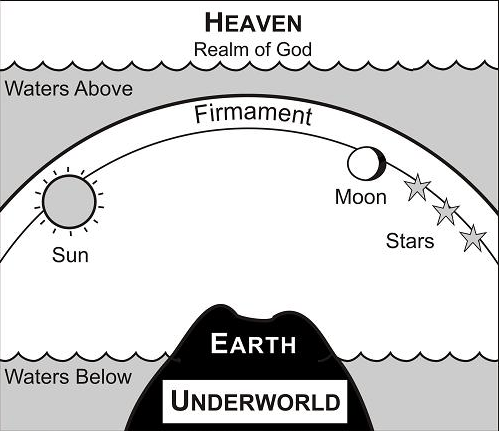

Let’s look at some passages, and I think you’ll see the similarities. Take Genesis 1:6,7, for instance:
And God said, “Let there be an expanse in the midst of the waters, and let it separate the waters from the waters.” And God made the expanse and separated the waters that were under the expanse from the waters that were above the expanse. And it was so.
What? This is probably one of the most confusing passages in this chapter if you’re trying to apply it to what we know of the cosmos. What does it mean to separate the waters from the waters? And what’s this “expanse” that it talks about? Well, verse 8 answers that for us:
And God called the expanse Heaven.
In other words, the expanse is the sky. It’s not “Heaven” in the spiritual sense, as we’ll see from some of the other verses. But how does the sky separate waters? We learn more starting with verse 9:
And God said, “Let the waters under the heavens be gathered together into one place, and let the dry land appear.” And it was so. God called the dry land Earth, and the waters that were gathered together he called Seas. And God saw that it was good.
So the waters under the expanse (sky) are oceans, rivers, etc. What are the waters above the sky? We can’t say it’s water vapor for two reasons: One, it doesn’t make sense in the context of the passage. But the second and more important reason is explained here (vs 14-18):
And God said, “Let there be lights in the expanse of the heavens to separate the day from the night. And let them be for signs and for seasons, and for days and years, and let them be lights in the expanse of the heavens to give light upon the earth.” And it was so. And God made the two great lights—the greater light to rule the day and the lesser light to rule the night—and the stars. And God set them in the expanse of the heavens to give light on the earth, to rule over the day and over the night, and to separate the light from the darkness. And God saw that it was good.
According to this passage, the sun, moon, and stars are stuck in the sky — the same sky that keeps back the “waters above.”
Now look again at the two images I posted above. Genesis is describing a system in which the sky acts as a dome around the earth. This dome has pretty lights stuck in it to help us see, even when it’s night. The business about water being above the sky makes sense when you think about it — why else is the sky blue? And where do you think rain comes from? We see this in Genesis 7:11-12, when God decides to flood the earth:
In the six hundredth year of Noah’s life, in the second month, on the seventeenth day of the month, on that day all the fountains of the great deep burst forth, and the windows of the heavens were opened. And rain fell upon the earth forty days and forty nights.
For people living at the time Genesis was written, this was not a bad job of explaining things. It explained why the sky was blue, where rain came from, and why we have the sun, moon, and stars. We can easily understand why they held these beliefs. However, in today’s age, the Genesis account is absurd. Efforts to make it fit with what we now know about the universe is a bit like trying to rationally argue for the existence of Santa Claus. Why not just put an end to all the mental gymnastics and accept that like every other religious text in the world, the Bible is just the product of mankind’s imagination? It may be a difficult proposition to accept, if you’re a firm believer. But I can tell you from experience that the whole thing makes a lot more sense when you stop assuming God had anything to do with the Bible.

 Finding Truth
OR, you let both of them wander off by themselves into traffic, and don’t give where they went a second thought —
LikeLike
You’ll miss me, and you KNOW you will! And when you do, and come crawling back to beg me to come and visit you — I will – ’cause that’s just the wonderfulness of myself! Well that, and my modesty —
So is this goodbye, for reals? (Sniff!):-(
LikeLike
You were drafted? You didn’t have an MOS?
I’m sorry arch, I appreciate your service anyway.
LikeLike
Yes, I did. Possibly with an all-volunteer army, your MOS is decided before you go in, but prior to that, your MOS was assigned you, based on a battery of tests you were given your first couple of days at your Basic location – lucky me, I got Fort Polk, we used to go out on the weekend and shoot down mosquitos with a 50-caliber machine gun.
LikeLike
And?
LikeLike
11 bravo
LikeLike
And we bagged a few, the rest just laughed and flew away.
LikeLike
You were in the service? Yay, you!
Maybe you’re not so bad after all —
LikeLike
You are crazy 😉
LikeLike
That’s the nicest thing you’ve ever said to me!
LikeLike
And I didn’t even have to lie!
LikeLike
Sorry if any of this is redundant, but I didn’t take the time to read all of the comments I missed. I did want to cover a few things related to this topic.
6 Days: In each creation event, Genesis says “…the evening and the morning were the ‘n-th’ day.” Genesis is defining what a day is: the period of dark followed by the period of daylight – in other words, literal days. I think believers are forced to say it is figurative when they become educated on the evidence of how the earth and life more likely came about. For itself, genesis seems to think it is 6 literal days, and if not, what is the figurative meaning of “evening” and “morning”?
Waters Above: This one always confused me as a child, but verse 20 of chapter 1 says that god made the birds to fly in the firmament. The same firmament that god supposedly placed the sun, moon and stars in verses 16 & 17. I think verse 20 really drives the last nail in that coffin because it shows the waters above to be at what we would call the atmosphere (genesis places the sun and moon under those waters). Even if the “waters above” referred to the frozen ice bodies in the Kuiper Belt at the limits of our solar system, we’d have a hard time placing birds in outer space.
The really curious thing is that the fundamentalist groups that I departed believed in what science tells us regarding the atmosphere and our solar system, but maintain a 6 literal day creation. Those fundamentalists, at least, cherry pick what’s literal and figurative – even from the same chapter.
Origin of Birds: Chapter 1 says from Water, and chapter 2 says from the earth. Should we combine the accounts and agree on swampland?
Genesis is simply incorrect. And only after learning it’s a failure do the believers start to claim it is really “figurative.” I guess if god is capable of anything and everything (even the absurd or impossible) then anything that can be imagined can be used to “validate” what one wants their holy book to say. When anything is possible for god, then any idiotic explanation becomes “possible.” It’s an “Emperor’s New Clothes” defense.
Instead of trying to work it out, if the believers had enough faith in god, then they should believe that god is good enough to speak clearly for himself. If he is that good, then we should be able to take a writing that is attributed to him and weigh it against the known facts and then see if it stands up to that scrutiny. When it does not, I wish they had enough faith to discard it instead of make excuses for it.
LikeLike
I can see where your coming from William. But if you believe in a mighty God who created the earth, why put him in box. I believe he created the earth fully matured, with trees that were a thousand years old, and caves with formed stalagmites and stalactites for our enjoyment. Not a ball of dirt and seeds. If you believe, than its not impossible that he created it in whatever order suited him and then put everything into motion when he was done. So I believe in something that can’t be proven, AND so do you. Maybe that will change in the future, I guess we shall see.
LikeLike
Laurie, that’s what I used to believe as well. I thought that if God made Adam and Eve as though they were adults, why couldn’t he have made the earth as though it had been here for billions of years? I even thought it was reasonable that he might have made fossils of animals that had never actually lived. Where do you stand on fossil evidence? Especially on fossil evidence of human settlements, tools, artwork, etc? That’s where some of the theory broke down for me a bit, when I was a believer.
LikeLike
Still here, making with the fairy tales? I thought you’d be deeply engrossed with the task of creating your own website and having my invitation engraved.
LikeLike
Nate, Good to hear from you. I believe that the antiquity of the earth c 4.7 billion years and the cosmos c 13.8 billion years are not in dispute. That God created it all over an extended period of time is a revelation in its self. It shows us that we are made in God’s image and likeness because we create in the same fashion. We “evolve” a creation through continuous improvement. The anatomical and physiological components of human beings developed as part of this process, and was completed sometime within the last hundred thousands of years or so. It was the addition of the human spirit that makes our creation complete, and I believe that is took place sometime before the Neolithic period began 12,000 years ago.
LikeLike
Hi Laurie,
With regard to God creating the universe to “appear” to be crazy-old, while, in fact it is “really” young…
…Does that rub you the wrong way?
Why would God choose to be so deceptive, and, well, dishonest? Surely He realizes the huge mess that has become of our curiosity over origins and the foggy view we get from the scriptures. If God is “unwilling that any should perish, but that all should come to repentence,” why would he intentionally cause so much doubt?
I guess I’m of the opinion that a God who’s fudging the log books has some real ‘splainin’ to do.
LikeLike
Ask that question often enough, and SOMEbody’s going to chime up with, “To test our faith!” which translated from religious-speak, means, “To test our gullibility!”
LikeLike
True, I’ve heard that excuse before too, Arch. But as you know, there are some significant problems with it.
If there is a god, then he’s definitely left us at least one revelation: creation. And creation reveals itself to us in the languages of math and science. As we decipher that message, we discover more and more about the universe we live in, and it’s a message that can be translated by anyone, regardless of their culture. Math and science transcend cultural barriers. Doesn’t it make sense that if God was going to communicate with us, it would be in a way that people from every nationality and ethnicity could understand?
So while it’s always being refined, there are still a great number of things we can treat as fact, based on what we’ve learned through math and science.
In addition to creation, there are also a great many written texts that claim to be divine revelations. When it comes time to analyze those to see if any of them are true, wouldn’t it make sense to compare their claims to what we’ve already learned from creation — the one revelation we can count on? When the texts contradict what we already know from science, that’s a really good indication that the text is false. To cling to the text and shun science seems like the worst tactic one could take. And as rodalena said, if God really expects us to do that, what does it say about him?
I don’t believe in a god, but I do understand why some people believe in one. I think there are some good, rational reasons for belief. However, I don’t understand the people that believe in the god of the Bible. It takes so much work to keep him propped up. The Bible’s account of creation fits what others in the Levant believed long ago, and it requires incredible amounts of twisting to warp it into anything resembling what we know of the universe today. The Bible contains many examples of contradictions, incorrect history, fantastical claims, failed prophecies, heinous morality, borrowed myths, etc.
If you have to work this hard to keep the Bible’s god relevant and believable, how great of a god can he really be?
LikeLike
Hi Howie,
I think you make a good point about using the word unreasonable. I don’t think the word reason defines what I meant.
And it’s true that we all use reason in some degree to come to conclusions. I suppose one of the differences between sound reason and misguided reason is how effective that reason is in meeting goals, and also if it accurately reflects the systems and interactions we move within this world.
Maybe the direction of our reasoning depends on the premises we start with. Jesus response to the Pharisees comes to my mind: He asked, Why are you reasoning in your hearts? When he healed the Paralytic (Luke 5:17-26).
Hope things are going well 🙂
LikeLike
Sorry to disagree with you this early in the discussion, Nate, but I must take exception with your statement, “If there is a god, then he’s definitely left us at least one revelation: creation.” – even if a god did exist (and I certainly do not believe one does), it does not necessarily follow that he/she/it created anything.
The Greeks, for example did not believe in a creator god – Greek poets envisioned various cosmogonies. The best preserved of these is “Hessiod’s Theogony,” in which hymn, out of primordial chaos came the earliest divinities, including Mother Earth herself: Gaia. Gaia created Uranus, the sky, to “cover” herself. The union of Gaia and Uranus produced creatures that later spawned the Titans, who in turn, bore such gods as Zeus Pater, Hera, Aphrodite, Apollo, and the rest of the clan.
There are other stories of gods who did not create the earth, but existed separately from it.
RE: “I think there are some good, rational reasons for belief.” Then we see in different wavelengths, because with all due respect, I can’t see them.
LikeLike
I agree with much of what you say Nate. I think we have to seek an integrated approach to try to understand any revelations of origins and purpose that are available to us. Observation using the tools of science is of the first order because it is current and widely accepted. Because I believe that any written divine revelation would not be limited in its readership to any particular time in history, the Bible has far more truth in it than any of the other written texts of religious origin available to us. That you speak of the creation, says that you are still open to the concept of a creator. This also says that you are being reasonable.
LikeLike
Laurie – “But if you believe in a mighty God who created the earth, why put him in box.”
I dont know, why?
I dont know that I believe that, and i dont think I’m putting him in a box. The bible claims certain things about god, so in a sense, the bible is putting god in a box. I’m just looking at that box and see that it’s flimsy and filled with holes..
Again, without talking about evolution or age of the earth, I think genesis 1’s portrayal of the solar system is contrary to what has been proven. The pictures posted with the blog post are accurate representations of genesis 1’s portrayal – and they’re wrong. They are not at all accurate. Therefore, the box that the bible placed god inside is flawed and consequently brings their notion of god into question.
LikeLike
Arch, good thoughts. This one struck me: “RE: “I think there are some good, rational reasons for belief.” Then we see in different wavelengths, because with all due respect, I can’t see them.”
I had been in agreement with nate on this one, but I find myself agreeing with you too. Perhaps If I were to accurately express my thoughts on this it would be to say that at a certain, early stage in a person’s quest for knowledge, it could be rational to think that god(s) created the world, etc. Like Thomas Paine said, I have seen nothing create itself, so it stands to reason that everything was created – ie, creator (paraphrased, or course).
But once a person acquires enough knowledge, it may become unreasonable to continue in such a belief.
Similar to Aristotle’s notion of falling objects; that the heavier would fall faster than the lighter seems reasonable on the surface…
LikeLike
I’ll have to take your word for Paine’s opinion on creation, but I do know he didn’t think too much of Moses:
LikeLike