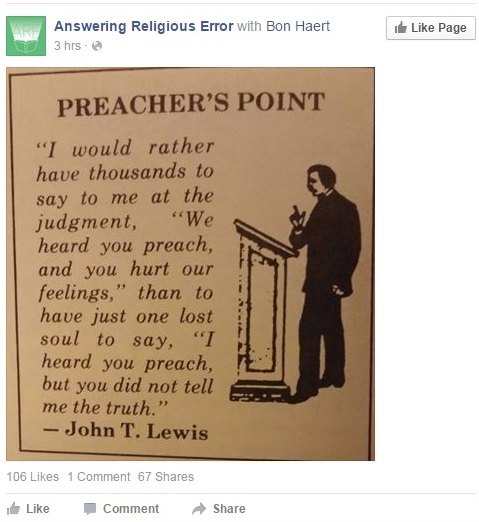
 Saw this today on Facebook and my blood started to boil. First of all, it was “liked” by one of my family members — a person who won’t discuss our differences. It really ticks me off to see her “like” a statement about truth, when she won’t defend that same statement.
Secondly, the quote says that a preacher would rather offend thousands than to fail to preach the truth to even one individual. Sadly, preachers don’t realize that they’re doing both the entire time.
Finally, if you bother to check out Answering Religious Error, it’s like shifting into another dimension. Each post is wrangling over some trivial detail, seemingly oblivious to the deluge of information that makes their entire stance irrelevant. I say “seemingly” rather than “completely,” because apologists of this stripe often do know some of the information that contradicts their stance, but they try very hard to keep their followers from discovering it.
I’ve gotten some flak over the years for the name of my blog, but I view “finding truth” as something aspirational — I’m not claiming to have found it. But “Answering Religious Error” definitely comes across as arrogant, especially when they’re so demonstrably wrong.

 Finding Truth
I didn’t start this, Nate. He’s your guest, it’s up to you where this goes from here —
LikeLiked by 1 person
Remember Arch imitation is the greatest form of flattery.
Terry I can provide Scriptural references, but I am loathe to devote my time to doing this unless you are prepared to seriously examine the points raised. I suppose I am surprised that as an expert in Scripture you would be questioning these points Arch and I have raised as they are hardly matters of dispute, rather they are plainly in the text for any objective reader to see.
Matters like the Messianic Secret in Mark is standard reading in any introductory text on the New Testament. Perhaps you could look at Craig Blomberg’s work ‘Jesus and the Gospels: An Introduction and Survey’, he is a well regarded evangelical scholar with a high view of Scripture. there is also an short article on the matter Here from the Oxford Biblical studies site.
The key to what Arch and I are saying is that the picture of Jesus varies between the Gospels.
LikeLiked by 1 person
Arch, Terry is starting to sound like our old troll Mike Anthony. Remember him and his sidekick Kathy ? Just sayin……
LikeLike
kcchief – I thought we weren’t supposed to utter that name?? Hope you didn’t kick the hornet’s nest. . . 🙂
LikeLiked by 1 person
Oooops ! You’re right Carmen! I’ll zip it. crickets …………………
LikeLike
Terry isn’t Mike. But it’s funny that you bring that up and call him a troll, Terry is one of the administrators of his facebook page, “Answering Religious Error,” where he often calls me a troll.
Terry may be trolling now, but out of fairness it’s only after he thought some from here were trolling his FB page. I wouldn’t speak for nate, but I wouldn’t mind any christian coming here, regardless of their intention. I really think that truth becomes evident, that reason and logic will expose absurdities.
The bible is what it is. An honest person can see which side makes most sense.
And Terry, shortly after your first comment, Arch did post quoted text from each Gospel to illustrate his point. It’s on this very thread, so all you should have to do is scroll upward to find it.
LikeLike
Thx William. I haven’t been blogging much lately so I really do appreciate your comments.
LikeLike
Hi Terry,
First of all, I think using “Archaeoptometry” is irritating arch. You may not realize it, and perhaps you didn’t see our earlier discussion about it, but you’re mistyping his name. It’s actually “archaeopteryx,” named after the famous fossil of a feathered dinosaur. To stay on the safe side, I suggest just shortening it to “arch,” like the rest of us.
I agree with arch and Peter that the passages concerning Jesus before Pilate are pretty easy to check out, but since you’re asking for them, I’ll provide them.
In John, Pilate and Jesus speak to each other twice. While this passage starts with “Pilate entered his headquarters again…” this is only the first time he’s speaking to Jesus.
And here’s the second interaction:
And now the synoptics:
It seems hard to square the statements “he gave him no answer, not even to a single charge” with all the conversation in John. Of course, this is also relevant, because many Christians believe that when Jesus was before Pilate, he fulfilled the “prophecy” from Isaiah 53:7:
LikeLike
Nate, I really admire your discipline and patience.
A challenging text for those who consider the Bible inerrant is Mark 2:26 where Jesus refers to Abiathar as being the High Priest when David and his men were given sacred bread to eat. A check of 1 Samuel 21:1-6 will reveal that the High Priest at that time was actually Ahimelech the father of Abiathar.
Apologist do admit that this text is somewhat problematic.
LikeLiked by 2 people
That’s true. I’ve seen some of them try to explain it by saying that Abiathar was still alive during that time, but to me, that’s like saying 9/11 happened during the days of President Obama. While he was certainly alive, the implication is pretty clear that he was currently in office.
LikeLiked by 1 person
There are no “problems, discrepancies, or errors” for inerrantists regarding the Bible. There is ALWAYS a harmonization…regardless of how absolutely far-fetched some of them are. Three of the most absurd to me are these:
1. The story of Judas: Did he hang himself or did his body implode? Did he buy the Potter’s Field or did the Jewish authorities?
2. The interaction of Mary Magdalene with the risen Jesus and the angels at the tomb. Did the angels tell her that Jesus was risen or did Jesus himself? Did Jesus allow Mary to touch him or did he forbid her because he had not yet ascended to the Father?
3. Did Jesus command the disciples to go to Galilee to meet him or did he order them to stay in Jerusalem until the coming of the Holy Spirit on Pentecost?
These three discrepancies alone should be enough proof to Christians that the Bible is not inerrant and that the “facts” presented in the Bible are not trustworthy…but alas, Christians always scramble to find a harmonization for a way out.
LikeLiked by 2 people
Great examples, Gary. I’d add Jesus’s divergent genealogies to the list as well. And his birth narrative.
LikeLiked by 1 person
Yes, you are right, Nate. It is amazing the harmonizations that Christians come up with to make the two genealogies harmonize. The most clever is that the genealogy in Luke is of Mary’s father thereby making Jesus a descendant of David, of the tribe of Judah, through is mother. When I point out to Christians that tribal association is only passed down from the father in Judaism, they ask me for a chapter and verse where GOD said that the messiah had to be descended from David on his father side.
They always have a comeback.
LikeLike
The real kicker to me are the places where the genealogies come back together but then diverge again. Those divergences are just as problematic as the ones concerning Joseph’s father.
It’s also funny to me that some apologists claim one of the men is Mary’s father, but they didn’t list Mary because she’s a woman. Yet Matthew’s genealogy references both Ruth and the harlot Rahab.
Confirmation bias at its best. 🙂
LikeLike
Unforgettable.
LikeLike
Regarding the birth narratives, this is the most clever “harmonization” that I have seen:
Luke’s narrative is the actual birth. There were no wise men present at Jesus birth. Soon after the birth of Jesus, the family returns to Nazareth, passing through Jerusalem for Mary’s purification. Sometime later, and prior to Jesus’ second birthday, the family moves from Nazareth to Bethlehem to live in a house. It is above this house that the star of Bethlehem comes to rest and to which the wise men arrive with gifts, to present to a two year old Christ child, not to an infant in a manger. Shortly after the visit of the wise men, Joseph is warned in a dream of Herod’s plot to kill Jesus and the family flees to Egypt.
Anyone see a hole in this harmonization?
LikeLike
I told him that too, Peter.

LikeLike
Sorry – William!
(Still working on my first coffee –)
LikeLike
Regarding the convergence and divergence of similar names in the two genealogies, I have heard this harmonization: “Many of the names in the two genealogies are common names, similar to “John”, “Matt”, “Mark”, “Tom”, “Joe” in our culture. The commonalities are simply a coincidence.
LikeLike
Yeah, Gary, I’ve heard that one before too (about the birth narratives). I see a some potential issues:
First of all, the biggest problem is that no such move is recorded by either author, when recording it would have completely erased the appearance of a contradiction here. Sounds really suspect, since this is supposedly a book inspired by a perfect deity.
When the wise men come to Jerusalem asking about where the Messiah is supposed to be, the chief priests and scribes tell them Bethlehem, because of a prophecy. How strange then that Mary and Joseph have just happened to move back to Bethlehem. Because (according to this theory) while Jesus was born in Bethlehem, the family had immediately left. If not for this move that no one records, then the wise men would have missed them altogether.
Also, if the family’s hometown was Nazareth, once they knew Herod was on the lookout for them, why not just go back there? They would have been just as safe in Nazareth as in Egypt.
Finally, when they come back from Egypt, Nazareth is referred to as though they’d never been there before (Matt 2:22-23):
And the prophecy about being a Nazarene would have already been fulfilled when Jesus lived there earlier.
LikeLike
About the genealogies, regardless of how common the names might have been, Luke includes many more generations than Matthew does. So they still don’t match up.
LikeLike
Just look at all of the extra work you had to do, Nate, just to satisfy someone who, if he knew scripture, should have already known it.
Why don’t we start Terry with this?

LikeLiked by 1 person
Incidentally, I worked up this spreadsheet comparison of the genealogies several years ago. Not very pretty, but I think it’s point is clear if you spend a few minutes with hit:
LikeLike
“Did Jesus allow Mary to touch him or did he forbid her because he had not yet ascended to the Father?”
Which itself creates yet another contradiction, Gary, because he didn’t “ascend” until he had already offered the disciples the opportunity to feel him all over, including dipping a hand into the spear gash in his side. (EWWWWW!)
And yet another one, in that he told the thief on the cross that that night, he would be with him in paradise! If he wasn’t with big daddy, where was he for three days while his brain cells, without oxygen, were turning to mush?
LikeLiked by 1 person
Playing the Devil’s advocate:
There is nowhere in the Bible that says that Jesus only ascended once. And where was Jesus’ (spirit) during the three days his body was decomposing in the tomb: in Hell, bringing the saints with him to heaven. So here is the scenario:
1. Jesus body dies on the cross.
2. Jesus’ spirit immediately goes to Hell to take the righteous in Paradise to their new home in heaven. Jesus presents the occupants of Paradise to the Father.
3. On the third day, his spirit returns to the tomb to be reunited with his reanimated-but-supercharged body, which levitates out of the tomb and makes a quick trip to heaven to check on the new occupants of heaven to make sure that everyone has moved into their personal, custom-designed mansions and that everyone is happy.
4. Jesus then beams back to the Garden where he meets the women leaving the empty tomb. He allows the women to touch his feet but denies Mary’s request to embrace him, as he needs to make one more trip to heaven before his body as a whole can be embraced (feet embracing was ok). He beams himself to heaven to see his Father for a few hours, and then beams back to the Upper Room to be embraced bodily (not just his feet) by the Eleven.
5. Sometime in between beaming down to the Upper Room, Jesus teleports over to Emmaus to freak out two of the disciples.
6. Jesus ascends forty days later.
7. Jesus descends at least once more to appear as a talking, bright light to Paul, the thirteenth apostle, and according to Paul, the greatest apostle of all.
8. And then Jesus teleports himself again to sit at the right hand of the Father, although if you are a Calvinist, only Jesus spirit could have appeared to Paul, as Calvinism does not allow for Jesus body to move one inch from the right hand of the Father until the Second Coming.
LikeLiked by 1 person