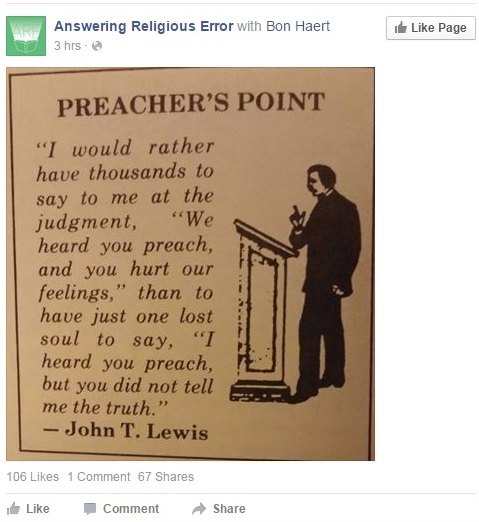
 Saw this today on Facebook and my blood started to boil. First of all, it was “liked” by one of my family members — a person who won’t discuss our differences. It really ticks me off to see her “like” a statement about truth, when she won’t defend that same statement.
Secondly, the quote says that a preacher would rather offend thousands than to fail to preach the truth to even one individual. Sadly, preachers don’t realize that they’re doing both the entire time.
Finally, if you bother to check out Answering Religious Error, it’s like shifting into another dimension. Each post is wrangling over some trivial detail, seemingly oblivious to the deluge of information that makes their entire stance irrelevant. I say “seemingly” rather than “completely,” because apologists of this stripe often do know some of the information that contradicts their stance, but they try very hard to keep their followers from discovering it.
I’ve gotten some flak over the years for the name of my blog, but I view “finding truth” as something aspirational — I’m not claiming to have found it. But “Answering Religious Error” definitely comes across as arrogant, especially when they’re so demonstrably wrong.

 Finding Truth
I have a question for my fellow skeptics: Which do you feel is the better way to break through the brainwashing of conservative Christians:
1. Point out and debate the alleged contradictions in the Bible.
2. Point out how silly and ignorant it is to believe in the supernatural.
I left this message on the blog of our visitor Terry:
The supernatural is not real. Ghosts are not real. Goblins are not real. Warlocks are not real. Witches are not real. There has never been any scientific demonstration that the supernatural exists. When bad things happen, such as lightning strikes, earthquakes, droughts, educated modern human beings no longer blame these unfortunate events on ghosts, evil spirits, and angry deities. We know that there are natural explanations for all these events.
Yes, our universe operates by a set of natural laws, it is true. Where did this “fine tuning” come from? We don’t know. But instead of jumping to the conclusion that a “god did it”, let’s keep studying the evidence, just as we did for the cause of lightning strikes, earthquakes, and droughts. We just may find out, yet once again, that a god…DIDN’T do it.
LikeLike
“…silly and ignorant” make me feel good, but other than that, doesn’t accomplish much beyond further entrenching them within their belief system, as they rebel against your accusations.
Debating the contradictions does little good either, as their experts have already combed the Bible, looking for just such contradictions and, finding them, have concocted reasons as to why they’re not contradictions at all – maybe not good reasons, but how good would they have to be to satisfy someone who already believes in the first place?
I guess the answer would have to be, “None of the above,” but someone such as Nate, Peter, Zoe, Neuronotes, or Ain’tNoShrinkingViolet could answer that more accurately than I, as, granted, they can’t speak for everyone, but they are at least cognizant of what convinced them to set aside their own beliefs.
LikeLike
A lot of what helped me was that I already understood that the Bible needed to be pretty unassailable, because its main purpose is to reach those who don’t already believe. So any hints that it’s inaccurate will turn people away, even if they aren’t strong enough problems to drive out the faithful.
That’s why, when I finally had a reason to look at some of the evidence against it, I was really troubled by how good it was. Even in areas where there were halfway decent explanations, the fact that these explanations aren’t provided in the text but take maneuvering made me really uncomfortable. And the sheer number of problems just became too great to ignore.
For me, contradictions were the key. But I already intuitively understood the outsider test for faith. So maybe that’s actually what we should be starting with…
LikeLiked by 1 person
I found this some time back, from The Jewish Encylopedia, regarding Genesis:
This is written by Jewish people who, more than any others, have the most to gain by covering up what they rather choose to admit freely – contrast that degree of honesty with that of a Christian evangelical.
I should have saved this for the Jewish website that Ark invited me to, then abandoned me, leaving me to fend for myself with no backup.

LikeLike
nate, I was much the same.
Once I finally allowed myself to honestly consider that the bible might not be what it claimed, suddenly everything finally became clear – all the stuff that didn’t make sense wasn’t because it God’s wisdom was greater than mine, it was because it didn’t make sense.
LikeLike
terry’s site is hard for me to follow. I don’t think my comments have been allowed up yet… but I am not sure, i just cant find them.
LikeLike
Here is a further question: Do you think that most people who deconvert from conservative Christianity do so because THEY saw a problem, investigated it, and deconverted, or, did someone approach them with evidence against conservative Christianity, and they were convinced by that evidence, from someone else, to deconvert?
LikeLike
Great question. I don’t know. For me, I ran across the articles on my own. I think if someone had come to my site, or spoke to me in person, I might have been much more defensive. But I wasn’t actually talking to the person whose articles I ran across. I simply read them, but then had time to think about them and research their sources on my own. I think that’s the biggest difference.
LikeLike
hm. It looks like all of my comments on Terry’s site are being marked as Spam….
LikeLike
weird…
LikeLike
I recall reading the initial issues like nate did. But for me, it wasnt even the initial issues, it was all the comments.
I mean, I was troubled by what i read, but thought that it must clean up somehow. but in the comments, I saw believers raise some of the questions I had in my own head, and saw the author make short work of them. and the rest of the comments, I saw that the believers struggled so much more, and had to work so much harder and ended up having to say that this meant that, or vise versa, and then were also so overly critical of why people wpouldnt believe.
If they believed it, okay, but i jsut could not understand how they could act like it was absurd for someone else to have issues with it, especially when they presented what looked like good cases to me. It seemed so extreme, that it looked like they were just being dishonest, like children clamping their ears shut as they scream, “I CANT HEAR YOU!!”
LikeLike
Nate, William and others:
When you came across evidence against your Christian beliefs, was it primarily information on skeptics’ sites or comments by skeptics on Christian sites?
Could you name the sites and blog authors who were instrumental in your deconversions?
For me, my deconversion happened when I went on the blog of an ex-Christian atheist in an attempt to re-convert him, this time to my “flavor” of conservative Christianity. I obviously failed in that endeavor.
LikeLike
William are your comments being blocked on Terry’s Facebook page or his website? My comments on his website have been posted instantaneously.
http://www.answeringreligiouserror.com/contradictions/silent-and-chatterbox-at-same-time/
LikeLike
I think it’s automated. Terry may not even know. Some of William’s comments have gotten flagged as spam here before too. Not sure why.
LikeLike
Gary, in my case it was less what was said, but rather who said it, that counted. When I was a believer I was automatically on the defensive against any objection raised by atheists as I knew they were not objective. What got under my guard were comments raising doubts from folk who were meant to be Christians or at the very least were sympathetic to Christianity.
LikeLike
I posted this to ARE’s FB page. I’m at work so it may be a little too rambly, but other than that, your thoughts? Is my reasoning sound, or have I made some missteps?
Posted to ARE FB Page:
You Wrote,
“All interpretations of the past through that chosen lens ignore God’s testimony and thus will be wrong, though they give an explanation from that perspective”
But this assumes you know what God said.
It is an assumption, as the bible only claims to know what God said.
I don’t think they start with the assumption that there cannot be a god or that there could not ever be divine intervention or interaction, but instead they take the approach that since there are so many claims of so many different gods throughout time, along with claims and stories of magic and voodoo and what have you, that they strive to look for a natural explanation, as so far in most of our lives, that’s all we’ve experienced – natural events with physical causes.
So which god is right and what is the criteria for establishing that? Is it an arbitrary selection, or actually based on something tangible and definable? And if so, what?
But history doesn’t only come to us through written record, but in archaeology and geology and so on. Do the claims in history match those records? Do they agree or disagree? Or both?.
And what scientific advances have been made by scientists who’ve viewed their research through their religious lenses?
And is it possible that a God or gods or your God is real? Sure, it’s possible. But not every claim is the same is it? George Washington Crossing the Delaware on a boat isn’t a huge stretch. We have many other sources that say he was in the area. And men have been crossing bodies of water in boats for a long time, so nothing about this is outside the realm of possibility.
But what if we had a claim the George FLEW across the Delaware? Is this claim on the same level as the one that said he crossed by boat? Would one of these claims require more evidence to believe?
I think so, do you?
And if the Bible was the only holy book, and Christianity the only religion, speaking about the only God ever mentioned, then maybe it would be easier to default to this God over atheism, but that’s not the set up. In biblical times, and all the times surrounding them, there were many claims of many gods with miracles ascribed to all sorts of historical figures. The choice isn’t one or the other, but it’s a choice with thousands of options.
Even Tecumseh had miracles and prophecies ascribed to him.
There were 8 witnesses who signed letters of testimony that they saw Joseph Smith’s Golden plates and a few even signed off on having seen the Angel who spoke with Smith – do we believe them? Their religion has stood up so far to time and their college football team is even respectable…so it must be true?
So with all the miracles and gods claimed and credited throughout time, you’d say that only a small fraction are legitimate – so then naturally a researcher would be skeptical of such claims, and would likely try to interpret all such claims through a natural view point, and who could blame them?
There are even events that aren’t supernatural that historians are skeptical of and take very loosely and will even say are doubtful and then give what they think is much more realistic – like numbers of enemies or friendlies killed in battle, as they could have been embellished or underreported for propaganda reasons, and so forth.
What makes the bible better than all the others?
If you say “great prophecies” again, I’d really like you to put up an example, because I don’t see any.
And then you have criticized me that since I don’t believe the bible is from God, then it’s because I haven’t read or studied enough. But that speaks to a bias, as even if you’re right, I’ve still read and studied the bible far than you have read and studied the Koran. MICHAEL has criticized that I haven’t read the bible enough in Greek or Hebrew, and this also exposes a bias. How many of you have read the Koran in Arabic? And then what about all the other religious texts out there? How much time have you spent studying and researching those?
You likely read a little (if any) and dismissed them as I did because they appear to have problems. It’s also what I have found in the bible. But if you criticize me for my efforts (which have been extensive and still ongoing), then you’re criticizing yourselves for not investigating the other religions just as much. Anyone can say, “you just haven’t studied enough,” or “you just want it to be wrong,” or “you’re too worldly minded,” or “you’re not honest enough,” or “you haven’t studies it through the original language or didn’t consider the time period it was written in,” regarding their religion. Anyone can do that. There’s always more to learn and read, so if I haven’t read enough yet, then neither have you.
So with all that in mind, why should a scientist or Historian just accept religious, miraculous and divine claims, and what’s the method they should use to differentiate the good from the bad?
And can you provide an itemized list of reasons why the bible can be trusted as being the only Divine text? Perhaps we could address each point, one at a time.
LikeLiked by 2 people
Actually, William, that’s one of your best comments ever.
LikeLike
Yep, I’m with arch on that one. Very well said, William 🙂
LikeLike
Oh, and Gary, to answer your question from yesterday, there were three main things that kicked off the research that led to my deconversion.
One was a scathing comment made on my blog (here) in a response to one of the posts I had written while still a believer. His point was so well reasoned that I didn’t even reply to it. I just thought about it.
Another of the factors was a paper I read about Hell, titled “Hell, No!” — I think there was a subtitle too, but I can’t find it right now. If I do, I’ll post a link to it. It went through a lot of the logical problems with Hell, and also pointed out the scriptural issues: like it’s not mentioned in the Old Testament and uses various Greek terms for it in the New.
The final thing that really launched my research were the articles on the Book of Daniel. They were on a blog called Darwin’s Beagle, which was hosted by progressiveu.org. ProgressiveU’s site has been down for a long time, though, so none of that content is around. Luckily, I happened to find those articles just before their site began experiencing problems. And when I went back to find the articles, and realized they were down, I found them in Google’s cached pages and copied them. After getting permission from the blog’s author, I reposted them here. Most people think I wrote them, even though I preface each article saying I didn’t… but what can you do? You can find the links to each article here, though if I remember correctly, I think you’ve read these already…
Anyway, from there, I stuck to books. I didn’t really start back blogging and reading other blogs till I had already deconverted. If you’re interested in the books I’ve gone through, just click the page “Books I’ve Read”.
LikeLike
Thanks for the info, Nate. I’m going to read the comment you linked.
An FYI regarding my discussion over on Theology Web. I think I have Nick (the buddy apologist) caught in a corner. It will be interesting to see how he gets out of it, if he can:
http://www.theologyweb.com/campus/showthread.php?7724-Comment-Thread-for-The-Resurrection-of-Jesus-Apologiaphoenix-vs-Gary&p=253195&viewfull=1#post253195
Nick is really big on scholarship. He insists that we skeptics should accept the historicity of the Empty Tomb for the simple reason that the “majority of NT scholars” believe it to be historical. I have turned the tables on him. The OVERWHELMING majority of scholars do not believe that the Exodus is historical. Nick is an inerrantist. If the Exodus is a fable, Nick will have to admit that Jesus made a mistake because Jesus believed that events in a fable (the Passover, the Exodus, the giving of the Ten Commandments) were real. Jesus was wrong, therefore Jesus was a man, not a god.
LikeLiked by 1 person
Sounds interesting — I’ll check it out!
LikeLike
Have you mentioned, Gary (re, the empty tomb), that there was an entire night before guards were placed on the tomb? In fact, I believe, if memory serves, that that was your own earlier observation.
LikeLike
Hi Arch,
Yes, I did. They still dream up every possible reason why, even if the tomb was left unguarded for a period of time, it is “absolutely implausible” (their exact words) in that culture that anyone would steal/remove the body. I give them hypothetical suspects such as grave robbers, religious relic collectors, the disciples, Pilate, a subset of the Sanhedrin, but nope, none of these people would have ever done such a thing. There is therefore only one possibility left:
…an ancient Canaanite god named Yahweh teleported into the tomb and regenerated the bloated, decomposing, brain-dead body of a first century Jewish prophet, who then walked out of the tomb in his new super-hero body, ate a broiled fish lunch with his former fishing buddies, and finally levitated into outer space to never be seen again…
🙂
LikeLiked by 1 person
That certainly makes sense to me —
LikeLike
Gary, appealing to the view of the majority of scholars would lead one to conclude that 2 Peter was not written by the apostle Peter, which has implications for the truthfulness of the Bible.
LikeLiked by 2 people