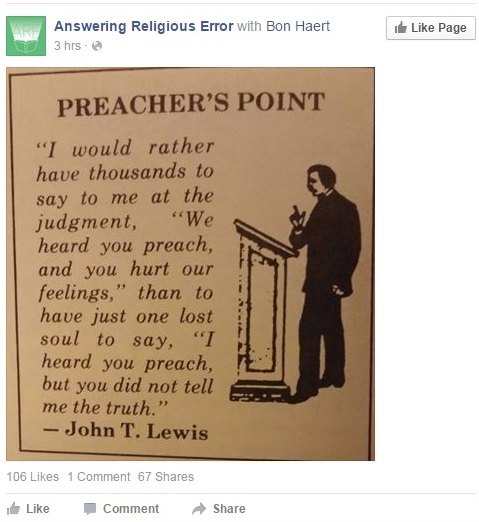
 Saw this today on Facebook and my blood started to boil. First of all, it was “liked” by one of my family members — a person who won’t discuss our differences. It really ticks me off to see her “like” a statement about truth, when she won’t defend that same statement.
Secondly, the quote says that a preacher would rather offend thousands than to fail to preach the truth to even one individual. Sadly, preachers don’t realize that they’re doing both the entire time.
Finally, if you bother to check out Answering Religious Error, it’s like shifting into another dimension. Each post is wrangling over some trivial detail, seemingly oblivious to the deluge of information that makes their entire stance irrelevant. I say “seemingly” rather than “completely,” because apologists of this stripe often do know some of the information that contradicts their stance, but they try very hard to keep their followers from discovering it.
I’ve gotten some flak over the years for the name of my blog, but I view “finding truth” as something aspirational — I’m not claiming to have found it. But “Answering Religious Error” definitely comes across as arrogant, especially when they’re so demonstrably wrong.

 Finding Truth
William, if you don’t mind, do me a favor and post the link back to this page as a comment on his Facebook post. That way, anyone who sees his post pop up in their feed will know where to go if they want to see the full context. Thanks!
LikeLike
done
LikeLike
thank you 🙂
LikeLike
I’ve done the same thing on his actual website, but the comment’s currently in moderation.
LikeLike
I did not know that. Thanks, Peter.
LikeLike
“…if you’re posting them for Terry’s benefit….” – Terry who –?
LikeLike
Here is a point that I believe that all biblical inerrantist Christians such as Terry should consider:
Most if not all biblical inerrantists believe in this adage: “If there is ANY explanation that resolves an alleged discrepancy in the Bible, then there is no discrepancy.” If you believe this adage is true, then you will NEVER find an error in the Bible. The problem is, why then can’t other religions use this same adage for THEIR holy books? If Christians can explain away alleged discrepancies in the Bible with any explanation, then why can’t Mormons do the same for the Book of Mormon; Muslims do the same for the Koran; and Hindus do the same for the Hindu Scriptures?
If you start out with the premise that your holy book CANNOT be wrong, then you will always find an explanation to explain away the most blatant of discrepancies.
I challenge Terry and other Christians to do this: Use the same level of skepticism about YOUR holy book as you would for the holy books of other religions. For instance, when the Mormon holy book says that ancient Hebrews living in North America used horses, and archeologists say that there were no horses in North America during the alleged time that these ancient sea-faring Jews were inhabiting North America, then instead of attempting to find an explanation to harmonize this discrepancy, accept the fact that whoever wrote the Book of Mormon made a mistake. The author didn’t know that there weren’t any horses in North America during the period of time his story (allegedly) took place.
And the same is true for the discrepancies in the Bible. For instance, when you look at the two genealogies of Jesus, instead of trying to harmonize them by making Luke’s genealogy that of Mary’s father, even though the author of Luke specifically says the genealogy is of Joseph, accept that the authors of these two genealogies made mistakes.
LikeLiked by 1 person
“I asked him then why it was that the story of the Women caught in adultery (now in John’s Gospel) was not in any of the early manuscripts.
ColorStorm just ignored my question and never responded.”
Typical Colorstorm behavior. I’ve thoroughly addressed the “woman taken in adultry” story as first having been added to Luke in the 4th century, then shifted to the Gospel of John, and for my effort, received a faceful of flung scripture.
LikeLike
Not a response to anything, just some interesting information. I subscribe to a Jewish online magazine, “Chabad.org”, and thought some might find an interest in this:
LikeLike
1. “Rosh Hashanah, the day when G‑d determines our fate for the rest of the year
2. “…then there’s Shabbat Bereishit, when we read the first portion of Genesis. It is said that the way we conduct ourselves on Shabbat Bereishit will impact the entire year”
Am I the only one who sees a contradiction here? Can 1 and 2 be simultaneously true?
LikeLiked by 1 person
Ladies and Germs, sad news – this will be my last comment here (except possibly for the next one) – Christian Group Says Today Is The Day We Will Be ‘Annihilated’
LikeLike
It’s been great knowing you, except for Mike, Kathy, unkleE, Colorstorm, and what was his name? Ah, yes, TerryToons —
And to Pauli:
I think I’ll miss you most of all —
LikeLiked by 1 person
I don’t use Facebook so I can’t check out the conversation there, but I’ve got a real pissed off fundamentalist on Terry’s blog, AnsweringReligiousError, trying to tell me that the two accounts of Judas’ death are harmonizable and that I am an idiot for not seeing it. He’s really breathing fire!
http://www.answeringreligiouserror.com/contradictions/silent-and-chatterbox-at-same-time/
LikeLike
Ah, that’s the same guy that was commenting on Facebook last week. He reminds me of someone…
LikeLike
It is amazing how aggressive and rude many conservative Christians become when their beliefs are challenged. To me, it is a sure sign that conservative Christianity is a cult.
LikeLiked by 1 person
Yeah, I agree. Look, some of us can be rude here too, from time to time. But I do feel like a number of them are rude right out the gate when you present them with something they don’t like. There seems to be very little consideration that their position could be wrong. Too, you’d think with all the positive attributes claimed by Christianity, that Christians would be especially considerate. Some are — but like you said, they often seem to be moderate Christians, not conservative ones.
LikeLike
Two different sources, two different stories – the man’s a fool.
LikeLike
Terry and Michael (his fundamentalist supporter) are beyond hope, I’m afraid. I left this message on Terry’s blog:
Dear Terry,
You, like Michael, have been brainwashed to believe that an ancient myth from the Levant is historical fact.
Sadly, it is probably too late to save you and Michael. But it is the goal of secular humanists such as myself to spread the TRULY Good News of freedom; freedom from the fear of imaginary, vindictive, self-absorbed ghosts, goblins, ghouls, and gods. We know that many people caught up in this superstition, such as yourself, will refuse to listen and will continue to live your lives consumed with fearing and obeying an ancient superstition. However, it is our hope to save future generations from the tyranny of your ancient cult’s superstitions; superstitions which are responsible for massive discrimination, suffering, persecution, mass killings and mass murder…all in the name of an imaginary ancient Canaanite deity, named Yahweh.
How very sad.
The battle for freedom from fear and superstition goes on, Terry. I hope that one day, you and Michael will come to your senses and join us.
Peace, my misguided fellow human.
LikeLiked by 1 person
Gary, it is to be expected that fundamentalists are threatened by those who say their faith is illusory. It is especially threatening to them when it comes from someone who had once embraced their faith wholeheartedly.
The anger and vigor of their response is testimony to it being emotionally rather logically based. If you are correct then their whole world view crumbles. I would suggest that the robustness of their response shows that they know at one level they can’t refute your arguments.
The notes from a religious preacher of years past said, ‘argument is weakest here, shout loudly’.
A more moderate religious voice provides wisdom in this case that those folk would do well to emulate:
Though argument may not work because, as mentioned above, belief tends to be emotionally based. Indeed I found the following quote on a religious site:
LikeLike
Saw a fascinating defense of Bible contradictions on another site. To paraphrase it:
Classic spin, turn your weakness into a strength. However It does not take much contemplation to realise the slippery slope this type of reasoning leads one onto.
LikeLiked by 1 person
Yes, Peter, the spin they use is incredible. It’s very, very clever. But it should be. They’ve had two thousand years to concoct them.
LikeLike
Everyone still here? Whew! That was a close one —
LikeLiked by 1 person
SO God purposely made his Word appear to have errors to trip some people up. And if they think it is erroneous, as God in his wisdom decided to make it appear, then he will condemn them for thinking it was what it appeared ti be…
Of Course, had i only considered this before, i may still be a Christian.
LikeLike
“The Holy Spirit deliberately introduced these issues into the text to confound the wise and to test the faith of the reader.”
Of COURSE he/she/it did, the sneaky little sucker – it’s a reverse I.Q. test, if you pass, you fail.
LikeLike
Some might be interested in what Kuba has to say this morning, in her article, “Opium of the People” —
LikeLike