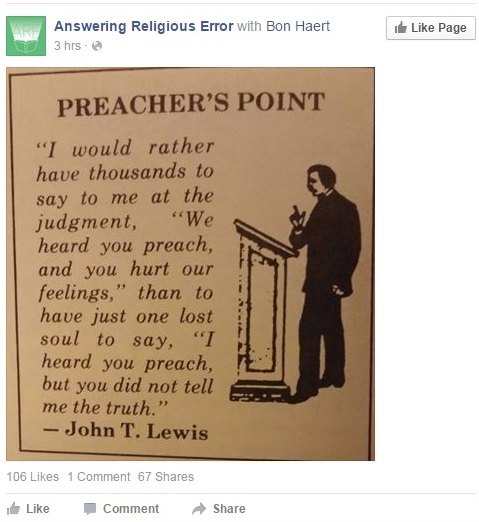
 Saw this today on Facebook and my blood started to boil. First of all, it was “liked” by one of my family members — a person who won’t discuss our differences. It really ticks me off to see her “like” a statement about truth, when she won’t defend that same statement.
Secondly, the quote says that a preacher would rather offend thousands than to fail to preach the truth to even one individual. Sadly, preachers don’t realize that they’re doing both the entire time.
Finally, if you bother to check out Answering Religious Error, it’s like shifting into another dimension. Each post is wrangling over some trivial detail, seemingly oblivious to the deluge of information that makes their entire stance irrelevant. I say “seemingly” rather than “completely,” because apologists of this stripe often do know some of the information that contradicts their stance, but they try very hard to keep their followers from discovering it.
I’ve gotten some flak over the years for the name of my blog, but I view “finding truth” as something aspirational — I’m not claiming to have found it. But “Answering Religious Error” definitely comes across as arrogant, especially when they’re so demonstrably wrong.

 Finding Truth
“I knew you were not looking at the accounts correctly” – THERE it is!
LikeLike
Pay no attention to the man behind the curtain, Carmen – you GO girl!
LikeLiked by 1 person
More likely, Gary, he’s doing what I like to call the Testament Twist – a soft-shoe that allows Christians to warp and twist scripture to make things say what they want them to say.
LikeLike
This just in – euthanasia bill passed today in California.
LikeLiked by 1 person
Think we could get some volunteers , Arch ?
LikeLike
“The other way was for Jesus to have told him all about it after His resurrection. Did you forget that part when you asked.”
The Gospel of John was written anonymously, TerryToons, around 100 CE – are you saying that JC popped back down 70 years after he died, to impart that bit of information to pseudo-John?
LikeLike
You know, KC, anybody that mentions chemicals as often as does TerryToons, must have a real dependency problem.
LikeLike
I think you might be on to something , Arch.
It’s kinda like Ted Haggard blasting gays.
LikeLiked by 1 person
One can only wish, KC – it’s amazing, Christians have this beautiful paradise just waiting for them, yet none seem to be in a hurry to go there —
LikeLike
Or like Jimmy Swaggart preaching against sexual immorality.
LikeLike
And the TV Evangelists who live in mansions and drive Bentleys. It’s as though they really aren’t sure they’re right so they want it ALL here on Earth just in case they’re wrong. 🙂
LikeLiked by 1 person
Or like me promoting sobriety!
LikeLike
Now there’s one for the book ! No other analogies are necessary 🙂
LikeLike
Quotes from Terry:
It is responses like this that disappoint me so much, they serve to extinguish that flicker of hope that Christianity just might be true.
When I still called myself a Christian I tried to apply:
When I see Christians failing to act with gentleness and respect it causes me to conclude that if there is a Spirit of God, that Spirit is not talking through them.
LikeLiked by 1 person
I think we should ask ourselves why the author of John would have Pilate acting like Henry Kissinger, using shuttle diplomacy between the two parties (the Jews and Jesus)? The Pilate of history is brutal and ruthless. The author of John paints him to be timid and hesitant. Why?
My guess would be this: The author of John is writing circa 100 AD. Christians had already faced persecution under Nero so tensions between Rome and this new religion were tense. What better way to get on Rome’s good side than to paint the brutal Pilate as an unwilling participant in the JEWISH murder of Jesus?
Let’s blame the Jews for Jesus death!
“Rome didn’t want to kill Jesus, but it had to because those evil Jews were going to throw the empire into revolt.”
I believe that the embellishments to John’s crucifixion story are nothing more than an attempt by the Church to pacify Roman antagonism against Christianity by shifting the blame to a convenient scapegoat: the Jews.
LikeLiked by 1 person
The Gospel of John is probably the most anti-Semitic of all the gospels:
THE JEWS:
No one is able to explain the tremendous number of times (70) the term “the Jews” is used in John alone. This is especially astounding when one realizes that there are only 16 “the Jews” in all the rest of the synoptic gospels:
Mark, 6;
Matthew, 5; and
Luke, 5.
When you study John’s cry of “the Jews,” one finds a horrible meaning embedded in that refrain. Let us take a closer look:
Reading the book of John shows that this unknown author deliberately placed himself and those he favorably represents as separate from the Jews. Examples are:
1. The Passover of the Jews (John 2:13, 6:4, 11:55);
2. The religious rules of the Jews about purification (John 2:6);
3. A religious festival of the Jews (John 5:1);
4. The Festival of Tabernacles of the Jews (John 7:2);
5. The Day of Preparation of the Jews (John 19:42); and
6. The way in which Jews prepare a body for burial (John 19:40).
The vast majority of the 70 instances of “the Jews” express a negative picture or attitude. When talking of Jesus dealing with the Jewish populous, the unknown author of John shows his distain by simply saying “the Jews.”
LikeLike
Source for above excerpt:
http://jdstone.org/cr/files/johnwasjewish_1.html
LikeLike
Gary, as a bit of a sub plot, it is interesting to see the attitude to the Roman authorities in the New Testament. In Mark 8:5-13 it is a Roman Centurion who is lauded as having greater faith than anyone in Israel. Then in Acts 10-11 it was the Roman Centurion Cornelius who is the first gentile convert of the Church.The letters of Paul and Peter suggest that Christians should cooperate with authorities.
But then against this is the Book of Revelation that is clearly anti Roman. In this book those who cooperate with the Roman Government are consigned to the lake of fire.
LikeLike
Bart Ehrman, in his textbook, “The New Testament, A Hstorical Introduction to the Early Christian Writings” (which I highly recommend), believes that either several authors may have been involved in the composition of the Gospel of John, or more likely, that the anonymous author used several sources – none of them the Synaoptics, as, in his opinion, the Synoptics had likely not been in circulation long enough for him to have been aware of them – he believes that pseudo-John may have used other stories in circulation at the time, which may or may not have had a synoptic basis.
The prologue, for example, “In the beginning was the Word…,” etc., he believes was a poetic hymn composed by someone else and inserted into the gospel. He notes that the, “…careful poetic pattern is broken up in two places where the subject matter shifts away from the ‘Word’ to a discussion of John the Baptist (vv.6-8, 15). And adds, “You will notice that when they are taken out, the passage flows quite smoothly without a break.”
Ehrman notes that chapters 14 and 16 seem to be repetitions of each other, and concludes that “John” may have used two separate sources and included them both.
Ehrman goes on to note that there are untidy “seams” in the story line, that would indicate that two stories were woven together, but not very carefully. Yeshua’s first ‘sign’ (miracle) was turning water into wine (2:11) and his ‘second sign’ – chapter 4 – was healing the Capernaum official’s son, after returning to Galilee from Judea – yet 2:23 indicates that while in Jerusalem, many believed because of ‘signs’ he did there. How can one have a ‘first sign,’ many other signs, and then a ‘second sign’? That is only one of many such untidy “seams.”
Ehrman felt that resentment against the Jews may have originated because ultimately – due to their proselytizing nature – early Christian Jews may have been expelled from synagogues, creating an “us vs them” mentality. He feels this can be seen in the story in which Yeshua had healed a blind man on the Sabbath – when Jewish authorities interrogate the man’s parents, they refuse to answer, which pseudo-John explains in 9:22, “His parents said this because they were afraid of the Jews; for the Jews had already agreed that anyone who confessed Jesus to be the Messiah would be put out of the synagogue. Ehrman explains that in Yeshua’s lifetime, there was no policy in place to reject any who accepted ANYone as a messiah, therefore the story must describe a later time when that may well have been the case. Ehrman says that, “The synagogue therefore became the enemy and took on a demonic hue in their eyes.” I suppose one could find a parallel between early protestants and the Catholic Church.
LikeLike
Arch, I have been reading through F.F. Bruce’s commentary on the Gospel of John, In commenting on John 9:22-23 he observes:
LikeLike
I think these points and questions about authorship and composition are interesting, and I think they add to the conversation. But just a word of caution: if you’re posting them for Terry’s benefit, I wouldn’t bother. I know when I was an inerrantist, none of those points would have been compelling to me. The church of Christ is incredibly mistrustful of scholarship, unless it’s the most conservative of the conservative. The gospel of John was written by John and inspired by God — that’s how he knows everything that he’s recounting. Simple as that. The perfection of the Bible attests to it, and any attempts to call its inspiration into question are just manipulations of the text made by people who are simply looking for an excuse to not follow (submit) to it.
For someone like that, you really just have to stick to what we can show from the text. At least, that’s how it was for me. I had to see that there were actual contradictions in the text that couldn’t be satisfactorily resolved. The historical problems in Daniel were convincing to me, and so were the discrepancies in the gospels (like the genealogies, birth narratives, etc). One thing that I had going in my favor was that I always believed that the Bible’s truth should be pretty evident to anyone who’s taking the time to look at it, because how else could people raised outside Christianity ever hope to believe it? So to me, even the appearance of a contradiction was a pretty big deal.
Terry may not think that way, though. If he’s the sort of Christian that thinks just any old off-the-wall explanation is good enough to resolve a contradiction, then I’d be curious to hear how he thinks nonbelievers are supposed to be converted, especially if they’re already aware of the potential scripture problems. And I’d also like to know if he thinks the texts from other religions have contradictions. And if he thinks they do, why can’t they be resolved in the same way the Bible’s problems can?
LikeLike
Nate, thanks for the wise advice.
I recall a discussion I had over on ColorStorm’s blog some time back. He brushed away my questions about the multiple endings to Mark’s Gospel by saying that the canon of Scripture was forever settled in heaven. I asked him then why it was that the story of the Women caught in adultery (now in John’s Gospel) was not in any of the early manuscripts.
ColorStorm just ignored my question and never responded.
One of the things that started to shake my faith was when I realised that even conservative Biblical Scholars concluded that there had been errors in the transmission of the Book of Samuel. I pondered why would an all powerful God allow such a thing to occur. I never did come up with a satisfactory resolution to that question, but I managed to subdue it for a while.
LikeLiked by 1 person
Thanks Peter. Yeah, it was a big deal to me too when I realized that certain passages were later additions. That completely shook my view that God protected his word.
LikeLike
The early church fathers realized the power, prestige, and wealth which could be acquired if 1.) they made the Bible infallible and inerrant 2.) kept the 90% + masses illiterate . Laws were created to forbid possession of the Bible and Bibles were chained to pulpits.
And then the Scientific Revolution and Enlightenment Period came about……………..
LikeLike
this jesus silent discussion is carried over here:https://www.facebook.com/answeringreligiouserror?fref=nf
and here:
http://www.answeringreligiouserror.com/contradictions/silent-and-chatterbox-at-same-time/
if anyone’s interested.
just use your manners.
LikeLike